
By Harshit, Washington, October 30, 2025 6 AM EDT
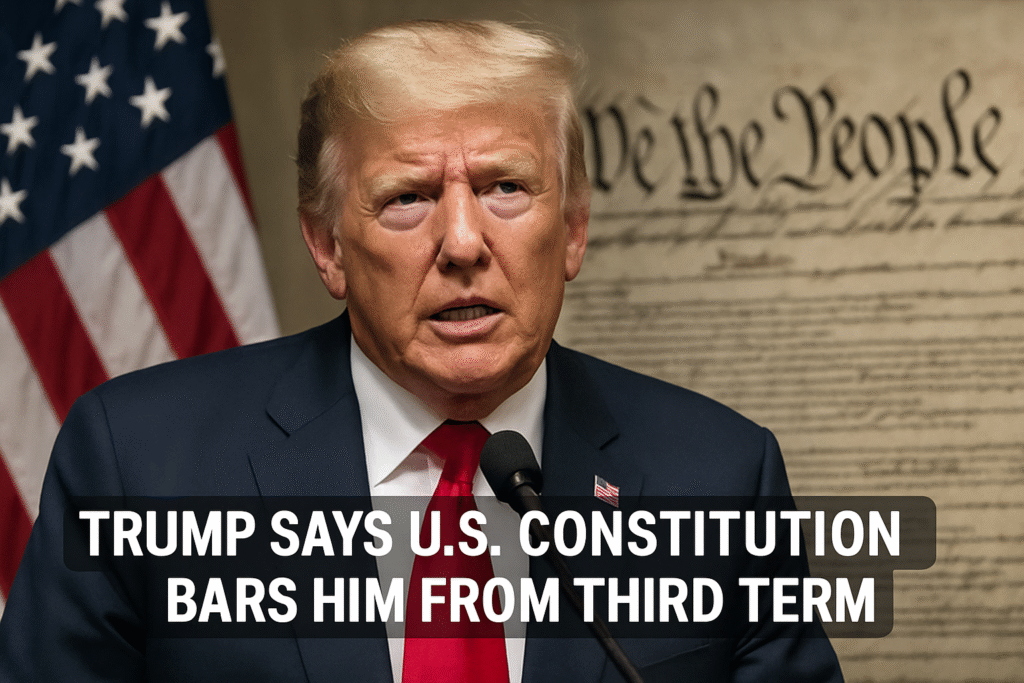
President Donald Trump on Wednesday publicly acknowledged that the U.S. Constitution clearly prevents him from seeking a third consecutive term in office, putting to rest mounting speculation among allies and supporters about a possible 2028 bid. Speaking aboard Air Force One en-route to South Korea, Trump said he has “my highest poll numbers that I’ve ever had,” but he added, “based on what I read, I guess I’m not allowed to run so we’ll see what happens.”
“I would say that if you read it, it’s pretty clear, I’m not allowed to run. It’s too bad,” he told reporters. He also stated that numerous American voters are lamenting that restriction, but he acknowledged the constitutional constraints and reiterated that he will abide by them.
House Speaker Mike Johnson confirmed Tuesday that he had discussed the matter with the president and saw no viable path for any change under the current political calendar. “It’s been a great run,” Johnson said, “but I think the president knows … the constrictions of the Constitution, as much as so many of the American people lament that.” Johnson added that any amendment to the Constitution would come after Trump has left office — meaning it would not apply to him.
The Speculation and the Push-Back
In recent days, speculation surged that Trump’s allies might explore legal or constitutional workarounds to enable a third term — including talk of a vice-presidential route or a special amendment. Influential adviser Steve Bannon had publicly claimed there was “a plan” for Trump to run again in 2028, which prompted Democrats and critics to raise alarms about potential challenges to the two-term limit established by the Twenty-Second Amendment.
Trump, though known for milestone-breaking rhetoric, appeared to shut down the possibility of unusual manoeuvres. He rejected one proposed strategy — running for vice president to later assume the presidency — calling that idea “too cute” and saying voters wouldn’t like it “because it’s too cute. It’s not — it wouldn’t be right.” He reserved, however, the legal right debate: “I don’t want to even talk about that…we’ll see,” he said.
What the Constitution Says
The Twenty-Second Amendment to the U.S. Constitution, ratified in 1951, states that no person shall be elected to the office of the President more than twice. It further states that if a person has served more than two years of a term to which someone else was elected, that counts as one term. In short: a president may only be elected to the office twice. Trump acknowledged this as “pretty clear.”
Constitutional scholars agree that the amendment sets a firm limit. Any change would require a new constitutional amendment: approval by two-thirds of both houses of Congress and ratification by three-quarters of the states, a process that typically takes years. Given that timeline, few saw a credible path for any rule-change before the 2028 election.
Why Talk of a Third Term Arose
The idea of Trump seeking a third term gained traction amid his continued high approval ratings among his base, the proliferation of “Trump 2028” hats and campaign-style branding, and comments from figures like Bannon. Some supporters argued that the country would benefit from continuity at a time they viewed as rife with economic uncertainty and global competition.
That said, party leaders including Johnson moved quickly to damping enthusiasm. Trump’s statement, combined with the speaker’s remarks, aims to quell internal Republican chaos ahead of the next election cycle by clarifying the firm constitutional boundary.
Political and Legal Implications
Public acknowledgment of ineligibility helps head off legal challenges and internal party fracturing. It also places the spotlight on what comes next for Trump in the post-2028 cycle: whether he endorses a successor, assumes a kingmaker role within the party, or pursues interests outside the White House.
On the legal side, while some fringe supporters and strategists may continue to explore creative options, the mainstream legal view is that the Twenty-Second Amendment is straightforward and binding. A constitutional amendment pursued just to enable one individual’s candidacy would likely provoke extensive debate and resistance across the American political spectrum.
Looking Ahead
With his public acknowledgment, Trump appears to be shifting his focus toward shaping the next generation of Republican leadership and maintaining influence from outside the Oval Office. Meanwhile the constitutional limit stands firm, underscoring America’s long-tested transition of executive power.
As 2028 approaches, the Republican field will likely start organizing early, and Trump’s supporters will watch to see whether he plays a starring role or assumes the role of elder statesman. But for now, he has made clear he intends to abide by the Constitution’s restriction — and that his focus remains on the remainder of his current term and the political legacy he hopes to leave.