
By Harshit
WASHINGTON, Nov. 20, 2025
United States President Donald Trump has formally signed a new federal law directing the US Department of Justice to publicly release all unclassified files related to the late sex offender Jeffrey Epstein, marking one of the most significant disclosures in the long-running scandal. The move follows months of political pressure, bipartisan demands in Congress, and intensifying public calls for transparency regarding Epstein’s network, his crimes, and his elite associations spanning business, entertainment, academia, and politics.
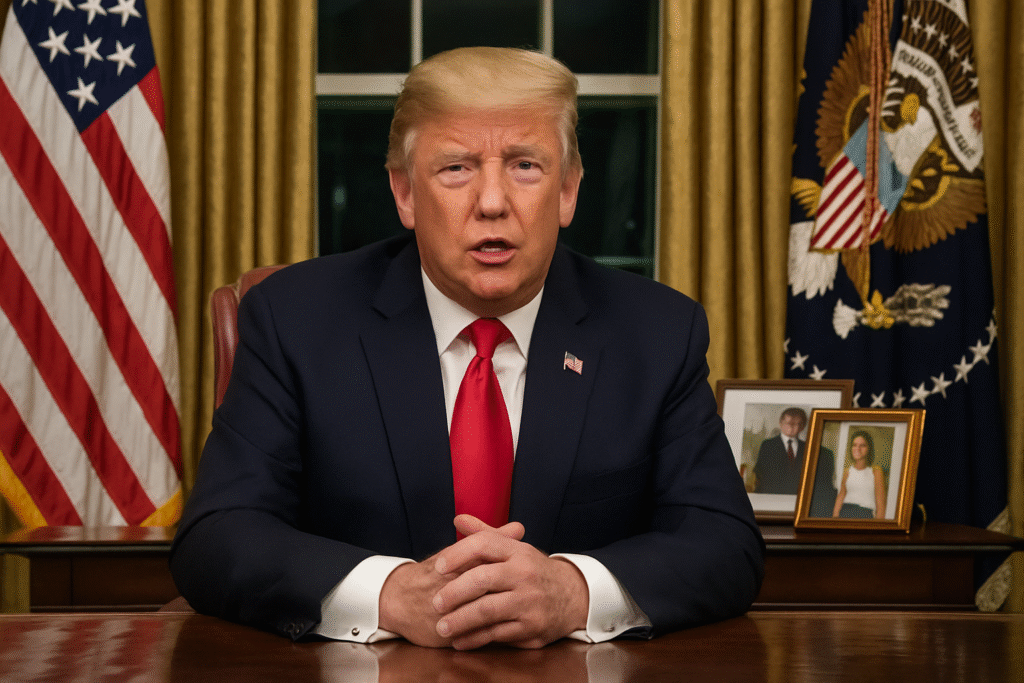
Trump announced the signing late Wednesday on Truth Social, framing the decision as an act of transparency and insisting that the controversy surrounding Epstein posed a larger threat to Democrats than to Republicans. The announcement comes just days after Trump abruptly reversed his earlier opposition to releasing the documents, which had placed him at odds with segments of his own political base as well as several high-profile Republican lawmakers.
A Bill Years in the Making
The newly signed Epstein Files Transparency Act requires Attorney General Pam Bondi to release all unclassified Justice Department records—including investigative materials, internal communications, flight logs, correspondence, and other documents—within 30 days. The materials must be provided in a “searchable and downloadable format,” according to the law.
The Act includes strict provisions preventing the release of child sexual exploitation content or any information that would identify victims. It also allows withholding materials that would jeopardize active investigations or national security. However, it explicitly prohibits withholding records on the grounds of “embarrassment, reputational harm, or political sensitivity,” a clause lawmakers say is intended to prevent protective editing of names belonging to public officials or powerful figures.
Officials familiar with the case estimate that the full trove of Epstein-related documents amounts to roughly 100,000 pages, far exceeding the thousands publicly released over the past decade.
Pressure From Congress and Trump’s Base
Trump’s signature arrives after overwhelming bipartisan support in both chambers of Congress. The House approved the bill in a 427-1 vote, while the Senate passed it through unanimous consent. The sole dissenter, Republican Rep. Clay Higgins, said he feared “innocent people being hurt” by the release, though he did not elaborate further.
The bill was championed by Rep. Thomas Massie (R-KY) and Rep. Ro Khanna (D-CA), who argued that transparency was necessary for public trust and for justice for Epstein’s victims. Their effort gained momentum after more than 20,000 pages of emails and internal documents from Epstein’s estate were released last week, resurfacing the financier’s connections to political figures—including Trump himself.
Last week, Epstein’s name—and Trump’s ties to him—re-entered the political conversation after Democrats on the House Oversight Committee released several email chains linked to Epstein and his former partner Ghislaine Maxwell, who is serving a 20-year federal sentence. One 2011 email, in particular, mentions Trump by name, though the White House stressed that it contained no implication of wrongdoing.
Trump had initially warned Republicans not to support the effort to force the documents’ release, triggering a political dispute with Rep. Marjorie Taylor Greene, once one of his most devoted allies. Greene accused Trump of trying to block transparency and referred to his opposition as “shocking.” Trump has since called Greene a “traitor,” marking one of the most dramatic fractures within the Republican Party this year.
Trump’s Messaging Shift
In announcing his decision Wednesday night, Trump labeled Epstein a “lifelong Democrat” and highlighted his connections with Bill Clinton and former Treasury Secretary Lawrence Summers, who stepped back from his Harvard teaching role this week after public scrutiny over his email exchanges with Epstein.
“Perhaps the truth about these Democrats, and their associations with Jeffrey Epstein, will soon be revealed, because I HAVE JUST SIGNED THE BILL TO RELEASE THE EPSTEIN FILES!” Trump wrote.
Despite Trump’s messaging, public records show Epstein also cultivated relationships with prominent Republicans and donors across the political spectrum. Trump himself socialized with Epstein in the 1990s and early 2000s, though he says he cut ties in the early 2000s and denies any knowledge of Epstein’s criminal activity.
Skepticism Over Whether Files Will Truly Be Released
Not everyone is convinced the Justice Department will comply. Rep. Adam Schiff (D-CA) said he had “serious doubts” the administration would release the materials fully.
“If past is prelude, what we can expect is more stonewalling, more cover-ups, more inartful ways of explaining why they’re covering up,” Schiff said, warning that the administration might exploit national security exemptions.
Epstein’s survivors, however, welcomed the bill. Annie Farmer, one of Epstein’s most outspoken victims, called the decades-long secrecy around the case an act of “institutional betrayal,” saying that meaningful transparency was essential to preventing future abuses.
What Comes Next
The Justice Department now faces a strict 30-day countdown. If the law is followed as written, the public will soon gain unprecedented insight into Epstein’s operations, his network of influence, and the failures of multiple institutions that allowed his sexual exploitation of minors to continue for years.
For survivors, lawmakers, and much of the public, the coming weeks may finally bring answers to questions that have lingered for more than two decades.