
By Harshit, WASHINGTON, Nov. 13, 2025 — 6:58 A.m. ET
After 43 days of paralysis, the United States government has officially reopened.
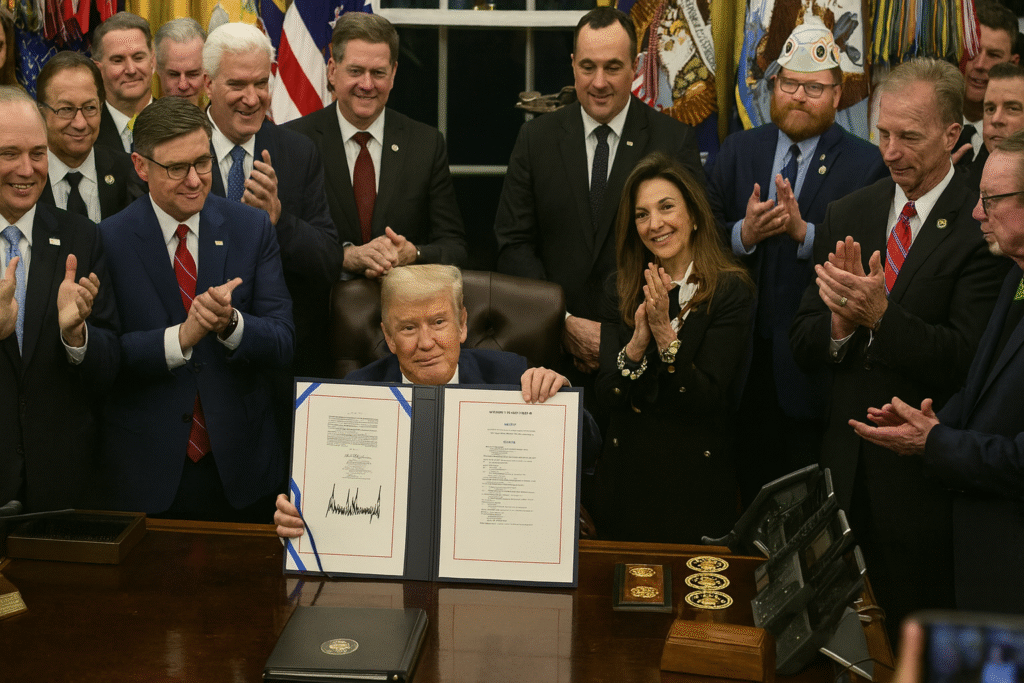
President Donald Trump late Wednesday signed a federal spending bill just under two hours after the House of Representatives passed it, formally ending the longest shutdown in U.S. history — a political standoff that left millions of Americans struggling with frozen paychecks, suspended aid, and travel disruptions.
“With my signature, the federal government will now resume normal operations,” Trump said during the late-night signing ceremony at the White House. “We will continue working to lower the cost of living and rebuild the economy for hardworking Americans.”
The bill — which extends funding through January 30 — passed the House 222–209, after being approved in the Senate earlier this week by a 60–40 vote. The Republican majority was joined by seven Democrats and one Independent, clearing the way for Trump’s endorsement.
Shutdown Ends After 43 Days of Political Deadlock
The shutdown, which began on October 1, had crippled government operations across the country. About 670,000 federal employees were furloughed, while an equal number continued to work without pay.
All will now receive back pay, though agencies have warned that normal operations could take several days to resume.
The shutdown had also crippled air travel, with more than 10,000 flight delays and cancellations in the past two weeks due to unpaid air traffic controllers calling in sick or overworked. Economists estimated that the shutdown cost the U.S. at least $18 billion in lost productivity and shaved 0.1 percentage point off GDP every six weeks.
Relief for Workers and Families
The reopening of the government comes as a major relief to millions of American families who rely on federal programs for food, housing, and healthcare.
“This will allow federal workers to get their paychecks, air traffic to stabilize before Thanksgiving, and food aid to resume before Christmas,” an administration official said.
The Supplemental Nutrition Assistance Program (SNAP) — which feeds roughly 41 million Americans — will now restore full monthly benefits after being partially suspended.
Health Insurance Battle Still Unresolved
Despite the breakthrough, the core dispute that caused the shutdown remains unresolved: whether to extend Affordable Care Act (ACA) health insurance subsidies for 24 million Americans.
Democrats had demanded that the subsidies be renewed through 2026. Trump and congressional Republicans resisted, arguing that the credits represented “wasteful spending” and inflated healthcare costs.
As part of the compromise, the Senate will hold a separate vote in December on the subsidies. Until then, the issue remains a political time bomb that could trigger another shutdown early next year.
“We’re not done yet,” said Senate Minority Leader Chuck Schumer. “Americans deserve affordable healthcare, not political brinkmanship every few months.”
Trump and Republicans Claim Victory
Speaking at the signing, President Trump framed the deal as a win for fiscal responsibility.
“Democrats played politics with the lives of hardworking Americans,” he said. “This is no way to run a country, and we will never let it happen again.”
House Speaker Mike Johnson (R-LA) echoed the sentiment:
“They knew this would cause pain, and they did it anyway,” Johnson said. “This shutdown was cruel and pointless.”
Republicans argue that the bill’s passage proves they can govern effectively while keeping spending “in check.” However, the new bill still adds roughly $1.8 trillion per year to the federal debt, which now stands at $38 trillion.
Democrats Push Back
Democrats rejected claims that they were to blame for the shutdown.
Rep. Mikie Sherrill (D-NJ) — who was elected last week as New Jersey’s next governor — used her final floor speech to condemn the spending deal and the administration’s policies.
“Do not let this body become a ceremonial red stamp for an administration that takes food away from children and rips away healthcare,” Sherrill said. “To the country: stand strong. As we say in the Navy — don’t give up the ship.”
Others accused Trump of creating the crisis in the first place by refusing to compromise on healthcare funding and by “manufacturing a standoff to score political points.”
Analysts: “Shutdown Could Return in January”
Experts say Wednesday’s agreement is a temporary patch, not a permanent fix.
Bruce Fein, a former U.S. associate deputy attorney general, told Al Jazeera that the deal “merely postpones the inevitable.”
“It’s too premature to call this a Republican victory,” Fein said. “We’ll be right back here in January because both parties remain deeply divided on budget priorities — particularly over healthcare, food aid, and tax policy.”
He warned that unless long-term fiscal reforms are agreed upon, the U.S. could face another government closure in early 2026.
“This is not a panacea for our economic troubles,” Fein added. “The core issues — inequality, defense overspending, and tax breaks for the wealthy — remain untouched.”
Public Opinion Divided
According to a Reuters/Ipsos poll released Wednesday, 50% of Americans blame Republicans for the shutdown, while 47% blame Democrats — reflecting the nation’s continued political polarization.
“Nobody really won here,” said political analyst Emily Cardenas. “Workers suffered, families suffered, and Washington once again showed that dysfunction is the new normal.”
Economic Impact and Outlook
The Congressional Budget Office (CBO) estimates that most lost output from the shutdown will be recovered within six months, but warns that consumer confidence has been shaken.
The shutdown delayed billions in federal contracts, stalled infrastructure projects, and strained small businesses dependent on government spending.
Still, economists expect a short-term boost from back pay disbursements and renewed public spending ahead of the Thanksgiving and Christmas holidays.
Looking Ahead
The White House is now focused on restoring normal operations across federal agencies by Monday. Key priorities include stabilizing air travel, resuming federal loan processing, and expediting backlogged court cases.
However, with the Affordable Care Act vote looming in December, another shutdown threat looms large.
“Both sides got breathing room — nothing more,” said budget expert Daniel Hoffman. “The next fight is already on the calendar.”