
By Harshit
WASHINGTON, DECEMBER 14, 2025 —
We are living through an unprecedented acceleration of scientific discovery. The progress being made in manipulating matter at the atomic level, rewriting genetic code, and bridging human thought with artificial intelligence is moving these fields out of pure theory and into the realm of applied technology.
For the American public, these breakthroughs are not abstract concepts; they are the foundation for the next wave of healthcare, economic dominance, and technological capability. As we enter 2026, three scientific domains stand out as the most critical, evergreen areas to watch.
I. Genetic Precision: The Maturation of CRISPR Therapy
The revolutionary gene-editing tool CRISPR-Cas has transitioned from an academic curiosity to a clinical reality. Originally a bacterial defense system, CRISPR allows scientists to target specific DNA sequences with unprecedented accuracy, acting as molecular “scissors” to cut out faulty genes and insert healthy ones.
The primary focus in 2026 is moving beyond treating blood disorders to tackling complex diseases and improving delivery and safety.
A. The Clinical Leap: From Rare to Routine
Early CRISPR success—particularly in sickle cell disease and beta thalassemia—proved technical feasibility. Today, the pipeline is expanding:
• Autoimmune Diseases: Rapidly advancing clinical trials now target refractory autoimmune conditions like Systemic Lupus Erythematosus (SLE) and Multiple Sclerosis, using CRISPR to modulate hyperactive immune cells.
• Personalized Gene Medicine: A landmark 2025 breakthrough treated a child with a custom-designed CRISPR therapy delivered via lipid nanoparticles, a blueprint for individualized treatments for ultra-rare diseases.
B. The AI and Delivery Solution
Two barriers—delivery and design accuracy—are being solved through converging technologies:
• AI-Powered Design: Tools like CRISPR-GPT automate guide RNA design and off-target prediction, accelerating research and democratizing access.
• Delivery Systems: Improvements in LNPs and viral vectors are enabling in vivo editing, with targeted work underway for liver fibrosis and other systemic diseases.
Evergreen Outlook: The next five years will focus on efficient in vivo editing and tackling polygenic diseases, pushing CRISPR from rare-disease therapy to mainstream medical infrastructure.
II. The Computational Frontier: The Quantum Leap
Quantum computing is the most disruptive technology on the horizon. Using superposition and entanglement, quantum computers perform calculations impossible for classical machines. In 2025, the field shifted from building qubits to achieving fault tolerance and identifying real quantum advantage.
A. The Race for Error Correction
Qubits are extremely sensitive to environmental noise, creating high error rates. The grand challenge is stabilizing them.
• Logical Qubits: The 2026 race focuses on encoding a stable logical qubit across many physical ones, surpassing the error-correction threshold.
• Competing Modalities:
- Superconducting Qubits (IBM, Google): Scalable, fast.
- Trapped Ions: Extremely precise but difficult to scale.
- Neutral Atoms & Silicon Spin: Promising for industrial integration.
B. Defining Quantum Advantage
Quantum systems are not yet commercially viable, but investment is exploding. Early applications include:
• Drug Discovery: Quantum simulations for molecular interactions.
• Financial Modeling: Optimization, fraud detection, risk analysis.
• Cryptography: Long-term threat to classical encryption, driving post-quantum cryptography development.
Evergreen Outlook: The next milestone is a system with 100 logical qubits, expected late in the decade, enabling true commercial quantum applications.
III. Human-Machine Integration: The Era of Brain-Computer Interfaces
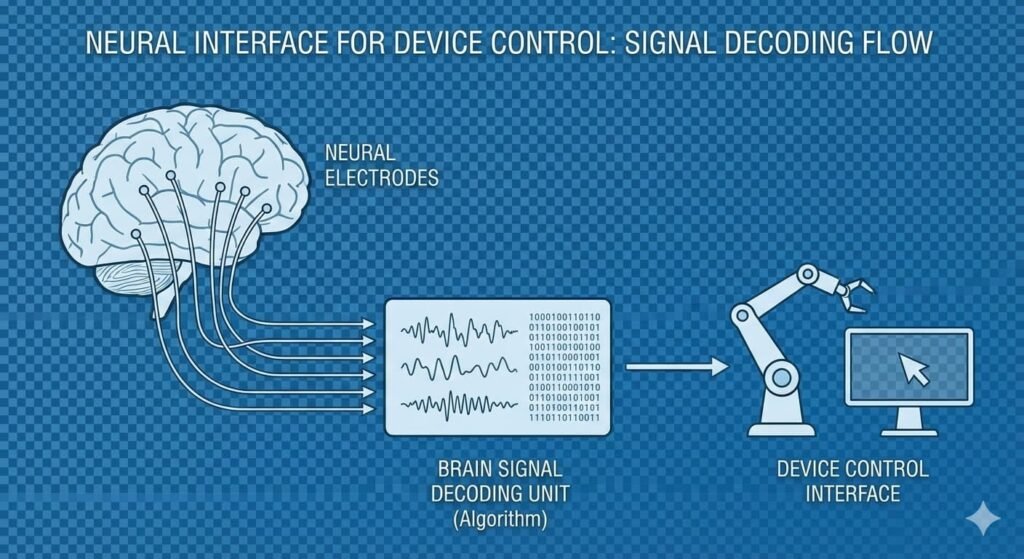
BCIs connect neuroscience with engineering, translating brain activity into real-time action. What began as paralysis treatment is evolving into broader human-machine integration.
A. Clinical Breakthroughs: Restoring Autonomy
• Invasive Interfaces: Companies like Neuralink now implant thousands of electrodes, enabling paralyzed individuals to control devices, text, or manipulate robotic arms using thought alone.
• Less Invasive Systems: Synchron’s Stentrode, implanted through blood vessels rather than open-brain surgery, offers a safer path to mass clinical adoption.
B. Deep Learning and Digital Biomarkers
AI decoders are rapidly improving BCI performance:
• Speech BCIs now reach ~99% accuracy with minimal latency.
• Digital Biomarkers from BCIs shed light on intention, memory, and emotion, shaping next-generation treatments for cognitive decline and mental illness.
Evergreen Outlook: The next frontier is bidirectional interfaces—systems that both read and write neural signals. Early work suggests future applications in restoring vision, modulating chronic pain, or enhancing cognition, though ethical debates loom large.
Conclusion: The New Frontier of Applied Science
The science shaping 2026 is defined by a unified theme: precision engineering of reality. We are moving beyond observation into direct manipulation—of genes, of computational limits, and of the human mind.
For Americans, CRISPR, quantum computing, and BCIs represent the most consequential revolutions of the next decade. They will shape personalized medicine, national technological security, and the definition of human potential.
Understanding these transformations is the best investment anyone can make in navigating the future.