
By Harshit, LOS ANGELES, Oct. 31, 2025 8 AM EDT
Star Wars: Visions has long served as a creative playground where international animation studios reinterpret the galaxy far, far away through their unique cultural and cinematic lenses. Among its standout stories, “The Duel” from the show’s first season drew praise for its stunning visual fusion of Akira Kurosawa-inspired samurai cinema and the Star Wars mythos. Now, director Takanobu Mizuno returns with a direct continuation, “The Duel: Payback,” in Visions Season 3 — and the episode once again challenges the very foundations of the franchise’s moral universe.
A Kurosawa Legacy in a Galaxy Far, Far Away
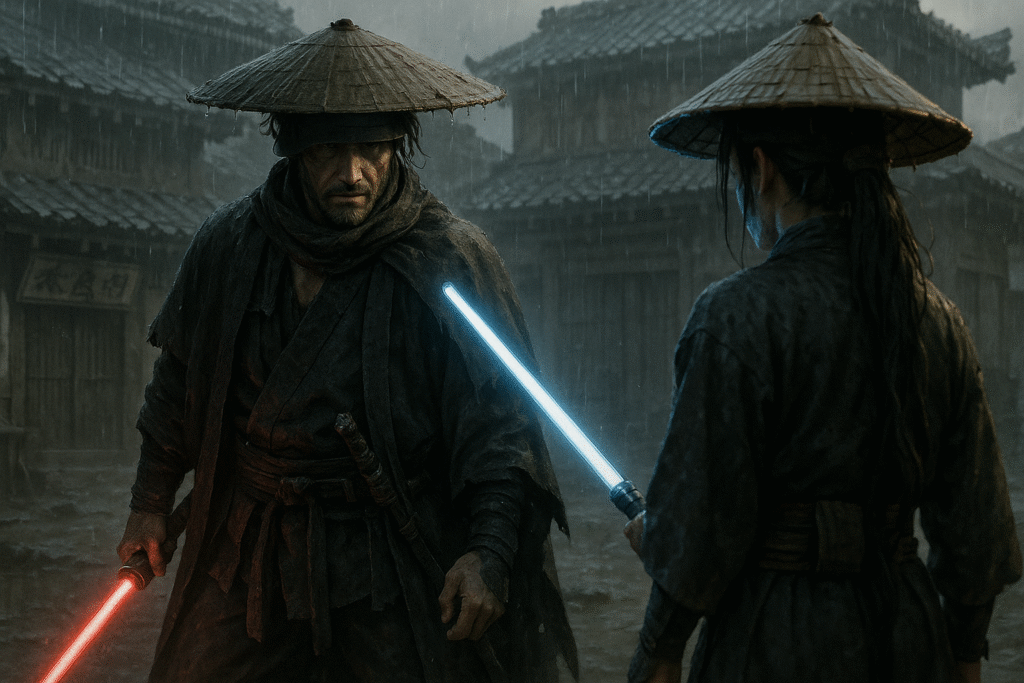
When “The Duel” first premiered, it immediately stood apart for its striking aesthetic — a black-and-white, film-grain texture punctuated by vibrant splashes of color from lightsabers and blaster fire. The short introduced viewers to a mysterious Ronin, a former Sith wandering the Outer Rim, hunting others who once shared his dark allegiance.
The new follow-up, “The Duel: Payback,” revisits this character in the aftermath of his previous battle. Drawing heavily from Kurosawa’s Yojimbo (1961), Mizuno’s latest tale finds the Ronin gravely injured and near death — only to be saved by an unlikely group of heroes: the Ewoks.
Unlike their familiar portrayal as gentle forest dwellers in Return of the Jedi (1983), these Ewoks are fierce warriors. They rescue the Ronin, nurse him back to health in their mountain hot springs, and later join him in an elaborate ambush against the oppressive Crusaders. This narrative twist not only flips expectations but also serves as a symbolic inversion of classic Star Wars storytelling tropes.
The Dark Reflection of the Jedi
At the heart of “The Duel: Payback” lies its most provocative theme — the moral inversion of the Jedi Order. The episode’s antagonist, known as the Grand Master, is a Jedi consumed by his own crusade to exterminate all remnants of the Sith. His methods, however, border on tyranny. In his obsessive pursuit of the recuperating Ronin, he imposes martial law on an entire planet, slaughtering civilians and enforcing total lockdown.
This depiction of the Jedi as authoritarian figures recalls Darth Vader’s ruthless efficiency and ideological fanaticism under Emperor Palpatine. Yet, unlike Vader’s eventual redemption, the Grand Master represents a complete surrender to darkness under the guise of righteousness.
The climactic duel between the Ronin and the Grand Master mirrors the emotional and visual language of Return of the Jedi. As the battle intensifies, the Grand Master’s mechanical enhancements are revealed, and his human faceplate is torn away — a deliberate echo of Vader’s unmasking. But here, the act carries opposite meaning: instead of revealing humanity beneath the machine, it exposes the Grand Master’s total loss of it.
Reversing the Mythos
Mizuno’s storytelling thrives on these mirrored contradictions. By portraying the Sith as conflicted yet self-aware and the Jedi as blind zealots, “The Duel: Payback” explores the cyclical nature of power and ideology.
The episode’s visual style reinforces this philosophical depth. Blending digital animation with hand-drawn brushwork, the imagery recalls traditional Japanese ink paintings while maintaining the dynamic movement of modern CG. The result is both meditative and violent — a dance between order and chaos that reflects the Ronin’s internal struggle.
Moreover, “The Duel: Payback” subtly references The Phantom Menace’s iconic “Duel of the Fates” sequence, but inverts its moral alignment. Instead of a noble Jedi confronting a Sith threat, viewers witness a corrupted Jedi facing a Ronin who, despite his dark past, fights to restore balance.
Expanding the Ronin Universe
The episode builds upon the groundwork laid by Emma Mieko Candon’s acclaimed novel Star Wars: Visions – Ronin (2021), which expanded on the lore surrounding the wandering antihero. Candon’s book had already blurred the traditional binary of light and dark, presenting a morally complex universe where identity, duty, and redemption intertwine.
“The Duel: Payback” continues this tradition, reinforcing Visions as a space for artistic experimentation within the Star Wars canon. Rather than adhering to strict continuity, it thrives on reinterpretation, treating mythology as fluid and culturally adaptive.
A Testament to Creative Freedom
With Visions Season 3, Lucasfilm once again affirms its commitment to international collaboration and creative autonomy. By allowing artists like Mizuno to reimagine its world through different cultural perspectives, the series keeps the Star Wars universe alive in ways that are both unexpected and profoundly resonant.
“The Duel: Payback” is not just another animated short — it is a philosophical and aesthetic statement that deepens the mythology while questioning its very foundation.
All three seasons of Star Wars: Visions are now streaming on Disney+.