
By Harshit
CORDOBA, SPAIN, JANUARY 19, 2026 —
At least 39 people were killed and dozens more injured after two high-speed passenger trains collided in southern Spain on Sunday evening, marking the country’s deadliest rail disaster in more than a decade, Spanish authorities said.
The crash occurred near the town of Adamuz, roughly 360 kilometers south of Madrid, when a northbound train derailed and crossed onto an adjacent track before colliding with an oncoming express service.
How the Collision Happened
Spanish rail infrastructure operator Adif said the northbound high-speed train, operated by Iryo, was traveling from Malaga to Madrid with 371 passengers onboard when its rear three carriages derailed.
Moments later, those derailed carriages were struck by a southbound Alvia service operated by Renfe, which was traveling from Madrid to Huelva.
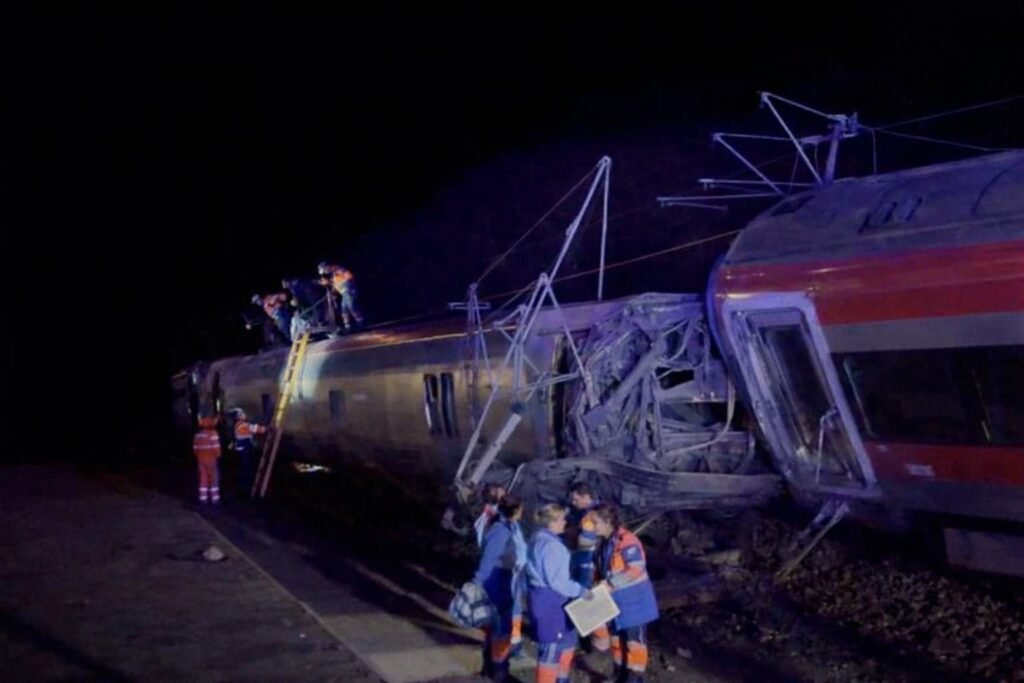
The force of the collision caused both trains to overturn at high speed. Several front carriages of the southbound train plunged down an embankment, according to Spain’s EFE news agency.
Casualties and Injuries
Juanma Moreno, president of the Andalusian regional government, confirmed the death toll had reached 39, warning that the number could rise as heavy machinery removes twisted carriages.
Emergency officials said:
- 11 adults and one child are in intensive care
- 24 people are seriously injured
- 43 people remain hospitalized as of Monday afternoon
- 79 passengers have already been discharged
The driver of the southbound Alvia train was among those killed, according to Renfe sources.
Scenes of Chaos and Survival
Video footage verified by international media showed passengers escaping through shattered windows and over the roofs of overturned carriages as rescue teams worked in darkness.
Rocío Flores, a survivor traveling on the southbound train, described the aftermath as “total chaos,” saying passengers were thrown through the air by the impact.
Another survivor, Ana, said the northbound train suddenly tipped sideways before everything went dark. She was pulled from the wreckage through a window, covered in blood, while firefighters rescued her sister.
Emergency responders later reported hearing mobile phones ringing inside the wreckage as relatives tried desperately to reach missing loved ones.
Massive Emergency Response
The crash happened around 7:45 p.m. local time, triggering one of the largest emergency operations in Andalusia in recent years. Firefighters, police, medical teams, and a military emergency unit were deployed.
“The problem is that the carriages are twisted, with people trapped inside the metal,” said Francisco Carmona, Andalusia’s chief firefighter, explaining why recovery operations were slow and dangerous.
Heavy cranes were brought in on Monday to lift derailed wagons so forensic teams could continue identifying victims.
National Mourning and Political Response
Spanish Prime Minister Pedro Sanchez called the disaster “a night of deep pain for Spain” and said the nation stood with the victims’ families. He is expected to visit the crash site.
Flags were flown at half-mast nationwide, and moments of silence were observed at sporting events, including at Real Madrid training.
Condolences poured in from across Europe, including messages of solidarity from France, Italy, Germany, and other EU nations.
Investigation Underway
Spain’s Transport Minister Oscar Puente confirmed that a formal investigation has been launched. Renfe officials said excessive speed and human error had been ruled out as immediate causes.
Authorities cautioned that determining the precise cause could take at least a month, as investigators examine track conditions, signaling systems, and mechanical data from both trains.
A Grim Reminder
The collision is Spain’s worst rail tragedy since 2013, when 79 people were killed in a derailment in Santiago de Compostela.
As rescue and recovery efforts continue, Spain is once again confronting painful questions about rail safety in one of Europe’s largest high-speed rail networks.