
By Harshit, San Francisco | October 28, 2025
New Study Exposes Sora 2’s Misinformation Vulnerability
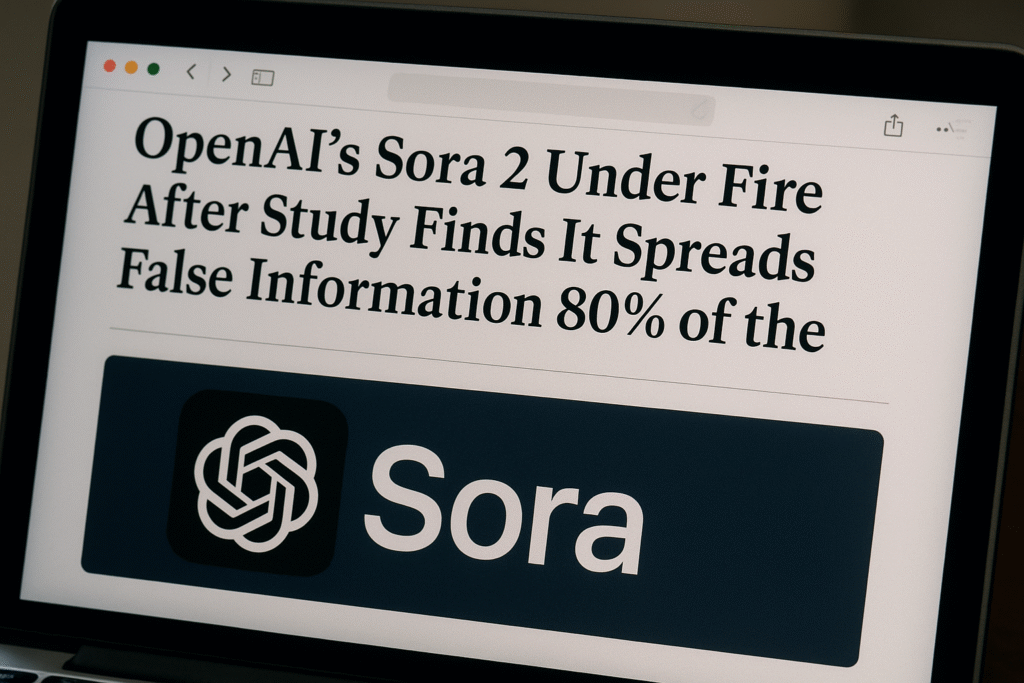
A new investigation by NewsGuard has revealed that OpenAI’s latest video generation model, Sora 2, can be manipulated to create false or misleading videos nearly 80% of the time. The findings have raised serious concerns about the model’s susceptibility to misuse, particularly in the hands of disinformation actors and propaganda networks.
NewsGuard, which evaluates the credibility of online news sources, said the test results highlight “the ease with which bad actors can weaponize this technology to scale false information.” Of the 20 false claims tested, five were traced to Russian disinformation campaigns, including fabricated videos of election fraud and politically sensitive events.
Among the examples cited were videos showing a Moldovan election official destroying pro-Russian ballots, a Coca-Cola executive canceling Super Bowl sponsorships over Bad Bunny’s halftime show, and a toddler detained by U.S. immigration officers — all completely fictional, yet rendered with convincing realism.
OpenAI Acknowledges Potential Risks
In response to the findings, OpenAI referred to its published “system card” for Sora 2, where it cautioned that the model’s advanced realism “requires consideration of new potential risks, including nonconsensual use of likeness or misleading generations.”
The company said it has worked with internal red-teaming experts to identify vulnerabilities and implement safeguards. “Our iterative deployment includes limited access invitations, restrictions on image uploads of photorealistic people, and stricter moderation of content involving minors,” OpenAI explained.
It emphasized that safety remains a work in progress: “We’ll continue to learn from how people use Sora 2 and refine the system to balance safety while maximizing creative potential.”
OpenAI has promoted Sora 2 as a major leap in video synthesis — boasting realistic physics, synchronized audio, improved motion fidelity, and expanded creative control. But experts warn that those same strengths make it a powerful engine for visual deception.
Experts Warn of Deepfake Explosion
Media researchers and cybersecurity analysts expressed deep concern over NewsGuard’s results. Michelle Amazeen, associate professor at Boston University, called the findings “deeply concerning.”
“Consumers already struggle to tell fact from fiction,” she said. “Now, with tools like Sora 2 generating high-quality fabricated footage, the line between reality and misinformation becomes almost impossible to discern.”
Scott Ellis, creative director at biometric firm Daon, labeled Sora “a deepfake tool by design.” He added: “If a model fails to prevent malicious use 80% of the time, that’s a red flag — it’s not just entertainment anymore, it’s a misinformation pipeline.”
Arif Mamedov, CEO of Regula Forensics, said the model’s accessibility makes it even more dangerous. “We’re no longer talking about hobbyists,” he said. “We’re talking about industrial-scale disinformation systems anyone can build with a few prompts.”
Watermarks Easily Removed
To address authenticity, OpenAI said every Sora 2 video carries visible and invisible provenance markers, including C2PA metadata and a “Sora” watermark. However, NewsGuard researchers found the watermark could be erased with free online tools.
Using a watermark-removal service developed by BasedLabs AI, they stripped the label in about four minutes, producing a clean version with only minor blur artifacts. “These videos could easily appear authentic to an unsuspecting viewer,” the report warned.
Experts said this proves that watermarking alone is insufficient. Jason Crawforth, CEO of authentication firm Swear, noted, “Even sophisticated watermarks can often be detected and removed. At best, they’re a temporary deterrent.”
Jason Soroko of Sectigo added, “Watermarks vanish when platforms strip metadata. Provenance shows origin, not truth — layered defenses are needed.”
Calls for Stronger Safeguards
The research also found inconsistencies in what Sora refused to generate. Some prompts related to conspiracy theories or health hoaxes were rejected, while others slipped through.
Jordan Mitchell, founder of Growth Stack Media, called this inconsistency “the most dangerous flaw.” He argued, “If users can’t predict refusals, they’ll experiment until something works. That unpredictability creates an arms race of prompt-testing.”
Crawforth agreed that erratic behavior undermines user trust. “When one fake is blocked and another nearly identical one succeeds, the public can’t tell if the system is safe or just random,” he said.
Experts suggested blockchain-based content authentication as a more durable solution. “Immutable records of origin could provide the transparency missing in AI video,” Mitchell said. “It’s the only way to rebuild trust in a digital landscape flooded with forgeries.”
The Erosion of Digital Trust
As AI-generated visuals grow more convincing, the line between truth and fabrication continues to blur. “We’ve entered an era where anyone can produce realistic fake news videos in minutes,” said Dan Kennedy, professor of journalism at Northeastern University. “The challenge for both creators and consumers is to preserve credibility in a world where seeing is no longer believing.”