
By HarshitWashington, D.C. | Wednesday, October 28, 2025 | 1:00 PM EDT
Millions Face Food Insecurity as SNAP Payments Suspended
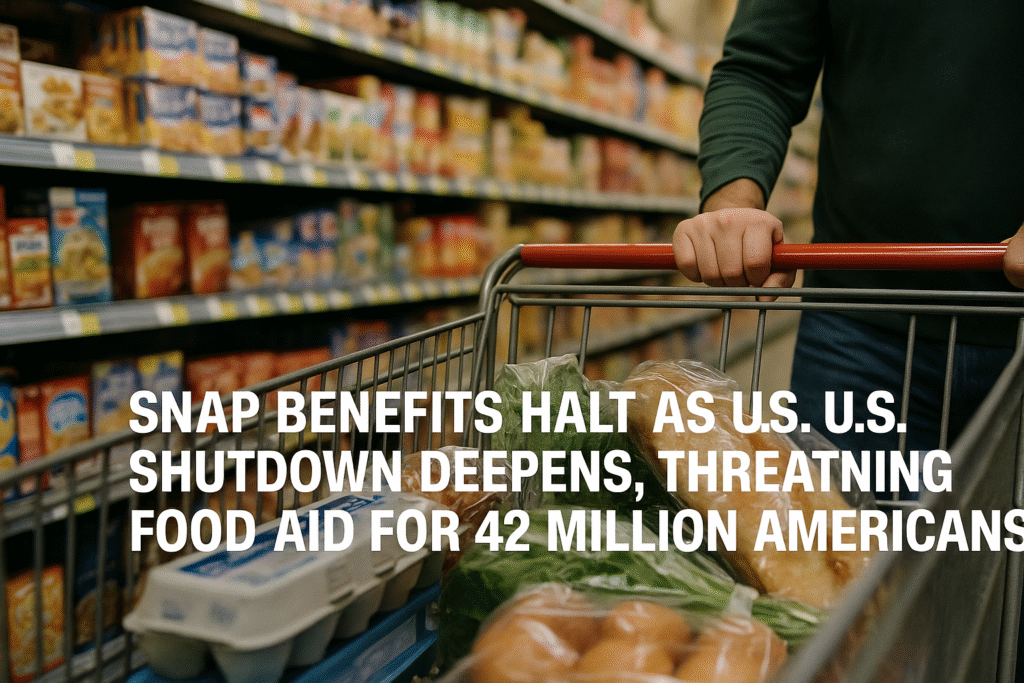
In a major escalation of the ongoing U.S. government shutdown, the Department of Agriculture (USDA) announced that Supplemental Nutrition Assistance Program (SNAP) benefits — commonly known as food stamps — will not be distributed on November 1, cutting off a vital source of food support for nearly 42 million Americans.
The announcement, issued late Tuesday, comes after the Trump administration opted not to tap into approximately $5 billion in contingency funds that could have temporarily sustained SNAP through November. The USDA attributed the suspension to Senate Democrats, accusing them of blocking legislation to reopen the government.
“The bottom line, the well has run dry,” the USDA statement read. “At this time, there will be no benefits issued November 1. We are approaching an inflection point for Senate Democrats.”
Shutdown Fallout Deepens
SNAP payments continued without disruption through October because states had already received federal allocations before the shutdown began on October 1. However, with no new congressional funding approved, the program has now reached what the USDA called an “operational cliff.”
In a strongly worded statement, the department blamed Democrats for “holding the American people hostage,” claiming that their refusal to negotiate on Affordable Care Act (ACA) subsidy extensions was prolonging the crisis.
“They can continue to hold out for healthcare for illegal aliens and gender mutilation procedures or reopen the government so mothers, babies, and the most vulnerable among us can receive critical nutrition assistance,” the USDA statement said, in unusually sharp political language.
The Trump administration maintains that the standoff could end immediately if Senate Democrats agree to a continuing resolution that funds government operations while discussions over ACA subsidies continue.
Democrats Urge USDA to Use Emergency Funds
Democratic lawmakers, however, are pushing back. Several Senate Democrats have urged Agriculture Secretary Brooke Rollins to deploy contingency resources to prevent a nationwide food aid collapse.
In a letter to Rollins, Democratic leaders argued that the $5 billion contingency fund should be used to sustain payments for November while Congress negotiates a broader resolution.
But the USDA insists it cannot legally do so. In a memo released Friday, the agency wrote: “Contingency funds are not legally available to cover regular benefits. These funds must remain available to assist people in disaster zones impacted by Hurricane Melissa.”
The memo makes clear that the emergency funds are earmarked for disaster relief rather than ongoing entitlement programs — a distinction that has left millions of low-income Americans in limbo.
What SNAP Does and Why It Matters
The Supplemental Nutrition Assistance Program (SNAP) is a federally funded initiative that helps low-income individuals and families purchase food. Benefits are delivered through an Electronic Benefit Transfer (EBT) card, which works like a debit card and can be used to buy USDA-approved food items at authorized retailers.
Before the current crisis, one in eight Americans — about 41 to 42 million people — relied on SNAP benefits to meet their monthly food needs. Recipients include children, senior citizens, people with disabilities, and low-income workers.
Without November payments, millions of households will struggle to afford groceries, rent, and basic necessities. Food banks and community kitchens are already bracing for an unprecedented surge in demand.
“The Most Serious SNAP Disruption in Decades”
Experts warn that the situation could evolve into the largest food aid disruption since SNAP’s inception in the 1960s. The program has faced funding disputes before — notably during the 2018–2019 shutdown — but benefits were never fully halted nationwide.
“This is the most serious interruption in food assistance we’ve seen in modern American history,” said Dr. Janet Givens, a food policy analyst at the Center on Budget and Policy Priorities. “SNAP is not a luxury — it’s a lifeline. Pulling it away during a shutdown will push millions into hunger within days.”
Local grocers who accept SNAP are also expected to feel the shockwave, particularly in rural and low-income communities where EBT transactions account for a large portion of total sales.
A Political and Human Crisis
While Washington remains locked in partisan gridlock, the human toll is mounting. According to advocacy group Feeding America, even a one-week delay in SNAP payments could leave more than 15 million children without access to adequate meals.
“This isn’t politics — it’s survival,” said Allison King, director of a community food pantry in Atlanta. “We’re already seeing people line up for emergency food boxes because they don’t know how they’ll feed their kids next week.”
The USDA’s move also signals the broader risks of a prolonged government shutdown. With federal workers furloughed, key safety-net programs — including housing assistance and nutritional aid for women and infants — are also nearing operational limits.
What Happens Next
Unless Congress passes an emergency funding bill by November 1, SNAP benefits will remain suspended until the government reopens. The USDA said it will continue “evaluating all available legal options” but warned there are “no immediate solutions” without new appropriations.
Meanwhile, several states, including California, Texas, and New York, have begun exploring short-term relief programs using state funds, though these efforts are limited and unlikely to replace federal assistance.
For millions of Americans who depend on SNAP each month, the clock is ticking — and the consequences could be devastating.