
By Harshit, WASHINGTON, Nov. 10, 2025 — 7:45 A.m. ETD
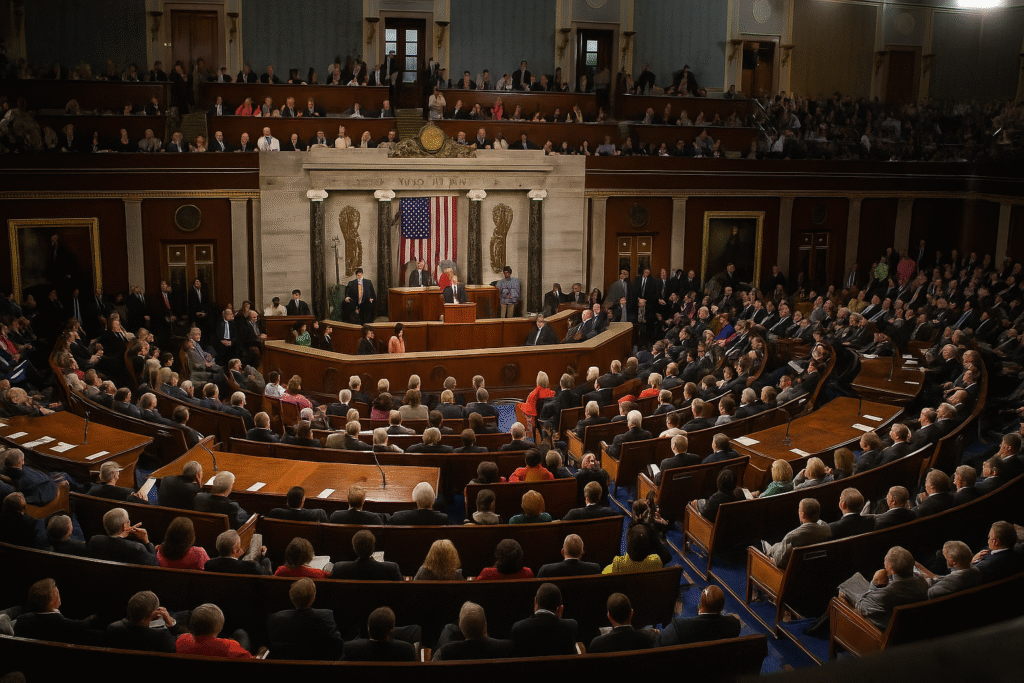
After 40 days of federal paralysis, the U.S. Senate has taken a decisive step toward ending the longest government shutdown in the nation’s history. Senators voted 60-40 Sunday evening to advance a stopgap spending measure negotiated between a bloc of centrist Democrats, Republican leaders, and the White House.
The agreement — brokered after days of private talks — would reopen the government through January 31, restore back pay for federal employees, and resume funding for food assistance, transportation, and other key services crippled by the shutdown.
However, the deal hinges on a political promise: in exchange for supporting the bill, Democrats secured a commitment from Senate Republicans and the Trump administration to hold a future vote on extending enhanced Affordable Care Act (ACA) subsidies before year’s end.
The vote marks the first tangible progress in weeks, though the shutdown’s fallout continues to ripple across the country — from crippled air traffic control systems to millions of Americans missing food aid.
Senators Break Ranks to Back Deal
A group of eight Senate Democrats — including Dick Durbin (IL), John Fetterman (PA), Jeanne Shaheen (NH), Maggie Hassan (NH), Catherine Cortez Masto (NV), Jacky Rosen (NV), and Tim Kaine (VA) — joined Republicans and Independent Angus King (ME) to secure the 60 votes needed to advance the bill.
“This bill is not perfect, but it takes important steps to reduce the shutdown’s hurt,” Durbin said, breaking ranks with Minority Leader Chuck Schumer, who opposed the deal.
King, who led the bipartisan negotiations, told reporters, “As the shutdown progresses, is a solution on the ACA becoming any more likely? It appears not.”
Kaine said the measure would “protect federal workers from baseless firings, reinstate those who have been wrongfully terminated during the shutdown, and ensure back pay.”
The House is expected to reconvene within 48 hours to consider the package, though procedural hurdles remain. Any senator can still delay final passage for up to three days under chamber rules.
If passed by the House, the bill will go to President Donald Trump’s desk, where aides say he is “likely” to sign it.
Air Traffic Chaos Marks Shutdown’s 40th Day
Across U.S. airports, the weekend saw the worst air traffic control staffing crisis since the shutdown began on October 1, according to a CNN analysis of FAA operations data.
There were 146 staffing “triggers” from Friday to Sunday — events in which too few controllers forced FAA to reroute planes or delay flights. Thirty-two occurred Friday, 63 Saturday, and 51 Sunday.
In total, the FAA has logged 596 short-staffing incidents since October — six times more than the same period last year.
Airlines canceled or delayed more than 10,000 flights nationwide over the weekend, particularly at major hubs including New York’s LaGuardia, Chicago O’Hare, and Atlanta Hartsfield-Jackson.
Transportation Secretary Sean Duffy warned on Sunday that if the shutdown were not resolved, air travel could soon be “reduced to a trickle” heading into Thanksgiving.
SNAP Benefits Still in Limbo for Millions
The food crisis also deepened this weekend after the Supreme Court temporarily blocked a lower-court order that required the U.S. Department of Agriculture (USDA) to issue full food stamp benefits for November.
The pause, issued Friday by Justice Ketanji Brown Jackson, allowed the Trump administration to move forward with only partial disbursements, citing lack of congressional authorization.
In a directive obtained by CNN, the USDA instructed states on Saturday to reverse any full benefit payments already made and issue only 65% of normal SNAP funds until further notice.
The decision affects an estimated 42 million Americans, including children, seniors, and people with disabilities.
“For Americans, this is really beginning to bite home,” Al Jazeera’s Mike Hanna reported from Washington, D.C. “People are trying to ramp up pressure on senators to get the government back open.”
Across the country, food banks and local agencies are bracing for a surge in demand. In Daytona Beach, Florida, volunteers distributed groceries to lines of SNAP recipients uncertain when they will next receive assistance.
“Some people have gotten their full benefits, others half, and many have gotten nothing,” said Danya Gainor, a local aid coordinator.
The Healthcare Flashpoint
At the center of the standoff is the fight over expiring ACA subsidies, which Democrats say are crucial to keeping health insurance affordable for millions.
Since their expansion in 2021, the subsidies have doubled ACA enrollment to 24 million, but they are set to expire this year. Democrats want a one-year extension; Republicans have resisted, calling for separate negotiations.
Trump, in a post on his Truth Social platform, called the subsidies “a windfall for insurance companies and a disaster for the American people,” instead proposing direct cash assistance to individuals.
California Senator Adam Schiff blasted the proposal, saying it would “gut the ACA and allow insurers to cancel coverage for people with preexisting conditions.”
Despite internal disagreements, most Democrats say they supported Sunday’s deal reluctantly — viewing it as a temporary fix to stop growing public pain.
“Waiting longer will only prolong the suffering Americans are feeling because of the shutdown,” said Senator Shaheen.
A Nation Weary of Crisis
The 40-day standoff has furloughed 750,000 federal employees, halted government services, and cost the U.S. economy an estimated $22 billion, according to the Congressional Budget Office.
Lines at airports have stretched for hours as unpaid TSA workers call in sick. National parks remain closed. Federal courts are scaling back operations.
While Sunday’s vote signals progress, Americans have grown deeply frustrated with what they see as Washington’s dysfunction.
In Louisville, where UPS operations were already paralyzed by last week’s cargo plane crash, local small business owner Steve Harmon summed up the mood: “Between the crash, the shutdown, and the food aid freeze — people here are just tired. We need normal back.”
If the Senate and House clear the package this week, the federal government could reopen by Wednesday, ending a shutdown that has become both a political and humanitarian crisis.
Until then, millions wait — for paychecks, food, or simply a sense that the system still works.