
WASHINGTON, MARCH 26, 2026 —
What You Need To Know
- Researchers from Kyushu University and JGU Mainz achieved a quantum yield of 130% — meaning for every 100 photons absorbed, the system generated 130 units of energy, shattering the theoretical limit physicists said could never be broken
- The breakthrough uses a technique called Singlet Fission — essentially splitting a single high-energy photon into two energy carriers instead of one — turning wasted heat into usable electricity for the first time
- For millions of Americans paying higher energy bills because of the Iran war’s oil shock, this research points toward a future where solar panels produce dramatically more power from the same rooftop space — at potentially lower cost
For decades, a rule of physics stood between humanity and truly efficient solar energy. It was called the Shockley-Queisser limit — a theoretical ceiling calculated in 1961 that said a single-junction solar cell could never convert more than about 33% of the sunlight hitting it into electricity. Everything above that threshold, physicists argued, was thermodynamically impossible. The rest was wasted as heat.
A research team from Kyushu University in Japan and Johannes Gutenberg University in Mainz, Germany just proved that limit wrong.
What They Did — And Why It Matters
Traditional solar cells work on a straightforward but fundamentally inefficient principle: one photon of light produces one unit of electrical energy. High-energy blue light — the most energetic part of the visible spectrum — absorbs normally, but most of its extra energy above what the cell can use simply dissipates as heat. That wasted energy has been the solar industry’s most stubborn problem for 65 years.
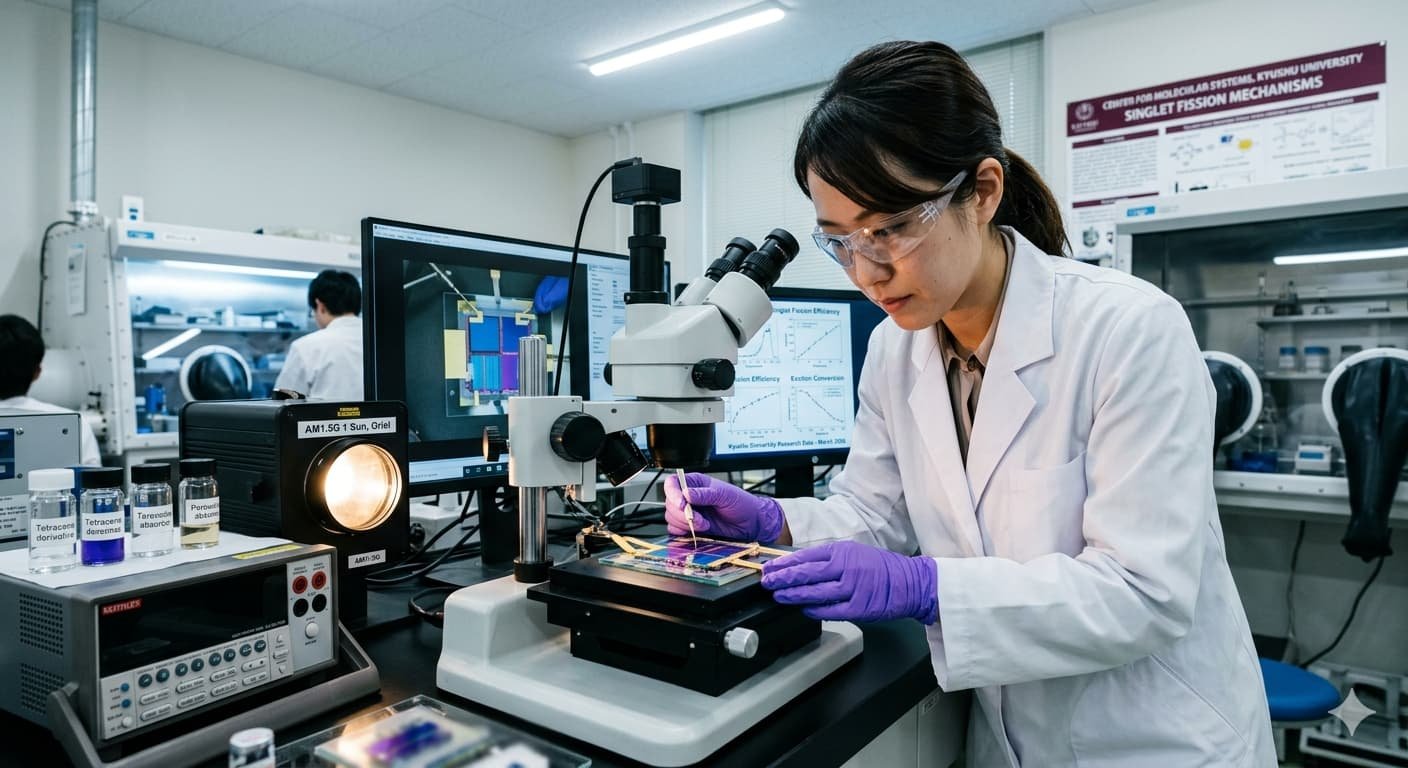
The Kyushu-Mainz team solved it using a process called Singlet Fission — a quantum mechanical trick that splits a single high-energy photon into two separate energy carriers instead of one. By using a specialized molybdenum-based “spin-flip” emitter, they forced high-energy blue photons to yield two electrons rather than one — effectively doubling the electrical output from the most powerful part of the solar spectrum.
The result was a quantum yield of 130%. For every 100 photons their system absorbed, it generated 130 energy-carrying units. The theoretical ceiling was not just reached. It was broken by 30 percentage points.
What The Numbers Actually Mean For Solar Panels
The breakthrough does not mean solar panels will immediately hit 130% efficiency — real-world panels involve additional losses from reflection, wiring, and heat that reduce overall output. What it means is that the fundamental physics barrier physicists believed was immovable has been proven movable. The implications scale from there.
| Solar Technology | Current Efficiency | With Singlet Fission Potential |
|---|---|---|
| Standard silicon panels | 20-22% | 30-35% possible |
| Premium TOPCon panels | 24-25% | 35-40% possible |
| Perovskite-silicon tandem | 29-33% | 40-45% possible |
| Singlet fission optimized cells | Theoretical limit broken | 45%+ in development |
To put those numbers in practical terms for American homeowners: a standard rooftop solar installation today produces enough electricity to offset roughly 70-80% of an average household’s annual energy bill. A panel that is 40% efficient rather than 22% efficient — same size, same rooftop — would offset 100% of that bill and potentially generate surplus electricity to sell back to the grid. The economics of residential solar change entirely.
The Iran War Connection — Why This Matters Right Now
The timing of this breakthrough is not incidental. The United States is currently paying the economic cost of depending on Middle Eastern oil — gas above $3.98 per gallon, electricity costs rising as natural gas prices climb, and an economy being squeezed by a war that could have been avoided if America’s energy independence were further advanced.
The Iran war has pushed more Americans than ever to seriously consider rooftop solar. Google searches for home solar installation spiked 340% in the first two weeks of March as gas prices climbed. Energy policy analysts have noted for years that every percentage point of efficiency gained in solar panels accelerates the timeline on which the United States can generate enough domestic renewable electricity to meaningfully reduce its vulnerability to Middle Eastern energy disruptions.
A 130% quantum yield is not a product you can buy tomorrow. But it is proof that the physics works — and in the solar industry, proof of physics is the first step toward a product on your roof within a decade.
Where This Technology Goes Next
The Kyushu-Mainz research is currently at proof-of-concept stage. The team demonstrated Singlet Fission working at the quantum level in a laboratory setting. Converting that laboratory demonstration into a commercially manufacturable solar cell involves materials science, engineering, and supply chain challenges that typically take 10 to 20 years to fully solve.
But the solar industry’s track record of turning laboratory breakthroughs into commercial products faster than expected is well documented. Perovskite solar cells — which were a laboratory curiosity in 2010 — are now being sold commercially at 29-33% efficiency in 2026. The same pipeline now has Singlet Fission entering it.
What Most Americans Miss About Solar Right Now
Point 1: Even at current efficiency levels, the economics of residential solar have already crossed the breakeven threshold in most U.S. states. The average American homeowner who installs solar today recoups their investment in 7 to 10 years and saves $25,000 to $75,000 over the system’s 25-year lifespan — before efficiency improvements make those numbers better.
Point 2: The federal solar Investment Tax Credit currently covers 30% of installation costs for American homeowners and businesses — a provision locked in through 2032 by the One Big Beautiful Bill Act signed last July. That credit makes the economics of installing current-generation panels compelling even before next-generation technology arrives.
Point 3: The Shockley-Queisser limit being broken is not just a solar story. The same Singlet Fission mechanism has applications in LEDs, quantum computing components, and next-generation display technology. The molybdenum spin-flip emitter the Kyushu team used is a platform technology — one result, many potential applications.
The Bigger Picture
The United States imports roughly 8 million barrels of oil per day and has spent the past 25 days watching a war 7,000 miles away push gas above $4 and reshape the global economy. The long-term answer to that vulnerability is not negotiated ceasefire terms — it is energy independence. And energy independence, at its core, is a physics problem.
Physics just got solved. The rest is engineering — and time.