
By Harshit, Tokyo | October 21, 2025
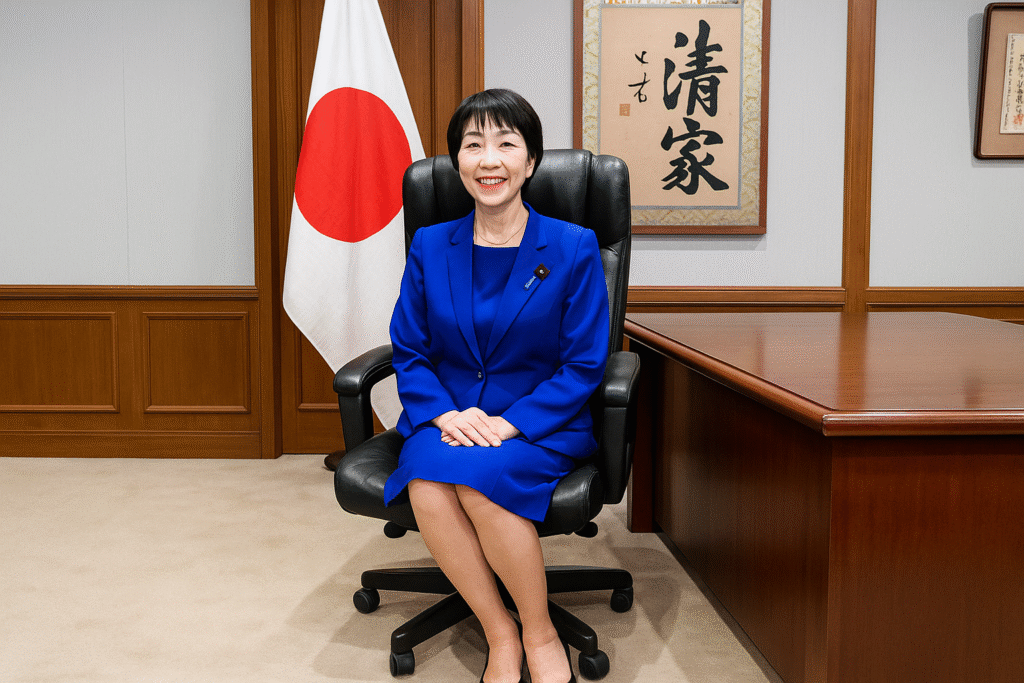
Japan made history on Tuesday as Sanae Takaichi, a staunch conservative and leader of the ruling Liberal Democratic Party (LDP), was elected Prime Minister by the National Diet, becoming the country’s first woman to hold its highest political office.
Takaichi, 64, secured 237 of 465 votes in the powerful lower house, comfortably defeating opposition candidate Yoshihiko Noda. In the upper chamber, she narrowly missed an outright majority in the initial round but prevailed in a runoff vote, solidifying her position as Japan’s next leader.
A Historic Yet Divisive Moment
The extraordinary parliamentary session began early Tuesday following the formal resignation of outgoing Prime Minister Shigeru Ishiba and his cabinet. His departure came after weeks of internal party turmoil and declining public approval, culminating in the LDP’s poor showing in regional elections last month.
While Japan has had several prominent female politicians in the past—including Yuriko Koike, the Tokyo governor, and former Defense Minister Tomomi Inada—Takaichi’s victory marks a first in the nation’s history. However, her ascent has also exposed deep divisions within Japan’s political establishment.
“This is a moment of great symbolic importance,” said political analyst Jun Saito. “But Takaichi’s challenge will be proving that symbolism can translate into effective governance and stability.”
Scandals and Party Struggles
The LDP, which has ruled Japan for most of the postwar era, has faced increasing public scrutiny in recent years. A string of corruption scandals, alleged misuse of public funds, and economic stagnation eroded its popularity and weakened its once ironclad coalition with the centrist Komeito Party.
After Ishiba’s resignation in September, the LDP scrambled to reorganize. Takaichi’s victory in the October 4 party leadership contest signaled a decisive shift to the right. Known for her nationalist rhetoric, Takaichi has long championed revision of Japan’s pacifist constitution and a tougher defense posture amid growing tensions with China and North Korea.
But her leadership faced immediate uncertainty when Komeito—its coalition partner for 26 years—abruptly exited the alliance. Without Komeito’s 43 parliamentary seats, the LDP was left short of a majority in both houses.
Forging a New Coalition
To secure her premiership, Takaichi moved swiftly to court new allies. On Monday, she struck a deal with the Nippon Ishin no Kai (Japan Innovation Party), a libertarian-leaning faction that shares many of her conservative views.
Ishin, which holds 54 seats, officially signed a coalition agreement with the LDP, giving the new ruling bloc a combined 351 seats across both chambers of parliament—enough to govern without Komeito.
“Both parties share many common views and are essentially heading in the same direction,” Takaichi told reporters on Monday, emphasizing their joint goals of strengthening national defense, reforming immigration, and modernizing Japan’s constitution.
Ishin’s former leader Nobuyuki Baba once described the party as “the second LDP,” underscoring its ideological closeness. Founded in 2010, the party has long supported higher defense spending and constitutional reform—positions that align closely with Takaichi’s hardline agenda.
An Unstable Alliance
Despite the numerical advantage, analysts warn the coalition’s future is fragile. Ishin declined to accept ministerial posts in Takaichi’s cabinet, a decision that leaves room for political maneuvering.
Jeff Kingston, a professor of Asian studies at Temple University’s Tokyo campus, told TIME that Ishin’s reluctance to share in cabinet power means “if things don’t work out the way Ishin hopes, then they can walk away.”
That flexibility could become a double-edged sword for Takaichi, who now faces the task of uniting her party, satisfying her new partners, and restoring public trust. Her administration is expected to face tough parliamentary questioning on the economy, Japan’s demographic decline, and regional security policy.
Policy Direction and Public Expectations
Takaichi’s rise to power also revives debate about Japan’s direction on gender equality. Although her election is historic, she has often been at odds with feminist activists, opposing policies such as separate surnames for married couples and broader abortion rights.
Still, her supporters view her as a symbol of progress in a country where only 10% of lawmakers are women. “Even if you don’t agree with her politics, her leadership breaks an important glass ceiling,” said Keiko Hashimoto, a Tokyo-based political commentator.
Internationally, Takaichi’s premiership is expected to bring continuity rather than disruption. She has pledged to strengthen Japan’s security alliance with the United States, maintain sanctions on Russia, and continue supporting Ukraine. Her emphasis on defense reform and military readiness has drawn comparisons to former Prime Minister Shinzo Abe, her political mentor.
As she begins forming her cabinet, Takaichi faces the daunting task of balancing a fractured parliament, skeptical voters, and growing regional challenges. Whether Japan’s first female prime minister can stabilize her government and fulfill her promises remains to be seen.