
By Harshit | 22 October 2025 | New Orleans, USA | 09:30 EDT
A New Hope for Dying Swamps
In the 1960s, saltwater intrusion devastated a swamp in southeast Louisiana, killing the native cypress and tupelo trees that once thrived there. Now, decades later, scientists have revived the ecosystem with freshwater — and a bold experiment involving recycled glass.
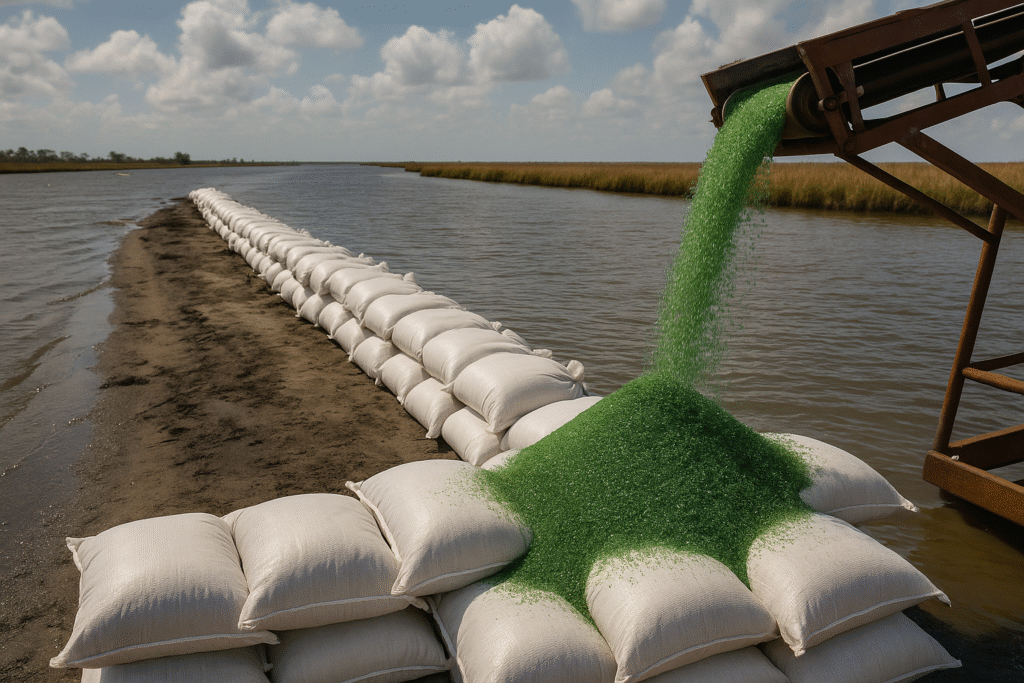
At Bayou Bienvenue, near New Orleans, an artificial island made partly of crushed glass is giving new life to the swamp. Researchers say this project could reshape how coastal regions worldwide approach restoration, particularly as rising sea levels and erosion threaten vulnerable habitats.
Turning Trash Into a Restoration Tool
The island, roughly 10 meters in diameter, is made from a blend of ground glass — processed into fine sand — and natural sediment from the Mississippi River. A nearby control island built solely with sediment allows scientists to compare plant growth and soil performance between the two materials.
The project is a collaboration between researchers at Tulane University and Glass Half Full, a Louisiana-based recycling company that saw potential in turning waste glass into a climate solution.
“We wanted to find out whether glass sand could play a real role in rebuilding coastal ecosystems,” says Franziska Trautmann, co-founder of Glass Half Full. “There were virtually no glass recycling facilities in Louisiana when we started in 2020, so we decided to build one and see how far we could take it.”
Each year, millions of metric tons of glass end up in landfills, a global waste management problem that also represents a lost opportunity for circular reuse. By using crushed glass as a partial replacement for dredged sediment, restoration projects could both conserve natural resources and reduce waste.
How Glass Helps the Coast
Wetlands, salt marshes, and mangroves form a natural defense line against hurricanes and flooding. As sea levels rise and erosion accelerates, these ecosystems are disappearing faster than they can recover. Traditional restoration relies on dredged sediment — but dredging is costly, environmentally disruptive, and limited in supply.
Glass sand offers an alternative. Laboratory and greenhouse studies published in Restoration Ecology show that plants grown in a mixture of glass sand and river sediment perform just as well as those in natural soils.
At Tulane University, Dr. Sunshine Van Bael, a community ecologist leading the field tests, explains: “We found that coarse-grind glass mixed with sediment supports healthy root growth and plant survival. The plants don’t seem to mind that part of their soil is made from recycled glass.”
In greenhouse trials, Van Bael’s team grew wetland plants — including grasses, trees, and marsh species — in five-gallon buckets filled with either Mississippi River mud, glass sand, or an even mix of both. The results showed that the coarse-grind glass blend matched the performance of natural sediment, confirming its potential as a restoration material.
Promising Global Implications
Similar research in Mississippi found that native salt marsh grasses such as saltmeadow hay (Sporobolus pumilus) thrived in mixtures containing up to 75 percent glass sand. In some cases, plants grew even taller in the recycled material.
According to Christine Whitcraft, a wetland ecologist at California State University, Long Beach, “These findings hold tremendous promise. The consistency of plant success across species shows that glass sand could be a viable restoration substrate — not just in Louisiana but potentially in other coastal systems.”
However, she cautions that location-specific studies are needed. Mangrove research in the U.S. Virgin Islands suggests that results may vary depending on species and grain size. Van Bael’s team also observed that mangrove roots were less dense in glass-sand mixtures, indicating that the texture and mineral composition might influence growth differently for each species.
Building Resilience for the Future
The Bayou Bienvenue project underscores a larger truth about climate adaptation — innovation often comes from unlikely materials. Over the next five years, researchers will monitor two experimental islands to measure plant survival, soil quality, and ecosystem recovery. Two more islands are already planned for construction.
If the findings remain positive, Louisiana could pioneer the large-scale use of recycled glass in coastal restoration — a model that other nations may follow as they combat coastal degradation.
“We need our trees and swamps to protect us,” says Van Bael. “If recycled glass can help us restore that shield, then it’s more than recycling — it’s resilience.”