
By Harshit
LONDON, Nov. 12 —
There’s an old sying among tech journalists — you can either explain quantum physics accurately or in a way people understand, but you can’t do both. That paradox perfectly captures why quantum technology, despite its staggering potential, still exists in the shadow of artificial intelligence (AI).
Quantum mechanics — the physics of the subatomic world — describes particles that behave in bizarre, counterintuitive ways. They can exist in multiple states at once, vanish and reappear, and even affect each other instantly across vast distances. These strange phenomena underpin quantum computing, a field that promises to outpace classical computers by orders of magnitude, and possibly reshape industries from medicine to defense.
Yet, while AI dominates headlines, quantum remains quieter, more mysterious, and far harder to explain. But that may not be the case for long.
The Quiet Rise of Quantum Power
Recent months have seen major developments from tech giants including Google, Microsoft, and Quantinuum, each claiming breakthroughs in quantum hardware and computation.
Unlike AI, which relies primarily on software running on existing processors, quantum computing is hardware-driven — its power comes from manipulating quantum bits, or qubits, which can exist as both 0 and 1 simultaneously. This property allows quantum machines to process vast combinations of data simultaneously, theoretically solving problems classical computers would take millennia to complete.
“Quantum and AI could one day merge into a form of technology more powerful than anything we’ve ever created,” says Brian Hopkins, Vice President and Principal Analyst at Forrester Research. “The potential is there — but the jury is still out. We still need much more powerful quantum computers and innovative research before we can truly apply quantum effects to AI.”
According to McKinsey & Company, the quantum technology market could reach $97 billion (£74 billion) by 2035. By comparison, AI is projected to be worth trillions, but both industries share something in common: extraordinary promise coupled with extreme hype.
“I used to think quantum computing was the most-hyped technology on Earth,” Hopkins adds, “until the AI boom came along.”
Quantum’s Fragility — and Its Beauty
Unlike AI, quantum’s greatest weakness lies in its instability. Qubits are exquisitely sensitive — the slightest vibration, change in temperature, or beam of light can disrupt their state and cause an error. Maintaining these delicate systems requires ultra-cold environments, lasers, and vacuum chambers.
In jest, Elon Musk recently suggested on X (formerly Twitter) that quantum computers might “run best on the permanently shadowed craters of the Moon.”
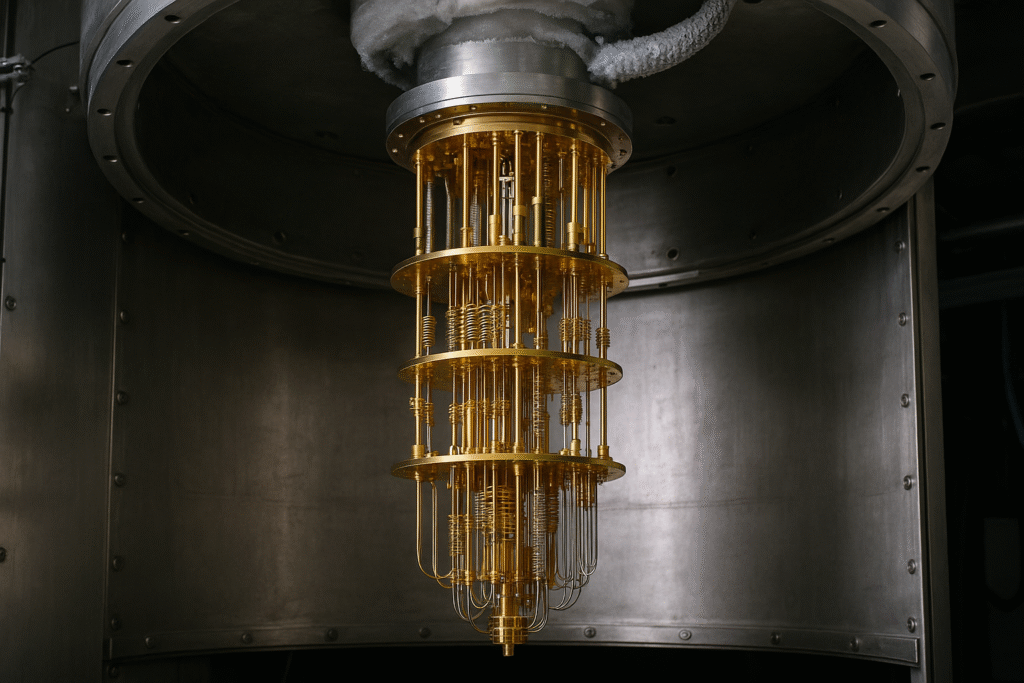
There are only about 200 operational quantum computers worldwide, mostly in laboratories. They don’t resemble traditional machines — many look like shimmering chandeliers or jellyfish, suspended in cooling systems. Some models now use synthetic diamonds to stabilize qubits at near-room temperatures.
De Beers, through its subsidiary Element Six, claims to have launched the world’s first quantum-grade diamond in 2020. The company is now working with Amazon Web Services to develop diamond-based components for future networks of quantum machines.
From Theory to Real-World Impact
So far, most quantum machines remain in the research phase. But their long-term promise is immense.
“Things that could take the age of the universe to calculate on today’s supercomputers could be solved in seconds,” says Prof. Sir Peter Knight, one of the UK’s leading quantum physicists.
Applications already being explored include:
- Drug discovery and personalized medicine: Quantum computers could simulate complex molecular interactions in minutes, enabling tailor-made drugs for individual patients.
- Agriculture: Quantum simulations could design new fertilizers that increase yield and reduce emissions.
- Navigation and defense: “Quantum compasses” tested by Imperial College London in 2024 offer precise underground navigation where GPS signals fail.
- Energy efficiency: The UK’s National Grid is investing in quantum algorithms to optimize power distribution and prevent blackouts in real time.
- Aviation logistics: Airbus has partnered with UK-based IonQ to use quantum systems for efficient aircraft cargo loading — saving thousands of kilograms of fuel.
Meanwhile, Google’s 2024 quantum chip “Willow” reportedly solved a problem in five minutes that would take today’s fastest supercomputers 10 septillion years — that’s a one followed by 25 zeros.
“The area of quantum computing is, in my mind, as big if not bigger than AI,” says Rajeeb Hazra, CEO of Quantinuum, recently valued at $10 billion. “We as consumers will eventually feel its impact in nearly every part of our lives.”
Quantum and AI: Allies or Rivals?
Experts believe AI and quantum will increasingly complement each other, not compete. Quantum could one day supercharge AI by generating unique datasets and solving optimization problems AI can’t handle.
But AI’s own neural networks are already being used to stabilize quantum systems and correct errors faster than human operators can.
“Quantum and AI may evolve symbiotically,” says Hopkins. “AI helps control quantum hardware, while quantum gives AI more computational depth. It’s a feedback loop of progress.”
Still, as with AI, quantum faces massive uncertainty, potential hype cycles, and regulatory challenges.
The Encryption Threat: “Q-Day”
Perhaps the most immediate concern is cybersecurity. Quantum computers are expected to eventually break current encryption systems, including the ones protecting global banking, healthcare, and military communications.
“It’s called harvest now, decrypt later,” explains Prof. Alan Woodward, cybersecurity expert at the University of Surrey. “State actors are already stealing encrypted data today, with the intent of unlocking it once quantum systems become powerful enough.”
That theoretical moment — when quantum computers can crack standard encryption — is ominously referred to as Q-Day. Experts predict it could arrive around 2030.
Apple, Google, and Signal have begun rolling out post-quantum encryption technologies designed to withstand future attacks. But as Daniel Shiu, former head of cryptographic design at the UK’s GCHQ, warned, “It’s credible that almost all UK citizens have already had data compromised by state-sponsored hackers — data that’s now being stockpiled for when it can be decrypted.”
A Race Against Time — and Physics
For now, quantum computing remains mostly confined to research facilities. But its evolution mirrors the early days of AI: once experimental, then suddenly indispensable.
As Dr. Hopkins of Forrester puts it: “Quantum may still be crawling, but when it learns to walk — AI might look like the training wheels.”
And perhaps that’s why quantum, the strangest and most complex frontier in science, may ultimately become humanity’s most powerful ally.