
By Harshit, TOKYO, Oct. 29, 2025
Detecting dark matter, the mysterious and invisible substance believed to hold galaxies together, remains one of physics’ most persistent challenges. While dark matter cannot be directly observed or touched, scientists believe it subtly interacts with normal matter — leaving behind faint signals that advanced quantum technologies may be able to detect.
Now, a research team at Tohoku University in Japan has proposed a groundbreaking method to strengthen quantum sensors by connecting them into carefully designed networks. This approach, detailed in a recent study, could make it possible to identify the elusive fingerprints of dark matter with unprecedented precision — marking a potential leap forward in both fundamental physics and practical quantum technology.
Superconducting Qubits as Cosmic Detectors
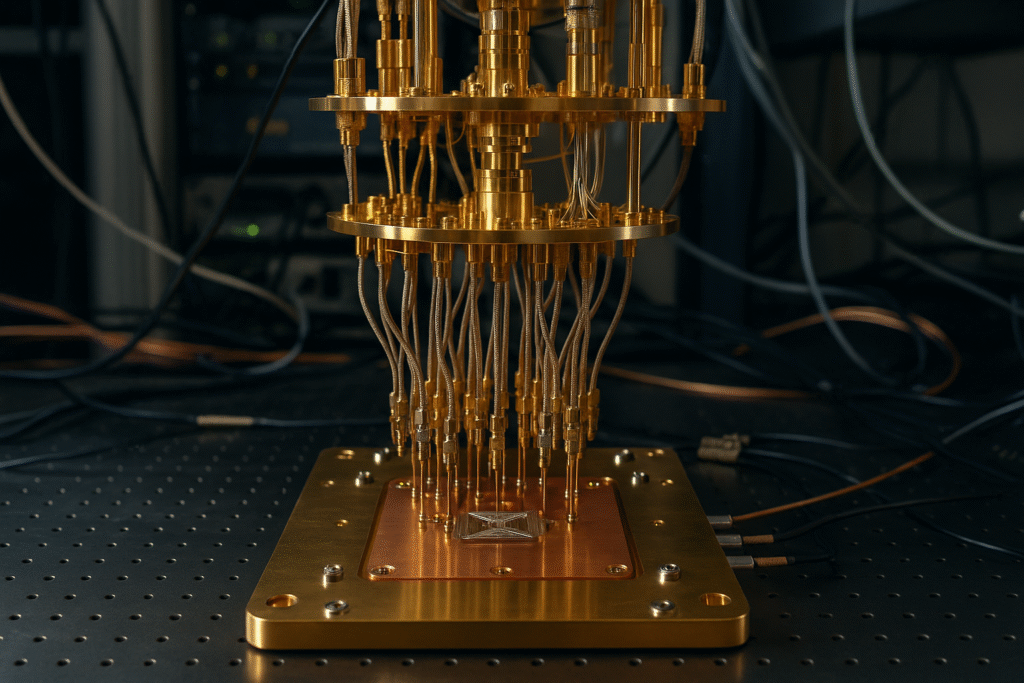
The new study focuses on superconducting qubits, the same building blocks used in quantum computers. These ultra-cold electronic circuits are capable of detecting the tiniest fluctuations in energy and electromagnetic fields — far beyond the reach of conventional instruments.
In the context of dark matter research, these qubits act as microscopic cosmic detectors. While a single qubit might be too weak to capture the subtle whispers of dark matter, a coordinated network of qubits can amplify and decode these signals through collective quantum behavior.
Dr. Le Bin Ho, the study’s lead author, compared this principle to teamwork. “A single quantum sensor might struggle to find a weak signal buried in noise, but a network can combine their strengths to reveal what was previously undetectable,” he said.
Optimizing Quantum Networks for Sensitivity
To put their theory to the test, the researchers explored several network structures — including ring, line, star, and fully connected designs. Each structure determined how information flowed between the qubits and how well they cooperated to sense disturbances possibly linked to dark matter interactions.
The team built systems using four and nine qubits and applied variational quantum metrology, a powerful technique inspired by machine learning. This approach allowed the network to “train” itself, automatically adjusting how each qubit’s quantum state was prepared and measured to achieve maximum sensitivity.
To further enhance accuracy, the scientists incorporated Bayesian estimation, a statistical method that helps separate real signals from background noise — much like sharpening a blurry photograph until hidden details emerge.
Breakthrough Results on Existing Devices
Even when realistic environmental noise was introduced, the optimized quantum networks outperformed traditional sensing approaches by a wide margin. This finding is significant because it means the new technique could already be implemented on existing quantum hardware — without requiring futuristic technology.
“Our goal was to figure out how to organize and fine-tune quantum sensors so they can detect dark matter more reliably,” Dr. Ho explained. “The network structure plays a key role in enhancing sensitivity, and we’ve shown it can be done using relatively simple circuits.”
The implications go far beyond dark matter detection. The same technology could revolutionize precision measurement across multiple fields, from quantum radar and gravitational wave detection to high-accuracy timekeeping and medical imaging.
Beyond Cosmology: Real-World Quantum Applications
Because quantum sensors can measure infinitesimally small changes in magnetic and gravitational fields, the method could transform industries reliant on high-precision data. Potential future uses include:
- Improved GPS accuracy, particularly in underground or remote environments where satellite signals are weak.
- Enhanced MRI scans, providing sharper brain imaging for early disease detection.
- Geological surveys, capable of revealing hidden mineral deposits or underground structures.
“This research shows that carefully designed quantum networks can push the boundaries of what’s possible in precision measurement,” said Dr. Ho. “It opens the door to real-world tools that require extreme sensitivity, not just experiments in isolated labs.”
Next Steps in Quantum Research
The Tohoku University team plans to scale up their model by linking larger networks of qubits and developing algorithms to make them more resilient to noise. By refining these methods, the researchers hope to bring quantum sensor arrays closer to practical deployment — potentially enabling the first direct detection of dark matter.
If successful, the work could redefine how humanity studies the unseen universe, bridging the gap between theoretical physics and next-generation technology.