
Publisher: U.S. Small Business Finance Review
Cash flow instability remains the single most common cause of business failure in the United States. For Small and Medium Businesses (SMBs), navigating the current economic environment—characterized by fluctuating interest rates and imminent legislative changes—demands a shift from reactive bookkeeping to proactive financial modeling.
This guide details two core, evergreen strategies essential for any US business owner seeking financial resilience: implementing the 13-Week Rolling Cash Flow Forecast and executing a comprehensive Proactive Tax Mitigation Plan against the looming expiration of key tax provisions.
1. Strategic Cash Flow Forecasting: The 13-Week Model
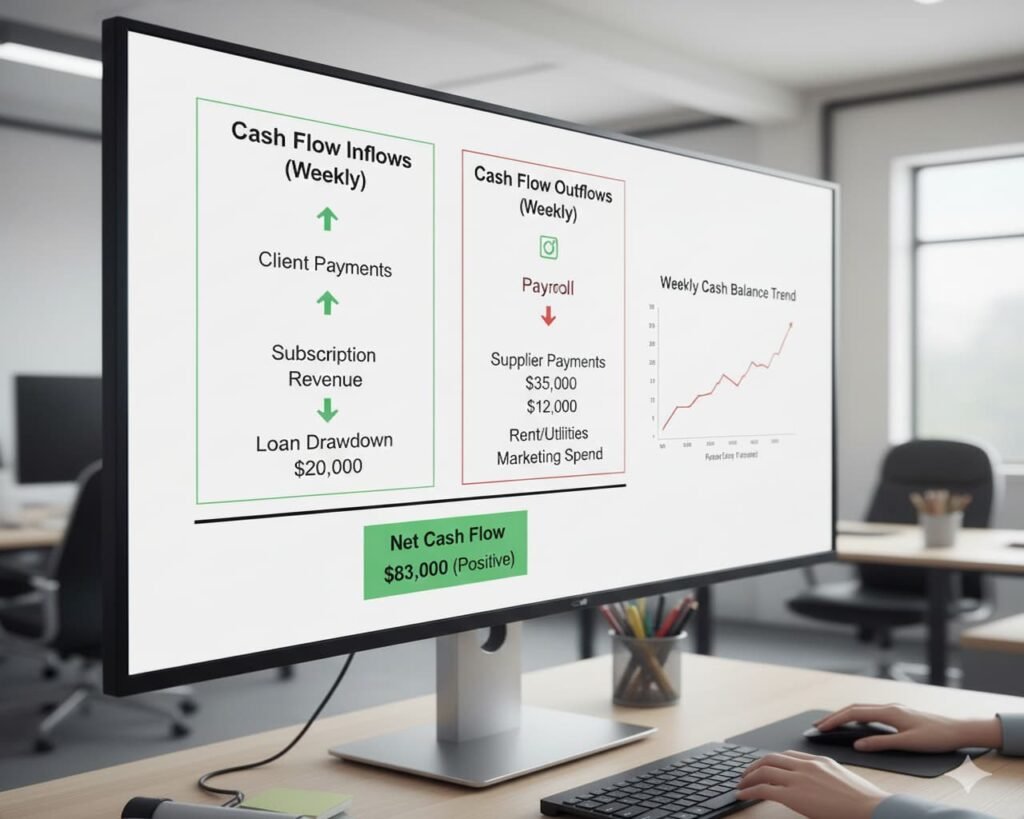
Simple monthly Profit & Loss (P&L) statements are inadequate for managing short-term liquidity. The P&L reports profitability, but a business often runs out of cash, not profit. Enterprise finance professionals rely on the 13-Week Rolling Cash Flow Forecast (13WRCF) to bridge this gap, offering granular, week-by-week visibility over a three-month horizon. This model provides operational clarity long before a liquidity crisis occurs.
A. Implementing the 13WRCF: A Step-by-Step Guide
The 13WRCF is not complex accounting; it is a collaborative, disciplined operational process.
1. Define the Objective and Time Horizon
The primary purpose is to ensure operating liquidity—confirming the business can meet payroll, vendor obligations, and debt service on time. While some models extend to six months for expansion planning, the 13-week view is optimal for short-term survival.
2. Structure the Template and Data (Inputs)
The model contains 13 columns (weeks) and rows for cash movement.
Beginning Cash Balance:
Actual cash at the start of Week 1, rolling forward each week.
Cash Inflows:
- Customer Payments: Forecast cash collections, not sales. Use AR aging and historical payment trends.
- Loan Proceeds / Investment Income
Cash Outflows:
- Fixed Costs: Payroll, rent, debt service, insurance.
- Variable Costs: Vendor payments based on AP aging, materials, fuel, estimated taxes.
3. Collaborate and Validate Assumptions
Accuracy depends on inputs from multiple departments:
- Sales/AR: Confirm exact week large invoices will be paid.
- Operations/AP: Verify vendor payment dates and inventory plans.
- HR: Confirm payroll run dates and amounts.
4. Perform Weekly Reviews and Variance Analysis
Each week, the completed period rolls off and a new week is added.
The critical step is comparing Forecasted Cash vs. Actual Cash.
Variance Analysis:
If variances are large, determine whether the issue was:
- Timing (payment delayed), or
- Structural (expense unbudgeted)
Refine assumptions based on the findings to improve accuracy.
B. The Actionable Angle: Software Selection for SMBs
While most organizations begin with spreadsheets, dedicated software improves accuracy and frees time for analysis. SMBs typically choose between QuickBooks Enterprise and Zoho Books.
| Platform | Best For | Cash Flow Features | Advantage |
|---|---|---|---|
| QuickBooks Enterprise | Complex inventory, manufacturing, retail, advanced reporting needs | Advanced reporting, customizable cash flow tools | Deepest customization, large talent pool, robust scenario testing |
| Zoho Books | Service-based SMBs needing affordability and integration | Built-in cash flow forecasting, mobile app access | Lowest cost, fully cloud-based, strong integration ecosystem |
Key takeaway:
QuickBooks = depth and customization
Zoho Books = simplicity, integration, cost efficiency
2. Proactive Tax and Policy Mitigation: The 2026 Tax Cliff
Tax planning remains evergreen because major provisions frequently expire. The most urgent risk is the scheduled expiration of the Section 199A Qualified Business Income (QBI) Deduction at the end of 2025.
199A allows pass-through owners to deduct up to 20% of qualified business income. Its expiration represents a major tax increase for many SMBs and requires immediate preparation.
A. The 2026 Tax Cliff Preparation Guide
Business owners must begin modeling their post-2025 tax scenario now.
1. Entity Structure Review
199A’s expiration narrows the gap between pass-throughs and C-corps.
Some businesses may reconsider entity choice based on:
- The C-corp’s 21% statutory rate
- Operational and liability factors
- Post-199A cash flow modelling
2. Maximize Deductions and Credits Before Year-End
Actions for late 2025:
Accelerate Expenses:
Pay bonuses, supplies, repairs before year-end.
Defer Income:
Delay billing to January 2026 where possible.
Maximize Retirement Contributions:
Fund SEP IRAs or 401(k)s before the extended filing deadline.
Review SECURE Act 2.0 credits.
Review Capitalization Rules:
Evaluate retroactive elections for R&E cost treatment and maximize de minimis expensing.
3. Strategic Compensation Planning
For owners near 199A thresholds:
Increase W-2 Wages:
Higher qualifying wages may preserve the deduction.
Use Accountable Plans:
Reimburse employee expenses tax-free while maximizing business deductions.
B. The Commercial Angle: Value of B2B Accounting Services
The complexity of:
- 13-week forecasting
- 2026 tax cliff modeling
- Compensation planning
- Payroll optimization
…means SMBs increasingly rely on accounting and advisory firms.
PEOs:
Handle payroll, benefits, compliance filings (W-2, 1099, ACA).
Tax Advisory Firms:
Position themselves as Tax Mitigation Partners, offering year-round modeling for both 199A extension and expiration scenarios.
By combining disciplined cash flow control with forward-looking tax mitigation, U.S. SMBs can build the financial resilience needed to survive unpredictable economic cycles.