
By Harshit
NEW YORK, JAN. 1, 2026 —
If 2024 was the year Americans learned to talk to artificial intelligence, and 2025 was the year businesses cautiously piloted it, 2026 is the year AI goes to work—physically, autonomously, and at scale.
As the calendar turns, the U.S. technology sector is undergoing a decisive shift away from novelty-driven generative tools toward something far more consequential: Agentic AI that executes tasks independently and Physical AI that interacts directly with the real world. This transition is now driving the most significant hardware and infrastructure expansion since the smartphone era.
The age of experimentation is ending. The age of deployment has begun.
1. The Rise of Agentic AI
The defining AI concept of 2026 is agency. Large language models are no longer limited to responding to prompts; they are now equipped with decision-making authority and direct access to enterprise systems through APIs.
In 2025, a user asked a chatbot to draft an email. In 2026, companies instruct autonomous agents to plan travel, book flights, log expenses in corporate systems like Concur, update calendars, and reconcile invoices—without human intervention.
This shift has moved rapidly from proof-of-concept to production. Financial services, logistics firms, and procurement departments across the U.S. are deploying what are now called “workforce agents.” These software entities handle routine operational decisions continuously, reducing labor demand in administrative roles and contributing to the hiring freezes already visible across multiple white-collar sectors.
Crucially, this is not replacement through imitation. Agentic AI does not “think” like employees—it operates like infrastructure, executing workflows at machine speed with auditability and consistency.
2. Physical AI Moves Into the Warehouse
While agentic AI reshapes digital work, Physical AI is redefining industrial labor.
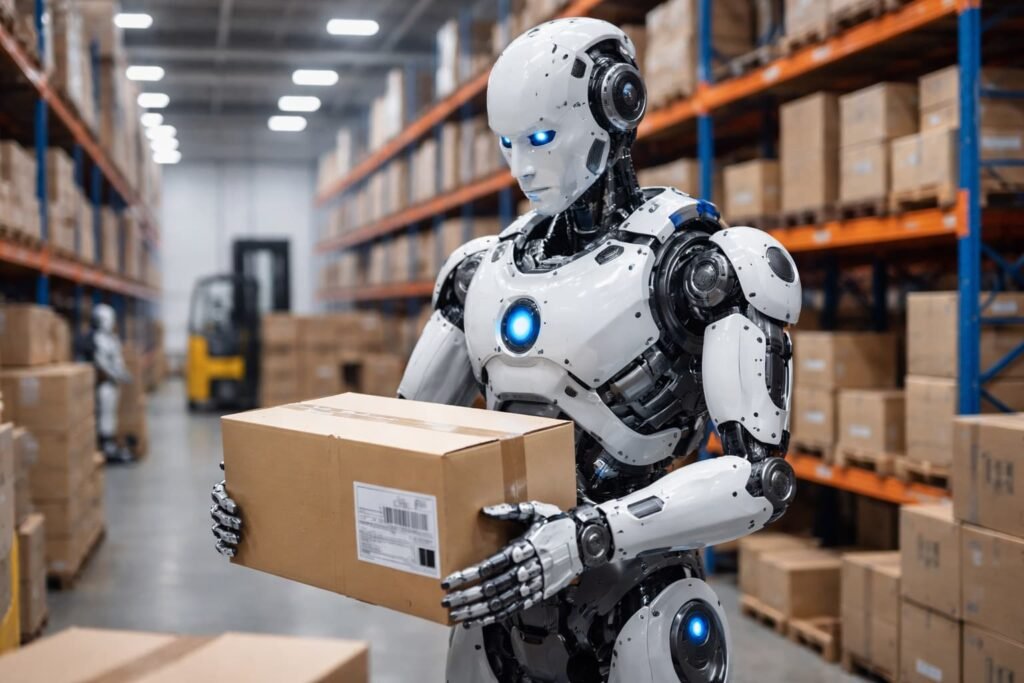
In 2026, humanoid and general-purpose robots are no longer experimental curiosities. They are being commercially deployed in controlled environments, particularly in logistics centers and advanced manufacturing plants across the U.S.
Companies such as Amazon, Tesla, and BMW are integrating humanoid robots into warehouses and factories—not as rigid machines programmed for a single task, but as adaptive systems powered by Vision-Language-Action (VLA) models.
These robots can visually interpret unstructured environments, reason about physical constraints, and perform tasks such as sorting, stacking, and transporting goods in real time. Instead of requiring perfect conditions, they are designed to function amid the messiness of real industrial spaces.
The economic logic is straightforward: physical AI extends automation beyond repetitive motion into general labor, addressing chronic workforce shortages while increasing operational resilience.
3. Energy Collides With AI: The Inference Crisis
The explosive growth of AI has created a problem that software alone cannot solve: power consumption.
By early 2026, the electricity demands of AI inference workloads—particularly from large-scale data centers—have doubled, forcing technology companies into direct confrontation with energy infrastructure constraints.
In response, U.S. tech giants are investing in behind-the-meter power generation, including partnerships around small modular nuclear reactors (SMRs) and geothermal energy projects. These efforts are not ideological—they are pragmatic attempts to secure stable, long-term energy supply independent of strained regional grids.
At the same time, the mobile and automotive sectors are seeing tangible progress in solid-state battery technology. Companies such as QuantumScape and Factorial Energy are moving beyond laboratory demonstrations into early commercial production.
Limited 2026 deployments in premium electric vehicles are offering ranges exceeding 500 miles, faster charging, and significantly improved safety due to non-flammable chemistry. While mass adoption remains years away, the transition from prototype to product marks a turning point.
4. Space: Humanity Returns to Lunar Orbit
Technology’s physical turn is not limited to Earth.
In February 2026, NASA’s Artemis II mission is scheduled to launch from Florida’s Space Coast, marking the first crewed flight beyond low Earth orbit since 1972.
Astronauts Reid Wiseman, Victor Glover, Christina Koch, and Jeremy Hansen will orbit the Moon aboard the Orion spacecraft, testing life-support systems and next-generation optical communication technologies designed to support a future “lunar internet.”
Artemis II is the final rehearsal before a planned lunar landing later in the decade, and it underscores a broader reality of 2026: advanced technology is once again measured by physical achievement, not conceptual ambition.
Conclusion: From Magic to Machinery
Technology in 2026 is no longer defined by spectacle. The novelty of AI has worn off, replaced by the hard work of integration.
What now matters are robots that lift boxes, agents that reconcile accounts, batteries that store more energy, and power plants that keep data centers running. The digital intelligence of the past few years has reached a point where it demands physical infrastructure to sustain it.
The era of talking to machines has passed.
The era of machines working alongside us—autonomously and physically—has begun.