
By Harshit
WASHINGTON, NOV. 22, 2025
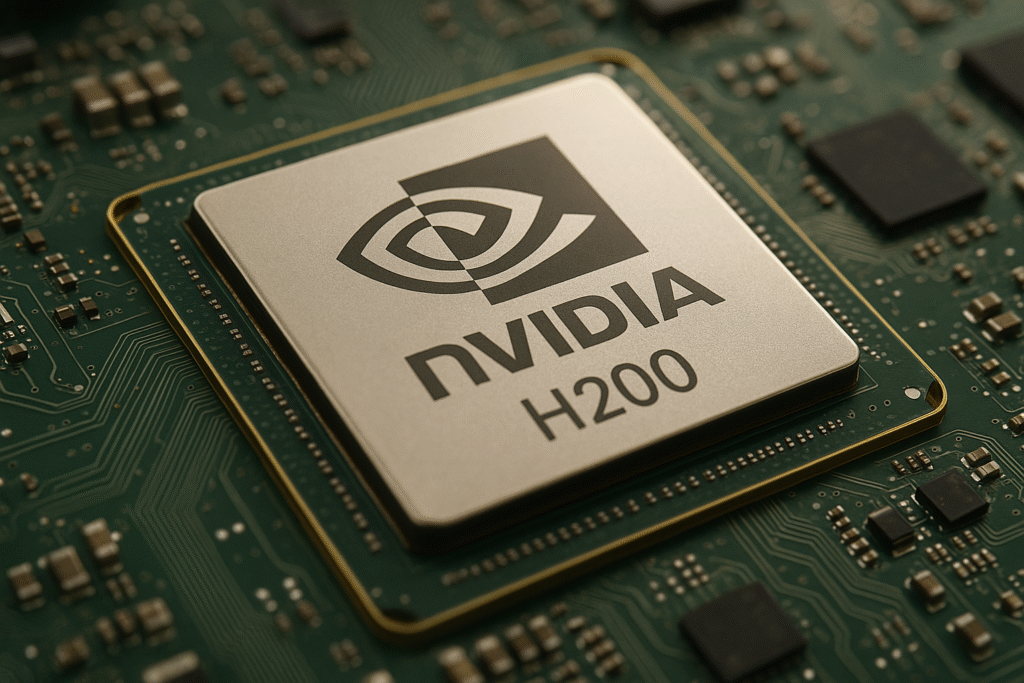
The Trump administration is weighing whether to ease restrictions on Nvidia’s high-end artificial intelligence chips, potentially allowing the company to sell its H200 processors to China in what would mark the administration’s most significant technology-policy shift since the recent trade détente with Beijing. According to sources familiar with the internal deliberations, the Commerce Department is actively reviewing whether the previously banned H200 chip can be exported to Chinese companies — a move that could reshape the competitive landscape of global AI hardware.
While officials insist no final decision has been made, the policy review reflects growing confidence following the tech and trade truce reached last month between President Donald Trump and Chinese leader Xi Jinping in Busan. The agreement paused years of escalating export controls and retaliatory restrictions that had locked U.S. and Chinese firms out of each other’s most advanced technologies.
A Potential Reset in U.S.–China Tech Relations
A senior White House official declined to comment on the ongoing review but said the administration remains committed to protecting U.S. technological leadership. “The administration is committed to securing America’s global technology leadership and safeguarding our national security,” the official said.
Behind closed doors, multiple agencies — including the Commerce Department’s Bureau of Industry and Security (BIS) — are considering whether selling the H200 aligns with broader strategic objectives. Analysts say the review represents a significant recalibration, particularly because the H200 was previously on the restricted list under both the Biden and Trump administrations.
For Nvidia, the stakes are enormous. China remains the world’s second-largest market for datacenter AI hardware, and current export restrictions prevent the company from selling anything more advanced than its H20 chip — a reduced-performance model specifically designed to comply with U.S. rules. Nvidia publicly noted that the existing regulations “do not allow the company to offer a competitive AI data-center chip in China,” effectively ceding the region to a growing roster of Chinese semiconductor rivals.
Washington Hawks Sound the Alarm
Not everyone in the capital is comfortable with the shift. Longtime China critics fear that allowing more powerful AI processors into Chinese markets could accelerate Beijing’s military modernization programs. These concerns originally drove the Biden-era limits on H100 and H200 shipments, as Pentagon advisers warned that advanced GPUs could support battlefield simulations, hypersonic weapons modeling, and real-time surveillance systems.
However, Beijing’s own aggressive export controls — particularly over rare earth minerals used in magnets, batteries, and advanced chips — have complicated Washington’s posture. Earlier this year, Trump floated several new restrictions on Chinese access to U.S. technology, only to walk most of them back amid concerns that Beijing might retaliate in ways that would hurt American manufacturers.
The H200: A Dramatic Boost in Capability
First unveiled two years ago, Nvidia’s H200 chip features significantly more high-bandwidth memory than the flagship H100. The extra memory boosts throughput, enabling the H200 to process larger AI models at faster speeds. Industry estimates suggest that the H200 is roughly twice as powerful as the legally exportable H20 — a gap that has left Chinese cloud providers desperate for more capable hardware.
The timing of the policy review adds intrigue. Nvidia CEO Jensen Huang, whom President Trump recently praised as a “great guy,” visited the White House this week during the arrival of Saudi Crown Prince Mohammed bin Salman. Just days earlier, the Commerce Department approved shipment of up to 70,000 Nvidia Blackwell-series chips — the company’s next-generation AI processors — to Saudi Arabia’s Humain and the UAE’s G42.
A Strategic Balancing Act
Experts say the administration’s evolving stance combines national security worries with economic realities. “The U.S. wants to stay ahead in AI performance, but it also wants to maintain influence over how global AI systems are built,” said one former Commerce official. “If American companies lose the Chinese market entirely, we may be weakening U.S. leadership rather than strengthening it.”
China, meanwhile, has rapidly accelerated domestic chip development. Analysts warn that keeping Nvidia entirely out of China may encourage faster growth of Chinese GPU alternatives — some backed directly by Beijing.
For now, the administration is proceeding cautiously. Officials emphasized that the review could still result in maintaining or even strengthening the ban. But the mere possibility of a policy reversal suggests a significant shift in how Washington views AI exports, economic leverage, and the long-term competitive landscape.
Whether the H200 ultimately reaches Chinese buyers will depend on assessments that blend geopolitics, national security, and global market pressure — a combination that has defined nearly every major U.S.–China technology decision of the past decade.