
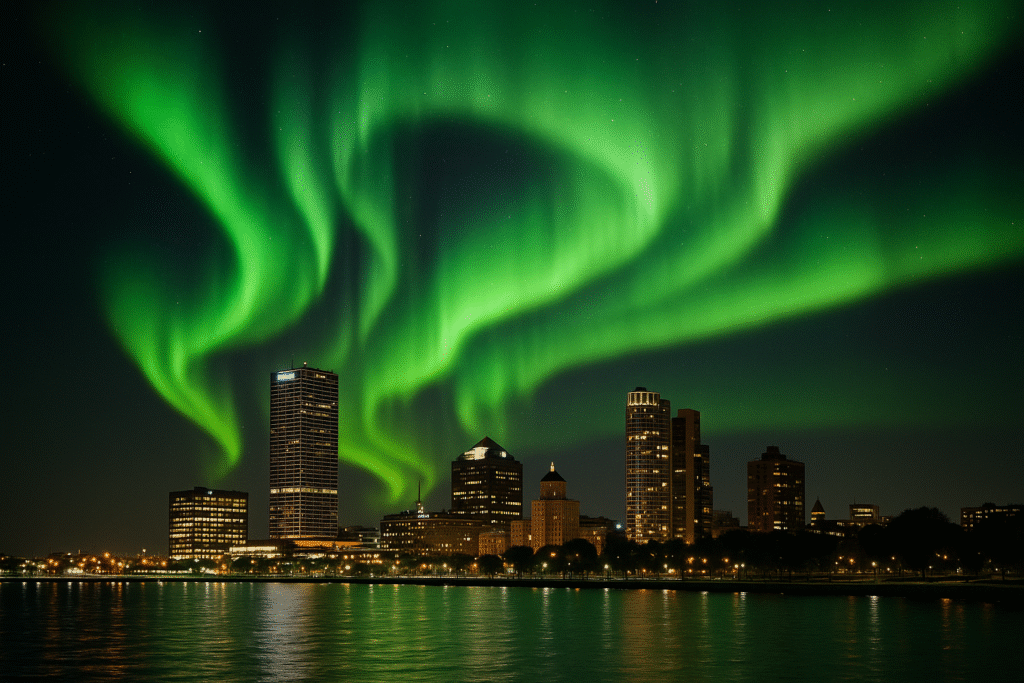
By Harshit
Milwaukee, Wisconsin | November 12, 2025 | 01:00 AM CST
A breathtaking natural light show is on the way for much of the United States. Beginning Tuesday evening, November 11, and continuing into the early hours of Wednesday, November 12, residents across 21 U.S. states could witness the aurora borealis, or northern lights, glowing vividly across the night sky — thanks to a powerful solar storm headed toward Earth.
According to the National Oceanic and Atmospheric Administration (NOAA), the auroras will be most visible between 6 p.m. and 6 a.m. Central Time, depending on local weather and cloud cover. The phenomenon, usually restricted to regions near the Arctic, is expected to extend farther south than usual due to an intensified geomagnetic disturbance.
What Causes the Northern Lights?
The aurora borealis, also known as the northern lights, occurs when charged particles from the Sun collide with Earth’s magnetic field and upper atmosphere. These collisions excite atmospheric gases, causing them to glow in colors ranging from vivid green and pink to purple and red.
This week’s spectacle comes as a result of a coronal mass ejection (CME) — a burst of solar plasma and magnetic field from the Sun’s corona — that is expected to hit Earth’s magnetosphere on Tuesday evening. NOAA’s Space Weather Prediction Center (SWPC) has classified the event as a strong (G3-level) geomagnetic storm, capable of pushing auroral activity deep into the continental U.S.
Where the Northern Lights Will Be Visible
According to NOAA’s latest aurora forecast map, residents in the following 21 states have a chance of seeing the northern lights:
Alaska, Idaho, Illinois, Indiana, Iowa, Maine, Massachusetts, Michigan, Minnesota, Montana, Nebraska, New Hampshire, New York, North Dakota, Ohio, Pennsylvania, South Dakota, Vermont, Washington, Wisconsin, and Wyoming.
While visibility will depend on local weather and light pollution, rural and northern areas within these states will have the best chance of seeing the auroras clearly.
“The aurora forecast looks promising for much of the northern U.S.,” said Rob Steenburgh, a space weather forecaster at NOAA’s SWPC. “If skies remain clear, people as far south as Illinois and Pennsylvania could catch a glimpse of green or purple light waves near the horizon.”
Best Viewing Tips
To maximize your chances of witnessing the celestial show:
- Go dark: Find a location away from city lights for better visibility.
- Face north: The auroras will generally appear toward the northern horizon.
- Look up between 10 p.m. and 2 a.m.: That’s typically when geomagnetic activity peaks.
- Bring a camera: Long-exposure shots often reveal more colors than the naked eye can see.
Experts note that auroras can appear as faint greenish glows at first before intensifying into vibrant curtains of light that ripple and dance across the sky.
Why the Aurora Is Moving South
This week’s solar activity is part of an ongoing solar maximum — a period of heightened solar storms that occurs roughly every 11 years in the Sun’s natural cycle. During this time, the Sun releases more solar flares and coronal mass ejections, increasing the frequency of geomagnetic storms on Earth.
When these solar eruptions reach Earth’s magnetic field, they can cause not only beautiful auroras but also minor disruptions to radio signals, GPS systems, and power grids at higher latitudes. However, NOAA says no significant impacts are expected from this event.
“Geomagnetic storms like this one are natural and generally harmless,” explained Steenburgh. “The most noticeable effect for most people will be the beautiful auroras lighting up the night sky.”
Recent Aurora Sightings and Context
Just last year, in October 2024, the northern lights were visible as far south as Milwaukee, Denver, and even parts of Kansas, stunning photographers and skywatchers. Photos captured from Ellsworth Park in Milwaukee showed the auroras shimmering in pink, violet, and green bands across the horizon.
This week’s forecasted storm may produce a similar, if not stronger, display.
A Rare Opportunity for the Lower 48
Aurora experts emphasize that displays this far south are relatively rare — happening only a few times per solar cycle.
“It’s not every day you can see the northern lights without leaving the continental U.S.,” said Michelle Nichols, director of public observing at Chicago’s Adler Planetarium. “Even a faint glow along the horizon is a reminder of how dynamic and connected our solar system is.”
For those hoping to witness the lights, the key is clear skies. Cloudy or rainy weather could obscure the view in some regions. Viewers are advised to check NOAA’s real-time aurora forecast or the Space Weather Prediction Center’s Kp index to monitor geomagnetic activity levels throughout the night.
The Magic of Space Weather
As the Sun continues its solar cycle peak through 2025–2026, scientists expect more frequent and more intense auroral events worldwide. These occurrences not only produce breathtaking skies but also help researchers understand how solar energy interacts with Earth’s magnetosphere, affecting satellites, aviation, and communications.
So, if you live anywhere from Maine to Montana or Ohio to Washington, tonight and tomorrow may be your chance to witness one of nature’s most spectacular light shows — no telescope required.