
By Harshit, CAPE CANAVERAL, FL —30 OCTOBER, 2025 |
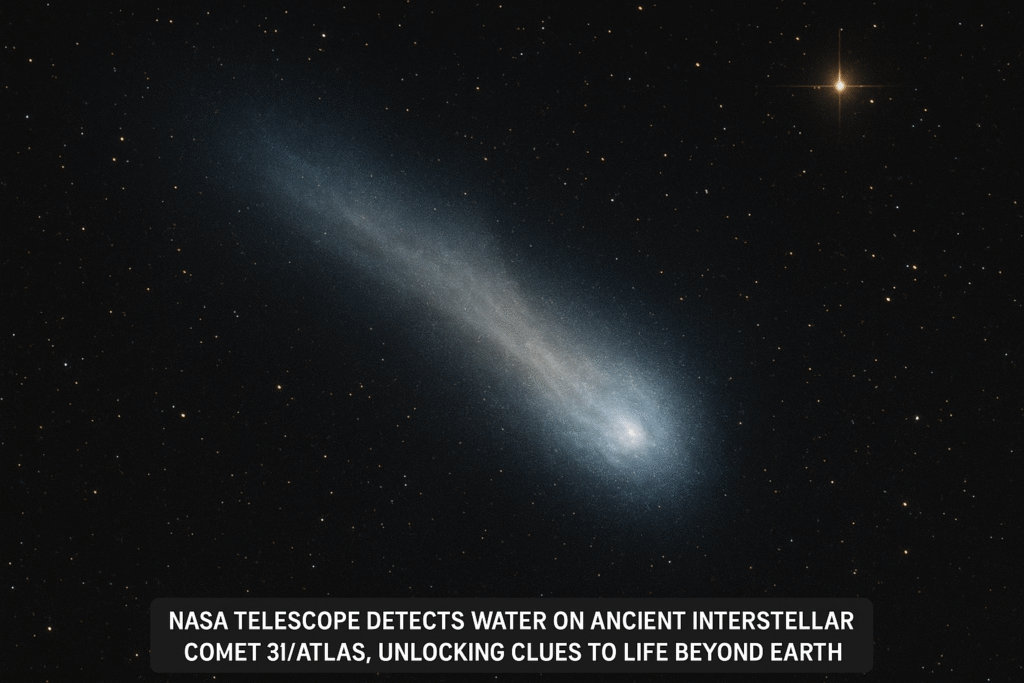
In a stunning discovery that could reshape our understanding of cometary behavior and the origins of life’s ingredients across the galaxy, astronomers using NASA’s Neil Gehrels Swift Observatory have detected water vapor escaping from Comet 3I/ATLAS — a rare interstellar visitor passing through our solar system.
This breakthrough marks the first confirmed detection of water from an interstellar comet, revealing that the building blocks of life may be far more universal than previously imagined. The findings challenge established models, as the comet displayed vigorous water activity far from the Sun, where such behavior should be nearly impossible.
A Watery Surprise Far from the Sun
Comet 3I/ATLAS, the third confirmed object from beyond our solar system, was observed by Swift’s Ultraviolet/Optical Telescope (UVOT) in July and August 2025. The telescope detected the unmistakable ultraviolet signature of hydroxyl (OH) gas — a byproduct formed when sunlight splits apart water molecules in space.
Astronomers were astonished to find that 3I/ATLAS was actively releasing water even though it was nearly three times farther from the Sun than Earth, a region where solar radiation is too weak to vaporize water ice.
According to NASA’s analysis, the comet was shedding water at an extraordinary rate of 40 kilograms per second — equivalent to a fire hose blasting continuously into space.
“When we detect water — or even its faint ultraviolet echo, OH — from an interstellar comet, we’re reading a note from another planetary system,” said Dr. Dennis Bodewits, an astronomer at Auburn University and co-author of the study. “It tells us that the ingredients for life’s chemistry are not unique to our own.”
Rewriting the Rules of Cometary Activity
The discovery has forced astronomers to rethink how comets behave at great distances from stars. Normally, when a comet approaches the Sun, surface ice warms, turns into vapor, and releases gas and dust — forming a visible tail. However, at such a distant range, sunlight is too weak to produce this effect directly.
Researchers now propose that 3I/ATLAS’s nucleus may not be sublimating surface ice in the traditional sense. Instead, it might be releasing clouds of tiny, ice-coated dust grains. Once ejected into space, these microscopic particles absorb weak sunlight and release trapped water, creating a vapor cloud, or coma, that surrounds the comet.
This phenomenon, seen only in a few distant solar system comets, suggests that 3I/ATLAS may have a unique internal structure, with volatile-rich materials buried beneath its surface. Such a mechanism could explain why it remains active even in the cold depths of interstellar space.
“The comet appears to be venting water from ice grains rather than from its solid core,” explained Dr. Zexi Xing, a postdoctoral researcher at Auburn University who led the research. “This kind of activity indicates that its surface is layered with dust and ice particles capable of releasing vapor even at extreme distances.”
Tracing the Chemistry of a Foreign Star System
The significance of this discovery extends far beyond the comet itself. Because water is a fundamental chemical marker, astronomers can now use it to compare 3I/ATLAS with native comets from our own solar system. Such comparisons help trace the chemical makeup of the environment in which the interstellar visitor was formed.
So far, each known interstellar object has exhibited a unique chemical fingerprint:
- 1I/ʻOumuamua (2017) appeared completely dry, showing no trace of gases or water.
- 2I/Borisov (2019) was carbon monoxide-rich, more so than any comet seen in our solar system.
- 3I/ATLAS (2025) is rich in water vapor but notably poor in cyanogen (CN), a compound commonly found in most local comets.
“Every interstellar comet so far has been a surprise,” said Xing. “Each one is rewriting what we thought we knew about how planets and comets form around stars.”
These findings suggest that comets born in other planetary systems may contain drastically different mixtures of ices and organic materials, depending on the temperature, pressure, and chemical conditions near their parent stars.
A Window Into the Origins of Life
Comets are often described as cosmic delivery vehicles, carrying water and organic molecules — the essential ingredients for life — across star systems. When they collide with young planets, they can seed them with the materials necessary for habitability.
The detection of water in an interstellar comet reinforces the idea that life’s chemical ingredients are widespread across the Milky Way. It also supports theories suggesting that Earth’s early water may have been delivered by comets and asteroids billions of years ago.
“If 3I/ATLAS formed in another star system and still contains liquid-bearing materials,” said Bodewits, “then it means that the same chemistry that gave rise to water on Earth could be happening throughout the galaxy.”
The discovery underscores how interstellar objects act as messengers, carrying vital clues from distant planetary nurseries. Each one offers astronomers a rare chance to study material untouched since the birth of other solar systems.
The Road Ahead: Observing the Traveler
NASA and international observatories continue to monitor 3I/ATLAS as it moves deeper into the inner solar system. The comet’s closest approach to the Sun, known as perihelion, occurred around October 30, 2025, at a distance of 1.36 astronomical units (about 200 million kilometers) — just inside Mars’ orbit.
Though it will remain far from Earth, astronomers expect 3I/ATLAS to become visible again to large ground-based telescopes in December 2025, once it re-emerges from behind the Sun.
Future missions, including NASA’s James Webb Space Telescope (JWST) and ESA’s Comet Interceptor, may gather additional data about its temperature, molecular composition, and internal structure before it exits the solar system forever.
A Cosmic Message from Afar
For scientists, Comet 3I/ATLAS represents more than just a rare celestial object. It is a scientific bridge between worlds, connecting humanity’s understanding of our solar system to the greater galaxy beyond.
The detection of water — the universal solvent of life — suggests that the chemistry that shapes living worlds may be a common story across the cosmos.
“Every time we study an interstellar visitor, we are reminded that our solar system is not an island,” said Bodewits. “Comets like 3I/ATLAS show us that the galaxy is alive with motion, chemistry, and potential — the same ingredients that may one day reveal how life begins everywhere.”