
By Harshit
Washington, D.C. | November 20, 2025 | 1:10 AM EST
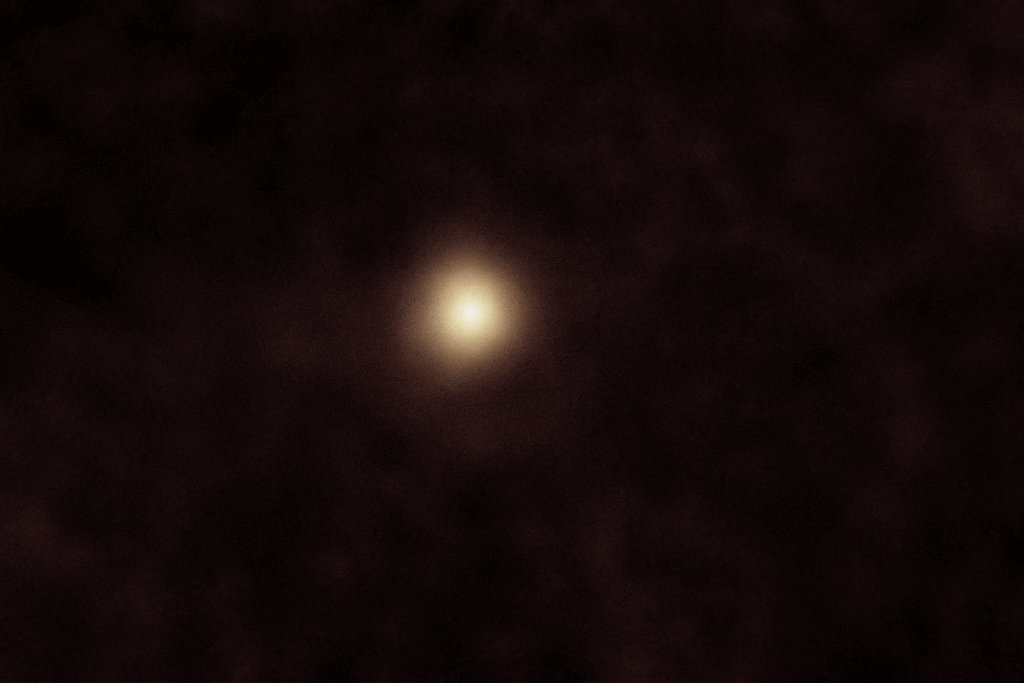
NASA has confirmed that its STEREO-A spacecraft has successfully observed interstellar comet 3I/ATLAS, marking the first time heliophysics missions have knowingly captured imagery of an object originating beyond our solar system. The observations, collected between September 11 and October 2, are part of an unprecedented multi-mission campaign to study the rare visitor as it moves through the inner solar system at over 130,000 miles (209,000 km) per hour.
A Comet Once Thought Too Faint to See
Initially, scientists believed 3I/ATLAS would be too dim for the STEREO spacecraft to detect. However, advanced processing techniques, including stacking and aligning multiple long-exposure images from the Heliospheric Imager-1 (HI-1), revealed the comet as a faint, glowing feature at the center of the frame.
The resulting images show a small but distinct brightening — the unmistakable signature of an interstellar object illuminated by reflected sunlight.
A Rare Interstellar Visitor
Discovered on July 1, 2025, by the NASA-funded ATLAS telescope in Río Hurtado, Chile, 3I/ATLAS is only the third confirmed interstellar object ever detected, following ‘Oumuamua (2017) and comet 2I/Borisov (2019). Its hyperbolic orbit proves it originated outside the solar system and will never return once it departs.
While the comet poses no threat to Earth, NASA is using every available spacecraft to collect as much data as possible before it disappears back into interstellar space.
NASA’s Solar System–Wide Observation Effort
NASA has activated more spacecraft than ever before to track a single comet, turning the event into a historic observational campaign. To date, twelve NASA assets have captured images or spectra of 3I/ATLAS, with more to follow as the comet approaches its closest point to Earth on December 19, 2025.
Closest Views From Mars
In September, 3I/ATLAS passed within 19 million miles of Mars, enabling NASA’s Mars fleet to capture some of the closest images yet:
- Mars Reconnaissance Orbiter (MRO) recorded detailed optical images.
- MAVEN collected ultraviolet measurements revealing the comet’s atmospheric chemistry.
- The Perseverance rover, from the surface, detected a faint silhouette of the comet low on the horizon.
Sun-Pointed Missions Fill the Observation Gap
Because 3I/ATLAS passed behind the Sun from Earth’s perspective, ground-based observatories were temporarily unable to observe it. NASA’s heliophysics missions stepped in:
- STEREO-A captured images from Sept. 11–Oct. 2
- SOHO, the ESA/NASA mission, recorded the comet from Oct. 15–26
- PUNCH imaged the comet’s tail from Sept. 20–Oct. 3
This is the first time ever NASA’s Sun-focused missions have deliberately observed an interstellar object.
Asteroid Missions Join the Effort
Two deep-space asteroid explorers — Psyche and Lucy — also recorded images of the comet:
- Psyche captured four sets of images on Sept. 8–9 from 33 million miles away
- Lucy photographed the comet on Sept. 16 from 240 million miles, revealing details of its coma and tail when the images were stacked
Early Findings: A Comet Unlike Those Born in Our Solar System
Images from Hubble, JWST, SPHEREx, and now STEREO suggest that 3I/ATLAS displays:
- unusual patterns of brightening
- a chemically distinct coma
- potential carbon-rich materials
- possible crust hardening from millions of years in interstellar space
NASA scientists aim to compare these findings to known solar system comets to better understand how planetary systems differ across the galaxy.
What Comes Next
3I/ATLAS will make its closest approach to Earth on December 19, 2025, at a distance of 170 million miles — nearly twice the Earth–Sun distance. It will pass Jupiter’s orbit in the spring of 2026 before leaving the solar system permanently.
NASA missions will continue monitoring the comet until it becomes too faint to detect.