
By Harshit
DATELINE: WASHINGTON, November 14, 2025 – 1:55 PM EDT
Intro:
In a groundbreaking astronomical development, NASA’s Hubble Space Telescope has captured the sharpest-ever image of Comet 3I/ATLAS — the third known interstellar object ever detected passing through our solar system. The discovery, made by the NASA-funded ATLAS survey, is reshaping scientists’ understanding of how interstellar comets travel across the galaxy and interact with solar systems beyond their own.
What Was Revealed:
Comet 3I/ATLAS was first detected on July 1, 2025, by the Asteroid Terrestrial-impact Last Alert System (ATLAS) telescope in Rio Hurtado, Chile. The telescope, funded by NASA and operated by the University of Hawai‘i, identified the object’s unusual hyperbolic trajectory, confirming its interstellar origin — meaning it came from outside our solar system.
Subsequent analysis of archival data extended the comet’s observation record back to June 14, 2025, using images from ATLAS telescopes around the world and Caltech’s Zwicky Transient Facility in California. The discovery marks the third interstellar object ever observed, following ʻOumuamua (2017) and 2I/Borisov (2019).
How It Works:
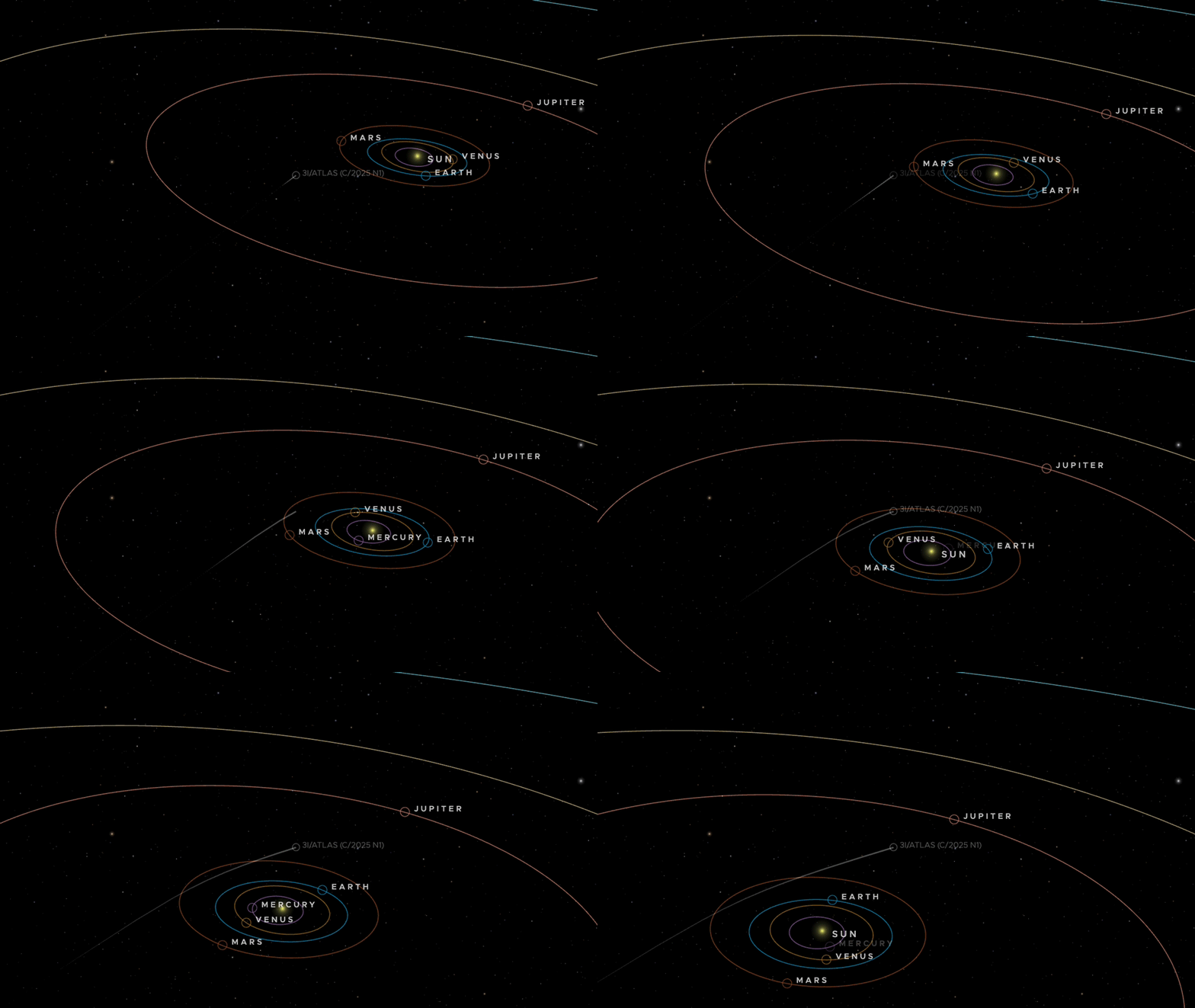
Unlike typical comets bound to the Sun’s gravity, 3I/ATLAS travels on an open, hyperbolic orbit, ensuring it will eventually leave our solar system forever. It is currently racing through space at an astonishing 130,000 miles per hour (209,000 km/h) — the fastest recorded speed for any solar system visitor.
NASA’s Hubble Space Telescope observed the comet on July 21, 2025, when it was about 277 million miles from Earth. The images revealed a teardrop-shaped dust cocoon surrounding the comet’s icy nucleus. Scientists estimate the nucleus could range between 1,400 feet (440 meters) and 3.5 miles (5.6 kilometers) in diameter.
Hubble’s precision allowed astronomers to detect subtle details, including a dust plume ejected from the Sun-warmed side of the comet and a faint dust tail trailing behind it. These features closely resemble those of comets originating within our solar system — a surprising finding that hints at universal cometary behavior across different star systems.
Implications:
NASA scientists say 3I/ATLAS offers an unprecedented window into the composition and behavior of interstellar bodies, helping astronomers understand how materials like ice, dust, and organic compounds form in distant planetary systems.
“This latest interstellar tourist is part of a previously unseen population of wandering relics,” said David Jewitt, a planetary scientist at the University of California, Los Angeles, and the science team leader for the Hubble observations. “It’s like glimpsing a rifle bullet for a thousandth of a second — you can’t trace it back exactly, but it tells us something profound about the galaxy’s hidden traffic.”
The comet will make its closest approach to the Sun around October 30, 2025, at about 1.4 astronomical units (210 million kilometers), just inside Mars’ orbit. Its closest approach to Earth will remain a safe 1.8 astronomical units (270 million kilometers) away — posing no threat to our planet.
NASA’s network of observatories, including the James Webb Space Telescope (JWST), TESS, Swift, SPHEREx, and even rovers like Perseverance and Curiosity, are coordinating to track the comet’s composition and behavior.
Future Steps:
NASA expects 3I/ATLAS to remain visible to ground-based telescopes through September 2025 before it moves too close to the Sun for observation. The comet is predicted to reappear in December 2025, providing another window for global observatories to capture its final moments before it departs the solar system forever.
The findings from Hubble’s observations will be published in The Astrophysical Journal Letters and have already been made available on the preprint server Astro-ph. NASA’s continuing efforts to track such interstellar visitors are advancing its long-term mission to find, study, and understand near-Earth and interstellar objects, ensuring early detection of any future cosmic travelers.