
By Harshit | New York | October 22, 2025 | 1:45 AM EDT
A Cosmic Companion, Not a True Moon
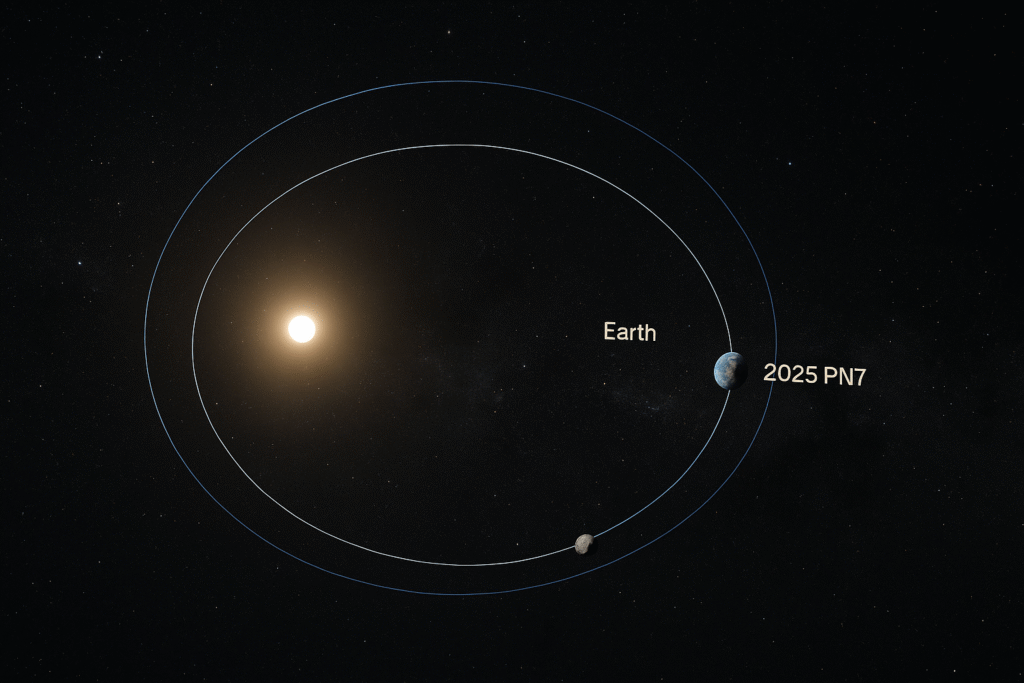
Earth doesn’t have two moons — but for the next few decades, it will have a cosmic companion traveling alongside it. NASA has confirmed that a small asteroid, officially named 2025 PN7, is now orbiting the Sun in a pattern that mirrors Earth’s path, making it what astronomers call a “quasi-moon.”
The object, estimated to be between 18 and 36 meters (60 to 120 feet) wide, was first observed by researchers at the University of Hawaii’s Pan-STARRS observatory. Though it appears to move in sync with Earth, scientists stress that it is not gravitationally bound to our planet — meaning it’s not a real moon.
Instead, 2025 PN7 simply shares a similar orbital rhythm around the Sun, giving the illusion that it’s following Earth through space. According to NASA, this asteroid will likely remain in Earth’s gravitational neighborhood until around 2083 before eventually drifting away.
What Exactly Is a Quasi-Moon?
A quasi-moon is a small celestial body that travels around the Sun on an orbit closely resembling Earth’s. Unlike the Moon, which orbits Earth directly, quasi-moons orbit the Sun but appear to move near Earth because their orbital periods are almost identical.
“These are like cosmic dance partners,” explained Carlos de la Fuentes, an astronomer at the Complutense University of Madrid and co-author of a September 2025 study on the discovery. “They move with us, but they’re not truly captured by Earth’s gravity.”
Astronomers believe that some quasi-moons originate from the main asteroid belt between Mars and Jupiter, while others might be fragments ejected from the Moon or even Earth itself after large meteorite impacts. However, the origins of 2025 PN7 remain uncertain. “No real hints about its origins — only speculations,” de la Fuentes said.
Discovery and Orbit
The asteroid was officially discovered on August 2, 2025, using the Pan-STARRS telescope network in Hawaii. Subsequent observations published in the American Astronomical Society’s journal confirmed that the space rock had been in a quasi-moon orbit since the 1950s — making it a long-time but unnoticed companion of Earth.
NASA’s orbital simulations show that 2025 PN7 maintains a stable orbit at an average distance of 4 million kilometers, roughly 10 times farther than the Moon. Its path ensures it poses no collision risk to Earth.
How Long Will It Stay?
NASA scientists estimate that 2025 PN7 has already accompanied Earth for about 60 years and will continue doing so for another half-century. It is expected to depart Earth’s vicinity around 2083, when gravitational interactions with other planets will nudge it out of its current path.
This means Earth will temporarily have a “second moon” only in a symbolic sense — a tag-along rock that quietly mirrors our orbit without ever becoming a true satellite.
No Threat to Earth
While social media chatter has stirred excitement — and mild alarm — about Earth “gaining a second moon,” scientists say there’s no cause for concern.
“2025 PN7 will not affect tides, gravity, or day-to-day life on Earth,” NASA clarified in a recent update. “It remains millions of kilometers away and poses zero danger to our planet.”
Its scientific value, however, is immense. By studying quasi-moons like this one, astronomers gain insight into how asteroids interact with Earth’s gravitational field and how small bodies move through the inner solar system.
Past and Future Quasi-Moons
This isn’t Earth’s first cosmic companion. Previous quasi-moons include Kamo‘oalewa, a near-Earth asteroid discovered in 2016 that remains in a stable orbit with Earth. China’s Tianwen-2 mission, set to launch later this decade, aims to collect samples from Kamo‘oalewa by 2027, underscoring global interest in these mysterious objects.
Such missions could help scientists understand whether quasi-moons are remnants of ancient collisions or captured asteroids, offering clues to Earth’s early solar history.
A Cosmic Passenger Until 2083
For now, 2025 PN7 continues its silent journey, pacing Earth like a distant companion on the same cosmic racetrack. It’s a small but fascinating reminder that our planet’s neighborhood is full of hidden travelers.
While it will never glow in the night sky like our Moon, this space rock tells an important story about how celestial bodies share — and sometimes briefly synchronize — their paths through the solar system.
In 2083, when 2025 PN7 finally drifts away, Earth will once again orbit the Sun with only its familiar lunar partner. But for now, we share our journey with a quiet, harmless shadow — a second “moon” that isn’t really a moon at all.