
By Harshit, RIO HURTADO, CHILE | Oct. 31, 2025 |
Astronomers have confirmed the discovery of a rare interstellar visitor — Comet 3I/ATLAS, the third known object from outside our solar system to pass through the Sun’s neighborhood. Detected by NASA’s Asteroid Terrestrial-impact Last Alert System (ATLAS) telescope in Chile, this comet is helping scientists probe the ancient chemistry of planetary systems beyond our own.
A Visitor from Beyond the Solar System
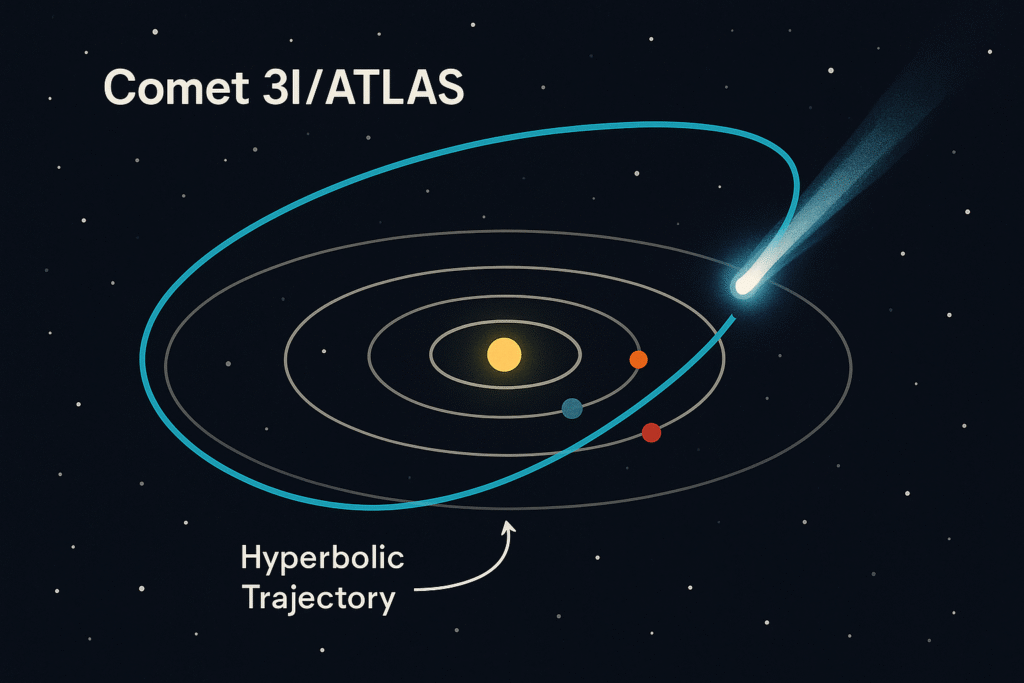
Comet 3I/ATLAS has captured the scientific community’s attention because of its hyperbolic orbit — a telltale sign that it did not originate within our solar system. Unlike typical comets that loop around the Sun on elliptical paths, 3I/ATLAS will sweep through once and depart forever.
NASA researchers have traced its trajectory backward and confirmed that it entered from interstellar space. The comet poses no threat to Earth — its closest approach will be about 1.8 astronomical units (around 270 million kilometers) from our planet.
It will make its nearest pass to the Sun on October 30, 2025, at roughly 1.4 astronomical units (just inside Mars’s orbit).
How Astronomers Spotted 3I/ATLAS
The ATLAS telescope in Rio Hurtado, Chile, first recorded the comet on July 1, 2025, submitting its data to the Minor Planet Center. Shortly after, astronomers analyzed archival images from three other ATLAS telescopes and Caltech’s Zwicky Transient Facility in California. These pre-discovery records dated back to June 14, 2025, extending the timeline of observation and confirming the object’s origin beyond the solar system.
Comets are named after their discoverers, and “3I/ATLAS” follows this rule. The “3” indicates that it is the third interstellar object ever found, while “I” stands for interstellar, distinguishing it from periodic or long-period comets.
Probing Its Size and Structure
NASA’s Hubble Space Telescope captured detailed images of 3I/ATLAS on July 21, 2025, when it was roughly 277 million miles (445 million kilometers) from Earth. The Hubble data revealed a teardrop-shaped cloud of dust enveloping the comet’s icy nucleus — evidence of active sublimation as it warms while approaching the Sun.
By tracking the object’s motion across the sky, Hubble allowed scientists to estimate its nucleus size. As of August 20, 2025, NASA placed its upper limit at 3.5 miles (5.6 kilometers) in diameter, with a possible minimum size of 440 meters. The streaks visible in the Hubble image are background stars blurred by the telescope’s tracking of the fast-moving comet.
The Significance of a Cosmic Wanderer
Comet 3I/ATLAS represents a rare opportunity to study materials that formed in another star system billions of years ago. Scientists estimate its age at around 7 billion years, making it potentially twice as old as Earth.
Because interstellar comets are not gravitationally bound to the Sun, their compositions offer direct evidence of the conditions in distant planetary nurseries. By comparing 3I/ATLAS with native comets from our solar system, astronomers can identify universal chemical building blocks and gain insight into how planets form across the galaxy.
Global Collaboration and Multi-Mission Effort
NASA and its international partners have mobilized a fleet of observatories to study 3I/ATLAS across different wavelengths. In addition to Hubble, space-based missions such as James Webb Space Telescope (JWST), TESS, Swift, and SPHEREx are scheduled to observe the comet.
Planetary missions including the Perseverance and Curiosity rovers on Mars, Mars Reconnaissance Orbiter, Europa Clipper, Lucy, Psyche, Parker Solar Probe, PUNCH, and SOHO will also monitor its trajectory and composition.
The multi-mission approach will allow researchers to cross-analyze data from visible, ultraviolet, and infrared wavelengths, providing a complete picture of how 3I/ATLAS interacts with solar radiation.
Observational Timeline
3I/ATLAS will remain visible to ground-based telescopes through September 2025, before disappearing behind the Sun. It is expected to re-emerge by early December 2025, providing astronomers another window for analysis as it exits the solar system.
NASA emphasizes that continuous monitoring of 3I/ATLAS will help refine models of interstellar comet dynamics and potentially prepare scientists for future discoveries. Each interstellar object observed — from ‘Oumuamua in 2017 to 2I/Borisov in 2019 — has revealed new aspects of cosmic chemistry.
A Glimpse into the Origins of Worlds
While 3I/ATLAS will eventually vanish into the depths of interstellar space, its brief visit offers a profound opportunity. The data collected may help answer one of astronomy’s oldest questions — how planetary systems form and evolve throughout the Milky Way.
As Dr. Dennis Bodewits of Auburn University explained in a related NASA statement, “Every interstellar comet tells a different story about the birth of planets. 3I/ATLAS gives us a chance to study chemistry from another star system without leaving our own.”