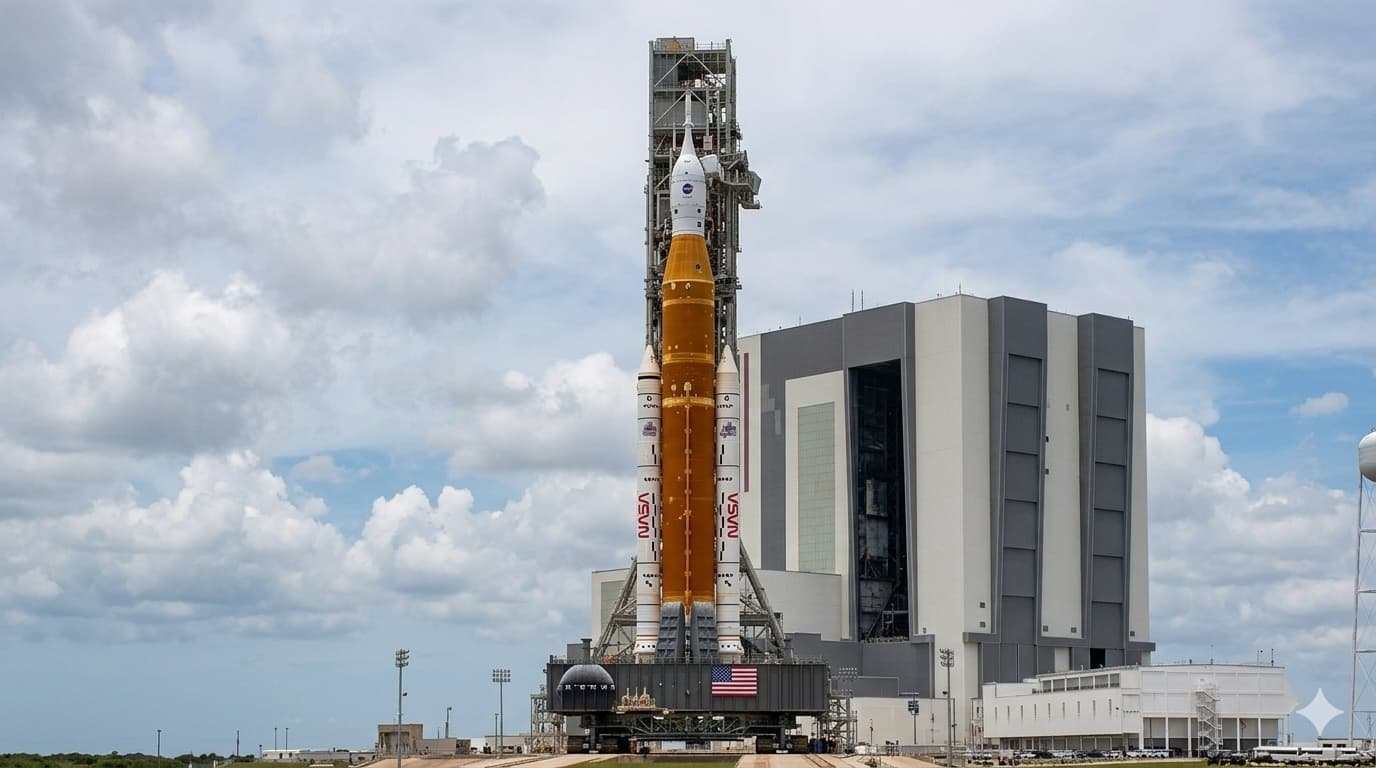

CAPE CANAVERAL, MARCH 14, 2026 — For the last time in a very long while, NASA is saying April 1 without anyone laughing. The space agency has officially set April 1, 2026 as the target launch date for Artemis II — the first mission to carry human beings to the vicinity of the Moon since Apollo 17 splashed down in the Pacific Ocean in December 1972. After four years of delays, hydrogen leaks, helium pressure failures, and two rounds of launchpad rollbacks, the rocket is going back to the pad next week. And this time, NASA says, it is ready.
“All teams polled go to launch and fly Artemis II around the Moon,” said Dr. Lori Glaze, NASA’s acting associate administrator for Exploration Systems, at the conclusion of a two-day Flight Readiness Review on Thursday. “Pending completion of some work before we roll out to the launch pad.”
The words were measured — as NASA words always are. But the meaning was unmistakable. Humanity is going back.
The Mission
Artemis II will carry four astronauts — NASA Commander Reid Wiseman, pilot Victor Glover, mission specialist Christina Koch, and Canadian Space Agency astronaut Jeremy Hansen — on a 10-day journey that will take them farther from Earth than any human being has traveled since the Apollo era. The crew will fly a free-return trajectory around the Moon, coming within approximately 8,000 kilometers of the lunar surface, before Orion’s engines push them back toward Earth and a Pacific Ocean splashdown.
This is not a Moon landing. Artemis II is explicitly a test flight — a real-world proving ground for the Space Launch System rocket, the Orion spacecraft, its deep-space life support systems, heat shield performance, and communication capabilities at lunar distances. Every system that will eventually put boots back on the Moon depends on what these four people learn on this mission.
Victor Glover will become the first person of color to reach deep space. Christina Koch will become the first woman to do so. Jeremy Hansen will become the first person not from the United States to travel beyond low Earth orbit. In a mission defined by firsts, those three may be the most significant.
What Went Wrong Before
The road to April 1 has been anything but smooth. NASA had originally hoped to launch Artemis II in February 2026 — itself a delay from earlier targets. A wet dress rehearsal on February 2 went badly. Liquid hydrogen, the super-chilled and notoriously leaky propellant that powers the SLS core stage, seeped out at rates above acceptable limits during a simulated launch countdown.
Just as engineers believed they had resolved the hydrogen issue, a new problem emerged in late February: helium wasn’t flowing properly to the rocket’s upper stage. Helium is critical for cleaning out propellant lines and pressurizing fuel tanks — without it, the rocket simply cannot launch safely. That discovery pulled all March launch dates off the table and forced NASA to roll the entire 322-foot stack back off the launchpad and into the Vehicle Assembly Building for repairs.
The fix turned out to be a blocked seal within a cable connecting the rocket to ground systems. Engineers replaced it. Managers reviewed the work. The Flight Readiness Review concluded Thursday with a unanimous go from all teams.
The New Plan — And What’s After It
The SLS rocket will roll back out to Launch Complex 39B — the same historic pad that hosted the Saturn V rockets of the Apollo program — on or after March 19. Liftoff on April 1 is set for 6:24 PM Eastern Time. If that date slips, NASA has six backup windows: April 2, 3, 4, 5, 6 and 30. Miss April entirely and the next opportunity slides to May.
Beyond Artemis II, NASA unveiled sweeping changes to the broader program. Artemis III — now redesigned as a systems test flight in Earth orbit — is targeted for mid-2027. The first actual Moon landing of the Artemis era, Artemis IV, is now scheduled for 2028, with NASA committing to approximately one crewed lunar landing per year thereafter. The long-term goal is a permanent base on the lunar surface — the foundation for eventual human missions to Mars.
Why This One Is Different
Many Americans have heard NASA announce Moon mission dates before. A generation of space enthusiasts watched Artemis I launch in 2022, waited through years of Artemis II delays, and have learned to hold their optimism loosely.
But April 1, 2026 carries a weight that previous dates didn’t. The rocket is built. The crew is trained. The technical problems have been identified, fixed, and reviewed by independent teams. The Flight Readiness Review — the most rigorous safety checkpoint in human spaceflight — has been cleared. And unlike every prior delay, which came from problems discovered during testing, this one comes from a problem that has already been solved.
Fifty-four years ago, Eugene Cernan climbed the ladder of the Apollo 17 lunar module, looked back at the surface he was leaving, and became the last human being to stand on the Moon. He died in 2017, never knowing when someone would follow.
In 18 days, four people will fly to the Moon’s doorstep. The answer to his unfinished question is finally close enough to touch.