
By Harshit, Paris, October 26, 2025 7 AM EDT
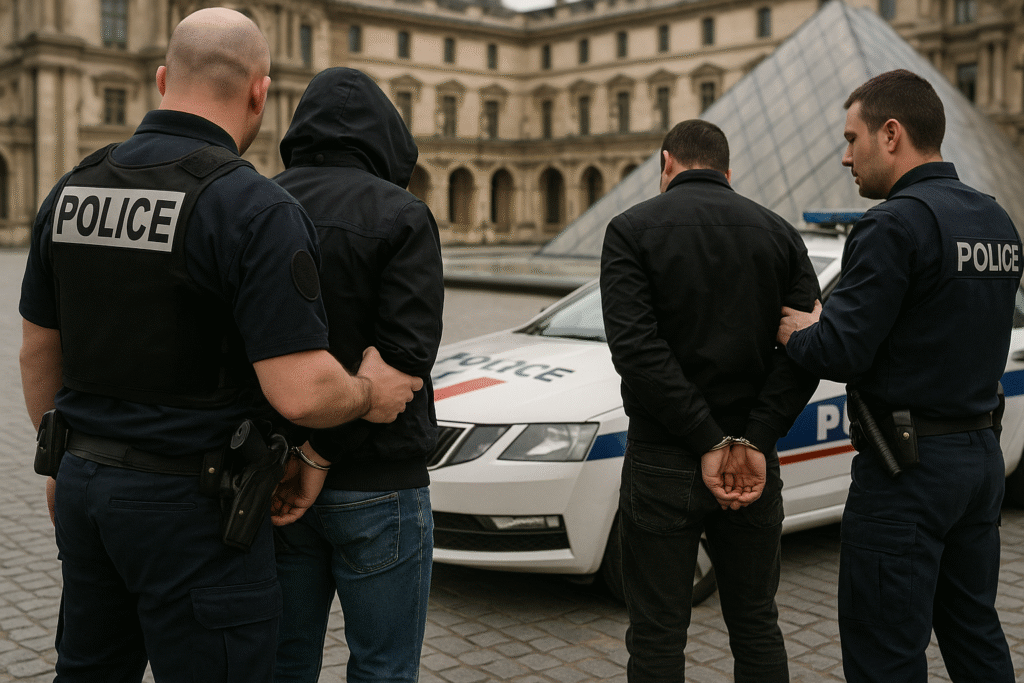
French authorities have arrested two suspects in connection with the audacious daylight theft of crown jewels worth an estimated €88 million ($102 million) from the Louvre Museum — the world’s most-visited cultural institution. The arrests come a week after four masked thieves broke into the museum’s Galerie d’Apollon using power tools and escaped within minutes.
According to the Paris prosecutor’s office, one of the men was taken into custody at Charles de Gaulle Airport while attempting to board a flight to Algeria, and the second suspect was intercepted while planning to travel to Mali. Both suspects are now being questioned by specialist police under France’s anti-organized crime laws and can be held for up to 96 hours.
High-Stakes Heist in Broad Daylight
The robbery unfolded in spectacular fashion last Sunday around 9:30 a.m. local time (06:30 GMT), just after the Louvre opened to the public. Witnesses reported seeing the thieves use a vehicle-mounted mechanical lift to reach a first-floor balcony near the River Seine, gaining access to the Gallery of Apollo — home to France’s most valuable crown jewels, including items once owned by Louis XIV and Napoleon Bonaparte.
Armed with power tools, the gang cut through a window, threatened guards, and smashed open two glass display cases containing historic gems and artifacts. Security staff were ordered to evacuate the area, allowing the thieves to operate uninterrupted for nearly four minutes before escaping on two scooters waiting outside.
Security Failures and Public Outrage
In the aftermath of the theft, France’s justice minister publicly admitted that museum security had “failed,” describing the incident as “a terrible image for the nation.” A preliminary internal report revealed that one in three rooms in the raided area lacked CCTV coverage, a staggering lapse in surveillance for a world-renowned institution.
The museum’s director, Laurence des Cars, told French senators that the only exterior camera near the Gallery of Apollo was angled away from the balcony used by the intruders. She further acknowledged that the Louvre’s security infrastructure was aging, leaving critical blind spots that the thieves exploited.
Authorities say the Paris prosecutor has criticized the “premature disclosure” of information about the investigation, arguing that media leaks may hinder efforts to track the remaining suspects and recover the missing jewels.
How the Robbery Was Executed
Police investigators believe the heist was a meticulously planned operation. The gang’s use of a mechanical lift, precision tools, and synchronized timing indicates professional experience. Once inside, the thieves swiftly neutralized security alarms and targeted only the most valuable items.
Security sources estimate that the entire operation lasted less than eight minutes, from entry to escape. By 9:38 a.m., the criminals had vanished into Paris’s narrow streets, evading pursuit amid morning traffic.
A preliminary crime scene analysis suggests that the stolen collection included a diamond tiara, ruby-encrusted brooches, and several emerald-studded necklaces, many of which date back to France’s royal era.
The Fate of the Stolen Jewels
Experts fear that the treasures may have already been disassembled or melted down, making recovery almost impossible. Dutch art detective Arthur Brand, known for recovering high-profile stolen artworks, told the BBC that gold and silver can easily be melted into untraceable bars, while precious gems can be recut into smaller, unidentifiable stones.
“If they’ve broken down the jewels, they’re gone forever,” Brand warned. “Once gems are cut and re-polished, it’s virtually impossible to prove their origin.”
In response, the Louvre has reportedly moved its most valuable artifacts to a secure underground vault at the Bank of France, located 26 meters (85 feet) below ground level. The relocation is intended to prevent any future thefts while the museum undergoes a comprehensive security overhaul.
International Hunt and Investigation
The arrests of the two suspects mark a significant breakthrough, but the main organizers and two additional thieves remain at large. French authorities are now collaborating with Interpol and Europol to trace cross-border movements and recover the stolen jewels before they are trafficked through black-market channels.
Investigators are also examining links between the Louvre robbery and recent art thefts in Belgium and Switzerland, which featured similar entry methods and timing precision.
Meanwhile, public pressure is mounting for accountability. French lawmakers have called for an independent review of museum security protocols across the country, especially in major cultural institutions like the Musée d’Orsay and the Palace of Versailles.
A Nation Shocked
The Louvre, which attracts nearly 10 million visitors annually, remains partially closed to the public as security upgrades continue. For many in France, the heist is not only a criminal scandal but also a symbolic wound to national pride — a violation of cultural heritage that resonates deeply in a nation that treasures its artistic legacy.
“This is more than theft,” one senator said during an emergency parliamentary session. “It is an attack on the soul of France.”