
WASHINGTON, MARCH 15, 2026 — For decades, Mars has been defined by what it lost. The red planet’s thin atmosphere, its frozen poles, its bone-dry surface — all of it tells the story of a world that once had water and gave it up. New research published Saturday suggests that story is incomplete. Scientists have found evidence of substantial liquid water hidden deep beneath the Martian surface — and the implications for life in the solar system are staggering.
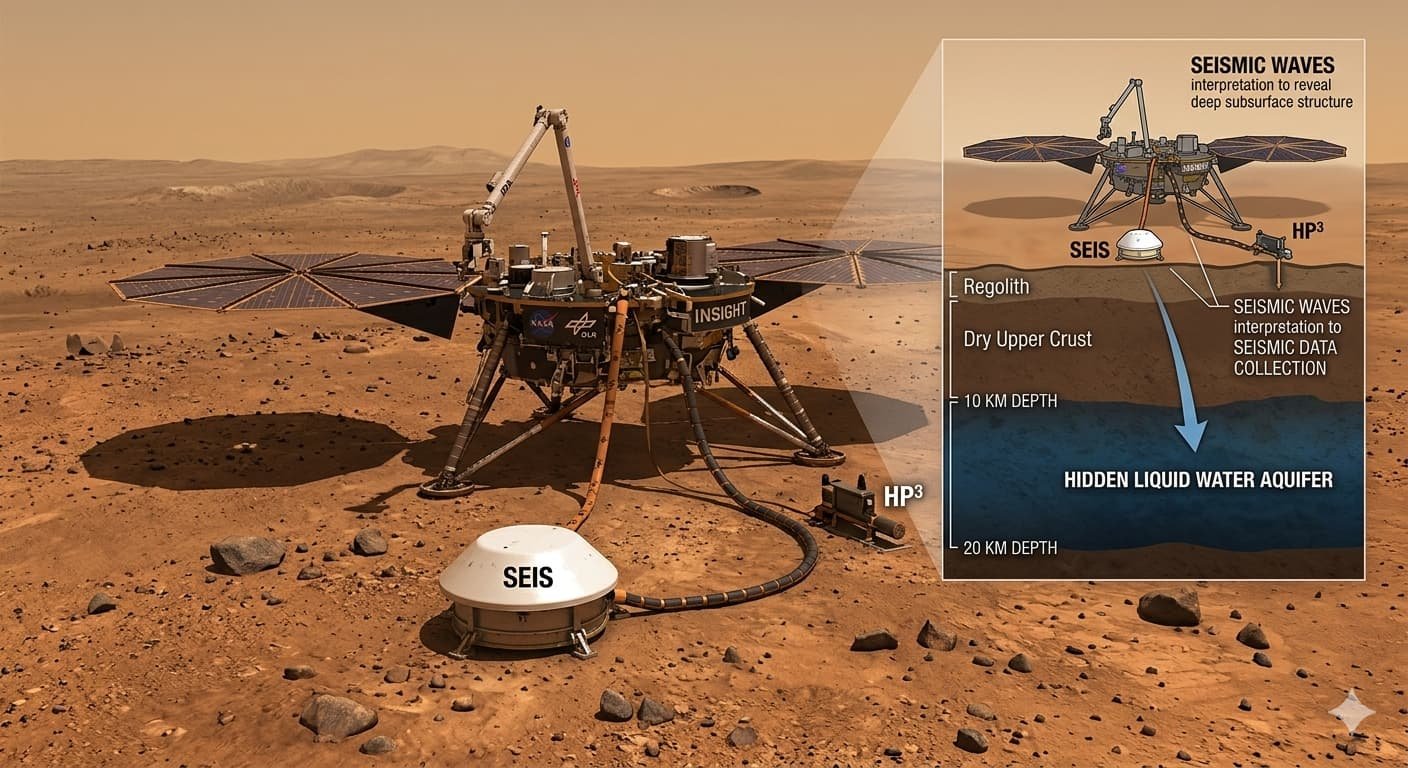
The discovery, detailed in a study published this week in the journal Nature Geoscience, analyzed seismic data collected by NASA’s InSight lander during its four years of operation on the Martian surface. By studying how seismic waves — the same kind generated by earthquakes — travel through Mars’s interior, researchers at the University of California San Diego identified a previously undetected layer of liquid water sitting between 10 and 20 kilometers below the planet’s surface. The water is believed to be held within fractured and porous rock in a zone that planetary scientists call the deep crust.
Why This Changes Everything
The Mars that most people picture — the one in textbook illustrations and science fiction films — is a dead world. Cold, barren, airless, inhospitable. That picture has been eroding for years as evidence mounted of ancient riverbeds, dried lake basins, and polar ice caps. Saturday’s discovery doesn’t just add a footnote to that picture. It tears it up.
Liquid water is the single non-negotiable requirement for life as we understand it. Every organism on Earth — from the deepest ocean bacteria to the extremophiles living in Antarctic ice — requires liquid water to survive. The discovery of a liquid water layer beneath Mars suggests the planet may not be as dead as it appears. It also suggests that the water Mars lost from its surface billions of years ago didn’t simply vanish into space. Some of it went underground.
The quantity involved is significant. Researchers estimate the volume of water locked in the Martian deep crust could be enough to cover the entire planet’s surface to a depth of between one and two kilometers — comparable in scale to Earth’s own deep groundwater systems. It would make Mars the most water-rich rocky planet in the solar system after Earth.
How the InSight Lander Made It Possible
The InSight lander touched down on Mars in November 2018 with one primary instrument that set it apart from every Mars mission before it: a seismometer sensitive enough to detect the faint vibrations of marsquakes. NASA’s lander operated until December 2022, when dust accumulation on its solar panels finally cut its power supply. In four years of operation, InSight detected more than 1,300 marsquakes — providing scientists with an unprecedented dataset of the planet’s internal structure.
The water detection came from analyzing seismic wave velocities at different depths. When seismic waves pass through rock saturated with liquid water, they travel at a measurably different speed than they do through dry rock or ice. The signature the UC San Diego team identified between 10 and 20 kilometers depth is consistent with — and the researchers argue, best explained by — liquid water saturating a layer of fractured rock in the deep crust.
The finding builds on two earlier, more tentative discoveries. European Space Agency radar data from the Mars Express orbiter had previously suggested the possible presence of liquid water beneath the Martian south polar ice cap. Saturday’s Nature Geoscience paper extends that possibility from a single polar location to the planet’s broader subsurface — suggesting deep water may be a global feature of Mars rather than a regional anomaly.
What Comes Next
The discovery immediately sharpens the scientific case for a specific type of Mars mission that NASA has been debating for years: a deep drilling mission capable of reaching the Martian subsurface at depths well beyond anything attempted before. Current Mars rovers operate on the surface. The Phoenix lander dug a few centimeters into Martian soil in 2008. Reaching the water layer identified in Saturday’s study would require drilling through 10 kilometers of rock — a technological challenge that does not yet have a solution but now has an urgent reason to find one.
The question that has driven Mars exploration since the first orbiters spotted ancient riverbeds in the 1970s has always been: was there ever life on Mars? Saturday’s discovery reframes that question in a way that makes it more urgent, more specific, and more answerable than it has ever been before. The question now is not just whether Mars once had the conditions for life. It’s whether those conditions still exist, right now, 10 kilometers below the surface.
The universe just got a little less lonely.