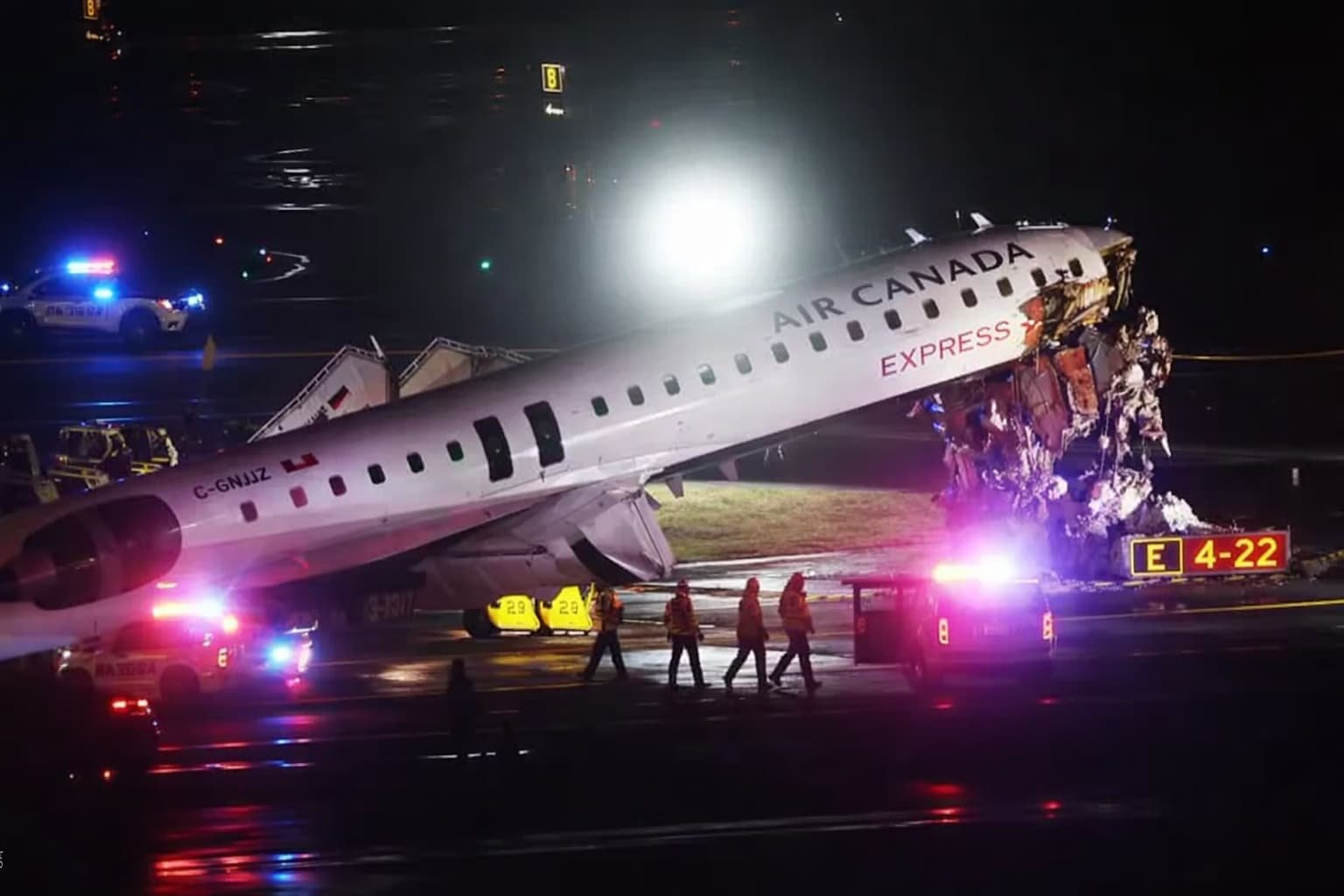

NEW YORK, MARCH 23, 2026 — Two pilots were killed and 41 people were hospitalized after an Air Canada Express regional jet struck a Port Authority fire truck on a runway at LaGuardia Airport late Sunday night — shutting down one of America’s busiest airports on one of its busiest travel days of the year and raising urgent new questions about runway safety at a moment when American aviation is already under intense scrutiny.
The collision occurred at 11:40 PM ET on Sunday as Jazz Aviation Flight AC8646 — a Bombardier CRJ-900 carrying 72 passengers and four crew members — was landing on Runway 4 after arriving from Montreal. A Port Authority Aircraft Rescue and Firefighting vehicle had been cleared by air traffic control to cross the runway at Taxiway Delta while responding to a separate incident on the other side of the airport. The plane and the truck met in the dark.
“Sadly, the two pilots are confirmed deceased and notifications are being made by Air Canada’s care team at this time,” Port Authority Executive Director Kathryn Garcia told reporters early Monday morning. The pilots — a captain and first officer both based in Canada — were not yet identified by name pending notification of their families.
What Happened — The Final Seconds
Air traffic control audio recordings, reviewed by multiple news organizations, capture the sequence of events with brutal clarity.
United Airlines Flight 2384 had aborted its takeoff earlier in the evening after an anti-ice warning light activated. The pilots reported a chemical odor in the cabin and said flight attendants had become ill. They declared an emergency and requested firefighting assistance.
A Port Authority fire truck — the same vehicle that would be involved in the collision moments later — was dispatched to respond. Air traffic control cleared the truck to cross Runway 4 at Taxiway Delta. Jazz Flight AC8646 was on final approach, descending toward the same runway.
Seconds later, the audio recording captures what went wrong.
“Stop, Truck 1. Stop.” The controller’s voice is urgent. Then, in the same transmission: “JAZZ 646, I see you collided with the vehicle.”
The plane was traveling at approximately 130 miles per hour when it struck the fire truck. The collision demolished the nose of the CRJ-900, crushing the cockpit where the pilots were seated. Video footage from the scene showed the aircraft sitting on the runway with the underside of its forward fuselage completely destroyed. The fire truck was knocked on its side.
LaGuardia Crash — Key Facts
| Detail | Information |
|---|---|
| Flight | Air Canada Express AC8646 — Jazz Aviation |
| Aircraft | Bombardier CRJ-900 |
| Route | Montreal → New York LaGuardia |
| Collision time | 11:40 PM ET, Sunday March 22 |
| Runway | Runway 4, Taxiway Delta |
| Pilots killed | Captain and First Officer — both Canadian |
| Passengers/crew on board | 72 passengers, 4 crew |
| Hospitalized | 41 people |
| Released from hospital | 32 as of Monday morning |
| Seriously injured | Several — exact number not confirmed |
| Airport status | Closed — reopen no earlier than 2:00 PM ET Monday |
| Investigating agencies | NTSB, FAA, Port Authority Police |
200 Flights Cancelled. Passengers Stranded.
LaGuardia — the 19th busiest airport in the United States — was immediately closed following the collision. As of early Monday morning, more than 200 flights had been cancelled and hundreds more were delayed system-wide as airlines scrambled to reroute passengers. The airport said it would remain closed until at least 2:00 PM ET Monday — with the possibility of an extended closure depending on how long investigators need to process the scene.
The timing could not be worse. LaGuardia is in the middle of one of the busiest spring break travel periods of the year — with millions of Americans moving through the nation’s airports while TSA staffing shortages caused by the DHS partial government shutdown have already pushed security wait times to two to three hours at major hubs. The LaGuardia closure will cascade disruptions far beyond New York throughout Monday.
New York Governor Kathy Hochul called the crash “heartbreaking” and said state officials were working with federal investigators. “All of New York is grieving with the families of the two pilots who lost their lives,” Hochul said.
The NTSB Is Already Asking the Same Question Everyone Else Is
The National Transportation Safety Board dispatched a go-team to LaGuardia within hours of the collision, with the first investigators arriving at the airport before dawn Monday. The agency said it was focusing immediately on two questions.
First: what was the communication breakdown that allowed the fire truck to be on the runway while an arriving aircraft was cleared to land on it? The air traffic control audio suggests the controller attempted to stop the truck — but the warning came seconds too late.
Second: was the air traffic controller working alone in the tower at the time of the collision? Aviation experts told reporters that a single controller managing multiple simultaneous emergencies — the United flight declaring an emergency, the fire truck crossing the runway, and the Air Canada jet on final approach — would face an extraordinarily difficult task. Whether that was the situation on Sunday night is one of the first things investigators will determine.
The crash is the second major aviation fatality event in the United States in 14 months — coming just over a year after the 67 people killed in the Reagan National Airport midair collision of January 2025. That crash prompted the FAA to fundamentally overhaul helicopter separation rules at major airports last week. Whether Sunday night’s collision at LaGuardia triggers a similar review of ground vehicle runway crossing procedures is a question that will be central to the NTSB’s investigation.
Aviation is supposed to be the safest form of transportation. Two fatal accidents in 14 months at two of America’s most prominent airports is a pattern that nobody in the industry — or in Congress — can afford to ignore.