
By Harshit, GAZA CITY, Nov. 13, 2025 — 11:24 a.m. GMT
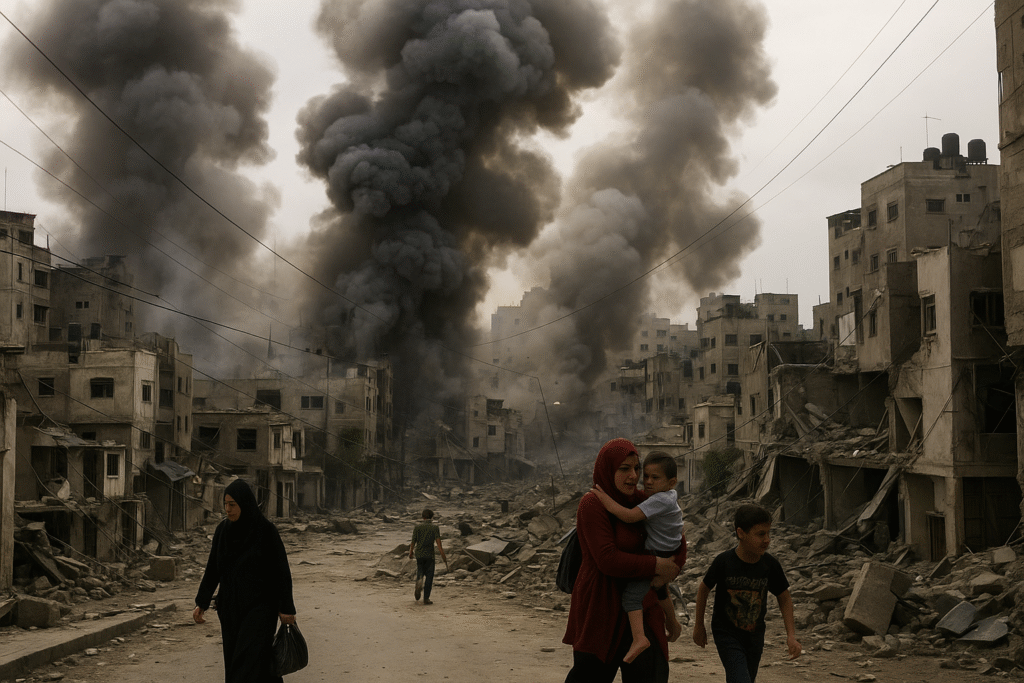
Israeli air raids and artillery shelling have once again struck several parts of the Gaza Strip, including the northern city of Beit Lahiya, eastern Gaza City, and the southern hub of Khan Younis, according to Al Jazeera Arabic correspondents on the ground.
The renewed escalation comes despite a fragile ceasefire that technically came into force on October 10 under U.S.-brokered mediation.
The Gaza Health Ministry reported on Thursday that Israel has killed at least 260 Palestinians and injured 632 since the ceasefire began. Additionally, 533 bodies have been recovered from rubble left by previous bombings, bringing the total death toll since October 7, 2023, to 69,187, with over 170,700 wounded.
Humanitarian officials warn that the situation in Gaza — already devastated by months of bombardment, displacement, and blockade — is deteriorating further as winter sets in.
Northern and Southern Gaza Hit Hard
Residents of Beit Lahiya described the overnight bombardment as one of the heaviest in weeks. Entire residential blocks were reduced to rubble, with firefighters and rescue teams struggling to reach survivors due to fuel shortages and blocked roads.
In eastern Gaza City, artillery fire continued through the early morning hours, while in Khan Younis, local officials said Israeli tanks had fired shells toward civilian areas on the eastern edge of the city.
“There was no warning,” said Khalil Hamad, a resident of Khan Younis. “They say there is a ceasefire, but every few nights, we hear explosions. We are living in fear again.”
Hospitals Struggling, Pharmacies Empty
Hani Mahmoud, reporting from Gaza City, said that hospitals are operating with minimal supplies and near-empty pharmacies.
“Four land crossings in Gaza remain mostly shut,” he said. “Only two are partially operational, allowing a trickle of commercial trucks through. Medical aid is almost nonexistent — you can find cans of soda, but not a single antibiotic.”
Clean water remains scarce. Many residents rely on contaminated wells or trucked-in water of dubious quality.
“The type of food entering Gaza is not what people need,” Mahmoud added. “There are no protein-rich foods or vitamins — just canned goods and junk items. Malnutrition is visible everywhere.”
Cold, Disease, and Shelter Crisis
With temperatures dropping across the coastal enclave, makeshift shelters are proving inadequate.
Tens of thousands of displaced people are living in flimsy tents made of salvaged materials, often without blankets or heating.
“It’s getting cold, and heavy rains are coming soon,” Mahmoud reported. “People have no protection — no proper tents, no fuel. Hospitals are also bracing for waves of infections due to overcrowding and unsanitary conditions.”
The Israeli blockade has banned the entry of prefabricated homes and high-quality tents, leaving humanitarian agencies scrambling for alternatives.
Environmental Devastation: 90% of Gaza’s Vegetation Destroyed
The mayor of Khan Younis, Alaa al-Batta, said Israeli operations have destroyed 90 percent of Gaza’s vegetation, crippling agriculture and waste management.
“We’re facing a catastrophe,” he said. “Without vegetation or waste disposal access, diseases and epidemics are spreading rapidly.”
Satellite images confirm widespread damage to farmland, greenhouses, and irrigation systems across the Strip.
International Reaction: Turkey Seeks Ceasefire Guarantees
In Ankara, Turkey’s Defense Ministry called for robust guarantees to ensure the ceasefire’s durability through an International Stabilisation Force (ISF) — part of President Trump’s ceasefire plan for Gaza.
“The ISF must guarantee that the ceasefire holds and that humanitarian aid reaches Gaza freely,” the ministry said.
The force, which Washington hopes to deploy under a proposed UN mandate, would work to demilitarize Gaza, secure borders, and train a new Palestinian police force.
However, several nations have expressed reluctance to join without stronger assurances of neutrality and safety for their troops.
Violence Spreads in the West Bank
In the occupied West Bank, tensions remain high as Israeli settlers continue attacking Palestinian villages.
According to U.S. Secretary of State Marco Rubio, unchecked violence in the West Bank risks “jeopardizing the fragile Gaza ceasefire.”
“We are concerned that events in the West Bank could have repercussions that undermine stability,” Rubio told reporters.
Earlier this week, dozens of masked settlers launched arson attacks in Tulkarem, destroying industrial facilities and injuring several people. Israeli army chief Eyal Zamir and President Isaac Herzog both condemned the violence, pledging to take legal action against perpetrators.
Human rights groups, however, accuse the Israeli government of fostering a “permissive environment” that enables settler attacks.
UN Report: Humanitarian Crisis Deepens in West Bank
The United Nations Office for the Coordination of Humanitarian Affairs (OCHA) released new statistics detailing the worsening humanitarian situation across the West Bank:
- 1,500 Palestinians displaced this year due to home demolitions for lacking building permits, including 500 in East Jerusalem.
- 1,460 structures destroyed or damaged in Jenin, Nur Shams, and Tulkarem refugee camps.
- 167 settler attacks recorded since October 1, targeting 87 Palestinian communities.
- 45 Palestinian children killed by Israeli forces in 2025 — accounting for 23% of all Palestinian fatalities in the West Bank this year.
- 31,919 refugees displaced from northern West Bank camps — the largest displacement since 1967.
Humanitarian Voices: “The Ceasefire Exists Only on Paper”
Despite the official truce, Gazans say daily life remains perilous. With aid convoys stalled, food and medicine running out, and temperatures dropping, many describe the ceasefire as “a pause in name only.”
“The ceasefire exists only on paper,” said Nour al-Khalidi, a displaced teacher sheltering near Deir al-Balah. “Bombs still fall at night, and children still cry themselves to sleep hungry.”