Iran Rejects “Surrender” Claims as War With U.S. and Israel Enters Second Week
By Harshit
TEHRAN/WASHINGTON, March 7, 2026 —
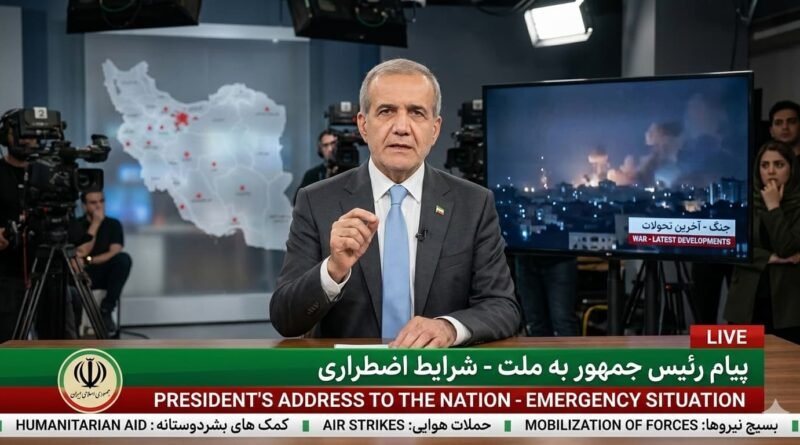
Iran’s President Masoud Pezeshkian declared that Iran will “never capitulate” as the war involving Iran, the United States, and Israel entered its second week, while U.S. President Donald Trump threatened new and potentially devastating strikes against Iranian targets.
The escalating conflict continues to spread across the Middle East, with missile and drone attacks targeting Israel and several Gulf countries, raising fears of a prolonged regional war.
Iran Says It Will Not Target Neighboring Countries
In a prerecorded message released Saturday, President Pezeshkian said Iran’s interim leadership council had approved a policy change under which neighboring countries will no longer be targeted, unless attacks against Iran originate from their territory.
Pezeshkian also issued an apology to regional countries that were struck by Iranian missiles or drones earlier in the conflict.
“Iran respects the sovereignty of neighboring states,” he said, adding that Tehran’s military actions are aimed specifically at U.S. and Israeli forces involved in the war.
Shortly after the president’s remarks, Iran’s Islamic Revolutionary Guard Corps (IRGC) released a statement confirming that it respects the interests and sovereignty of neighboring countries.
However, the IRGC warned that all U.S. and Israeli military bases and assets across the region will remain primary targets if attacks on Iran continue.
Trump Claims Iran “Surrendered”
President Donald Trump responded quickly to Pezeshkian’s statement, claiming Iran had effectively surrendered to its regional neighbors.
In a message posted on his Truth Social platform, Trump argued that Iran had apologized and promised to stop attacking nearby countries because of what he described as relentless U.S. and Israeli military pressure.
Trump also warned that Iran could face even more severe military strikes.
“Iran will be hit very hard today,” he wrote, adding that new targets were under consideration.
He also suggested that areas and groups previously not considered targets could now face attacks due to what he described as Iran’s “bad behavior.”
Iranian analysts and officials rejected the interpretation, saying the policy shift was not a surrender but a reaffirmation of Iran’s existing strategy of targeting only U.S. and Israeli military assets.
Massive Drone and Missile Attacks Across the Region
The conflict has already resulted in significant military exchanges across multiple countries.
Authorities in the United Arab Emirates reported that 16 ballistic missiles and 121 drones were launched toward the country during the latest wave of attacks.
According to UAE officials:
- All missiles except one that fell into the sea were intercepted
- 119 drones were intercepted
- Two drones crashed inside UAE territory
Since the start of the war, UAE defense authorities say they have detected:
- 221 ballistic missiles, with 205 destroyed
- 1,305 drones, with 1,229 intercepted
- Eight cruise missiles, all intercepted
The attacks have resulted in three deaths and 112 injuries, many caused by falling debris from intercepted missiles and drones.
IRGC Launches New Wave of Attacks
Iran’s Revolutionary Guards announced the 25th wave of missile and drone attacks as part of its retaliation campaign.
Iranian state media said the operation included the use of hypersonic Fatah missiles and Emad ballistic missiles, targeting military installations connected to the United States and Israel.
Meanwhile, multiple explosions were reported in Tehran, with smoke seen rising from areas southeast of the capital following Israeli airstrikes.
Unconfirmed reports suggested a Revolutionary Guard base in Qarchak County may have been among the targets.
Hezbollah Expands Front on Israel
The conflict is also expanding along Israel’s northern border with Lebanon.
The Lebanese armed group Hezbollah issued a warning to residents of the Israeli city Kiryat Shmona, urging them to evacuate and move south.
At the same time, Israel’s military issued evacuation orders for several neighborhoods in the Lebanese coastal city of Tyre, warning that buildings linked to Hezbollah would soon be targeted.
Earlier Israeli airstrikes in Lebanon’s Bekaa Valley killed at least 26 people in the town of Nabi Chit, according to Lebanese state media.
Leadership Uncertainty in Iran
The war is unfolding during a sensitive political transition inside Iran following the death of Supreme Leader Ayatollah Ali Khamenei.
Senior clerics including Ayatollah Hossein Nouri Hamedani and Ayatollah Naser Makarem Shirazi have called for the rapid announcement of a new supreme leader, arguing that a clear leadership structure is essential during wartime.
Analysts say the absence of a supreme leader may be contributing to mixed signals coming from Iran’s political leadership and military institutions.
International Divisions Grow
The expanding conflict is also dividing Western governments.
Germany’s Vice Chancellor Lars Klingbeil said his country would not join the war, expressing doubts about the legality of the military campaign.
“This is not our war,” Klingbeil said in an interview, warning that the conflict risks pushing the world toward a system where international rules are ignored.
Meanwhile, international officials continue to warn that the conflict could destabilize the entire Middle East and disrupt global energy supplies.
War Shows No Signs of Slowing
On the ground in Iran, explosions and fighter jet activity continue to be reported across several cities as Israeli and U.S. airstrikes target military facilities.
Iranian officials have said the country is preparing for a long-term conflict, while the IRGC has pledged to continue launching waves of retaliatory attacks against Israeli and American targets.
With missile strikes, drone warfare, and air attacks now affecting several countries simultaneously, analysts warn the war could escalate into a broader regional confrontation if diplomatic efforts fail.