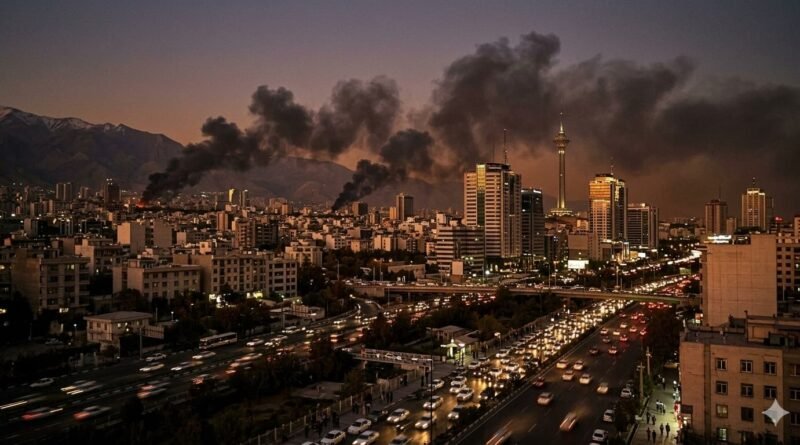
Iran Launches Missiles Toward Israel as Middle East War Escalates
By Harshit
JERUSALEM/TEHRAN, March 5, 2026 —
The rapidly expanding war between Iran, Israel, and the United States intensified on Thursday as the Israeli military confirmed that new missiles had been launched from Iran toward Israeli territory, triggering air-raid sirens and activating Israel’s missile defense systems across multiple cities.
According to the Israeli army, defensive systems were deployed to intercept the incoming projectiles shortly after the launches were detected. Explosions were reported in parts of central Israel as interception systems attempted to neutralize the missiles before impact. Early reports indicated that most of the missiles were intercepted, although authorities continued assessing possible damage.
The latest barrage marks another escalation in the conflict that began days earlier when the United States and Israel launched large-scale airstrikes across Iran targeting military infrastructure, missile sites, and security headquarters. The strikes have triggered widespread retaliation by Iran across the region and have drawn multiple countries into the growing crisis.
Iran Expands Retaliatory Attacks Across the Region
Iranian forces have expanded their response beyond Israel, targeting U.S. and allied military assets across the Middle East. Iranian military sources said drone strikes were launched against a base hosting U.S. troops in Erbil, Iraq, causing what officials described as “significant damage.”
Iran also reported attacks against U.S. forces stationed at Camp Arifjan in Kuwait, while Gulf nations such as Qatar and the United Arab Emirates reported intercepting incoming missiles and drones over their territory.
Qatar’s Defence Ministry said that air defense systems intercepted 14 ballistic missiles and four drones launched from Iran earlier in the day. Officials urged residents and visitors to remain calm and follow instructions from security authorities as the situation continues to evolve.
The attacks have created widespread alarm across the Gulf region, forcing several countries to raise security alerts and increase defensive deployments.
Strait of Hormuz Crisis Raises Global Oil Concerns
The strategic Strait of Hormuz — one of the world’s most critical shipping routes for oil — has emerged as a major flashpoint in the conflict.
Iran’s Islamic Revolutionary Guard Corps declared the waterway effectively closed during the war and warned that passing vessels could be targeted. The strait normally carries nearly 20 percent of the world’s oil trade, meaning any disruption could have severe consequences for global energy markets.
In response, the White House announced that the United States Navy may begin escorting commercial tankers through the strait if necessary to ensure the flow of oil shipments. U.S. officials also said crude oil carriers operating in the Gulf region would be eligible for political risk insurance through the United States Development Finance Corporation.
Energy analysts say prolonged disruptions in the region could push global oil prices significantly higher and trigger economic ripple effects worldwide.
United Kingdom Strengthens Military Presence
The United Kingdom also announced new military deployments in response to the escalating conflict.
Prime Minister Keir Starmer confirmed that Britain will send Wildcat helicopters equipped with anti-drone capabilities to Cyprus, where British forces maintain key military bases in the eastern Mediterranean.
Additionally, four Typhoon fighter jets have been deployed to Qatar to reinforce British defenses in the region. The Royal Navy destroyer HMS Dragon has also been sent to the eastern Mediterranean to support allied operations.
British officials emphasized that the deployments are intended for defensive purposes, including intercepting missile threats and protecting allied forces.
War Spreads to Lebanon and Beyond
The conflict is increasingly spilling over into neighboring countries. Israel has warned residents of Beirut’s southern suburbs to evacuate after launching airstrikes against Hezbollah positions in southern Lebanon.
At least eight people were reported killed in Israeli attacks across Lebanon on Thursday as clashes intensified along the border.
Meanwhile, tensions have also risen between Iran and Azerbaijan after drones struck the Azerbaijani exclave of Nakhchivan, injuring two people and damaging infrastructure near an airport and school. Azerbaijan accused Iran of carrying out the attack and demanded an apology, though Tehran has denied responsibility.
Rising Casualties and Global Alarm
The human toll of the conflict continues to grow. Reports indicate that more than 1,000 people have been killed in Iran since the U.S.-Israeli bombing campaign began, with thousands more injured and large sections of infrastructure damaged.
Hospitals, schools, and residential areas have been affected in several strikes, drawing condemnation from international organizations and calls for all parties to avoid attacks on civilian infrastructure.
Meanwhile, Israeli authorities have mobilized tens of thousands of reservists and deployed dozens of battalions across the country as the government prepares for the possibility of a prolonged war.
A Region on the Brink
Analysts say the conflict now risks turning into a multi-front regional war involving several countries and armed groups across the Middle East.
Missile exchanges between Iran and Israel continue almost daily, while U.S. military forces remain directly involved in operations against Iranian targets. The growing involvement of Hezbollah, Gulf states, and NATO-aligned forces has raised fears that the crisis could expand further.
With no immediate signs of diplomacy or ceasefire negotiations, the region faces one of its most dangerous military confrontations in decades.