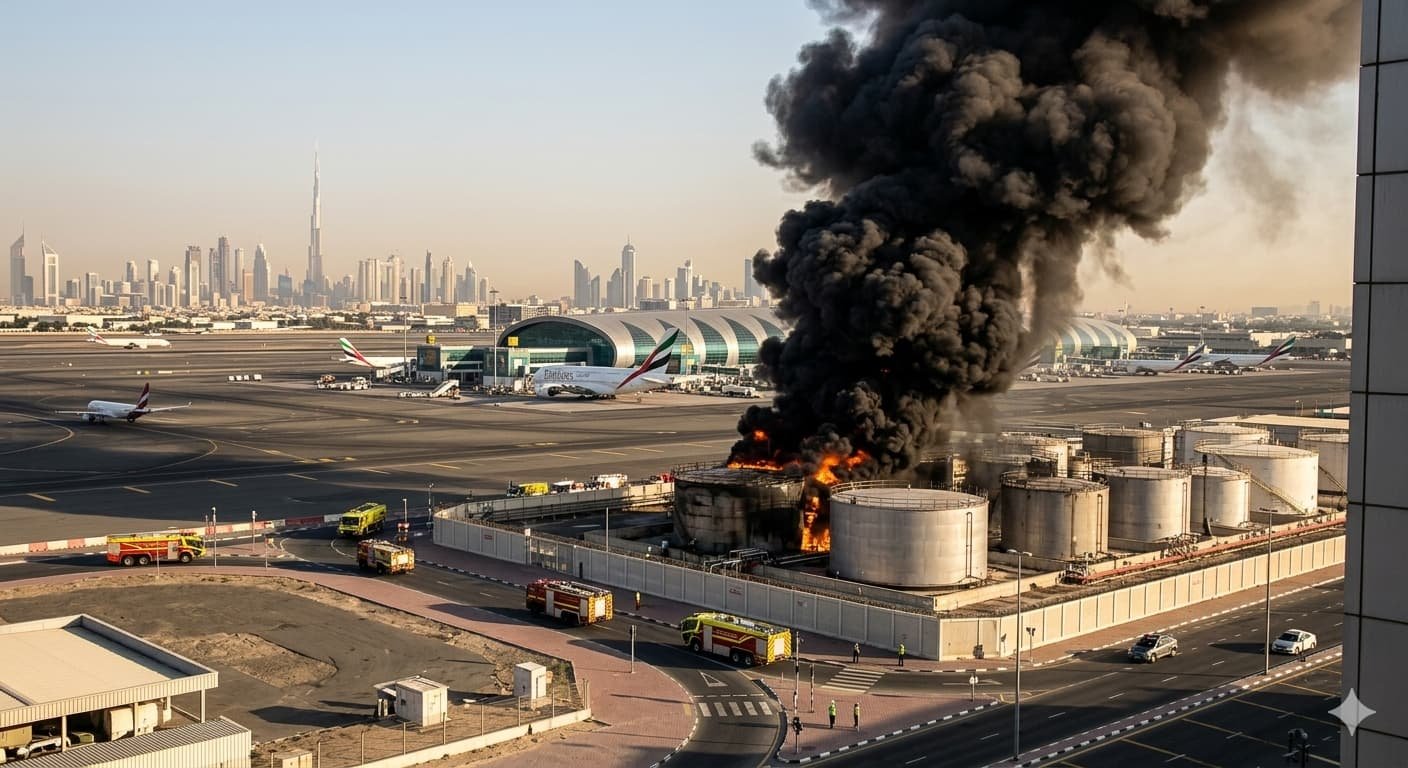

DUBAI, MARCH 17, 2026 — The war that has already closed the Strait of Hormuz, killed 13 Americans, and sent oil past $100 a barrel reached one of the world’s most traveled crossroads on Monday. An Iranian drone struck a fuel tank at Dubai International Airport, igniting a fire that sent a thick column of black smoke rising over one of the most recognizable skylines on earth — and forced one of the globe’s most critical aviation hubs to suspend flights for hours.
The attack marked a stark escalation in Iran’s campaign against Gulf infrastructure. For the first time since Operation Epic Fury began 17 days ago, Tehran had struck not a military base, not an oil facility, not a government compound — but the airport through which 90 million passengers pass every year, including hundreds of thousands of Americans.
What Happened
The drone struck a fuel storage tank near Dubai International Airport’s perimeter early Monday morning local time, UAE authorities confirmed. Witnesses reported seeing a thick plume of black smoke rising from the direction of the airport shortly after 10:00 AM local time. Emirates airline — the world’s largest long-haul carrier and Dubai’s primary aviation anchor — initially suspended all flights before announcing a partial resumption hours later, with several planned routes cancelled for the remainder of the day.
Passengers inside the terminal were evacuated to lower floors as a precaution. Flight tracking data showed dozens of aircraft holding in patterns over the Gulf, waiting for clearance to land. The UAE Defense Ministry confirmed its forces were simultaneously working to intercept a separate wave of Iranian missiles and drones targeting the country.
The damage to the airport itself was limited — a fuel tank fire, extinguished by emergency crews within hours, with no runway or terminal structural damage reported. The disruption, however, was immediate and global. Dubai International sits at the center of one of the world’s most traveled aviation networks, connecting Europe, Asia, Africa, and the Americas. When it stops, the entire global aviation system feels it.
A Gulf Under Siege
Monday’s Dubai strike was part of the most intense single day of Iranian attacks on Gulf nations since the war began. Saudi Arabia intercepted a wave of 35 Iranian drones launched at its eastern region — home to the oil installations that power the kingdom’s economy. Qatar’s Defense Ministry said it successfully intercepted a second wave of missile attacks. A Palestinian civilian was killed on the outskirts of Abu Dhabi when a missile struck a vehicle.
A drone also struck the Al-Rasheed Hotel in Baghdad’s heavily fortified Green Zone — the same compound that houses government offices and diplomatic missions including the U.S. Embassy. Iraq’s Ministry of Interior confirmed a drone hit the hotel’s upper fence but said there were no casualties or significant structural damage.
886 people have now been killed in Lebanon since Israel began striking the country on March 2. Of those, 111 were children.
Trump Delays China Visit, Calls Market Pain “Small Price”
President Trump spent Monday managing the war’s expanding diplomatic and economic fallout. He announced he had requested to delay a planned late-March trip to China, saying he felt he needed to remain in Washington as the conflict intensified. He told reporters he had been speaking with Chinese President Xi Jinping and looked forward to visiting — just not right now.
On the economy, Trump showed little concern. Told that the stock market had fallen sharply since the war began, he called it a very small price to pay compared to the alternative — and predicted oil prices would drop like a rock the moment the war ended. He also called on NATO and China to help secure the Strait of Hormuz, criticism of what he described as allies who had rebuffed his demands for assistance. The European Union’s foreign ministers decided this week against expanding their naval operations around the strait, a decision the White House received with open frustration.
One Tanker Got Through
In the otherwise paralyzed Strait of Hormuz, one small but significant development emerged Monday. Ship tracking data confirmed that an Aframax tanker named the Karachi — carrying Abu Dhabi’s Das crude oil — became the first non-Iranian cargo vessel to transit the strait while broadcasting its AIS tracking signal since the war began. It was a single ship. Dozens of others remained anchored and waiting on both sides of the chokepoint.
But one tanker getting through, on the record, with its tracking signal on, was not nothing. It suggested that select shipments might be negotiating safe passage — quietly, carefully, and without any public announcement. Whether that represents the beginning of a diplomatic breakthrough or simply a one-off exception remains to be seen.
For now, the Strait of Hormuz remains effectively closed. Dubai’s airport is operating at reduced capacity. Oil is above $100. And the war that was supposed to end soon is entering its third week with no sign of stopping.