
By Harshit | Oct. 29, 2025 | Santiago, Chile | 1:30 EDT
Nickel Found Where Metal Shouldn’t Vaporize
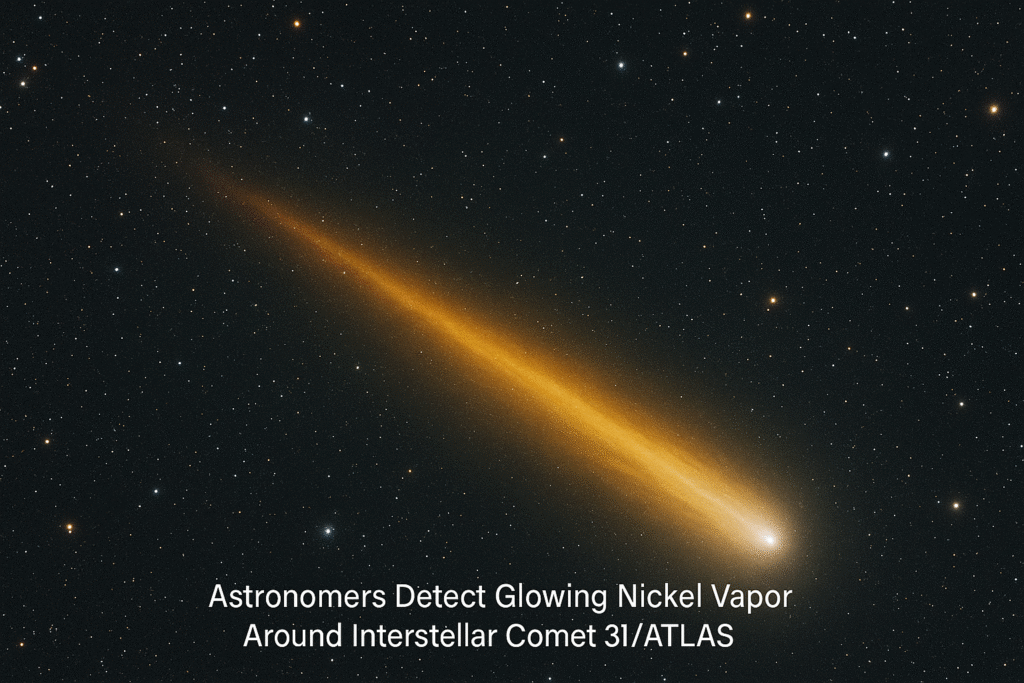
In a remarkable discovery, astronomers have detected glowing nickel vapor in the gas cloud surrounding the interstellar comet 3I/ATLAS — at a distance far too cold for metal to turn into gas. This finding, announced by an international research team using the Very Large Telescope (VLT) in Chile, challenges our current understanding of cometary chemistry and may offer the most direct glimpse yet into material forged beyond our solar system.
The detection, made when 3I/ATLAS was still nearly four times farther from the Sun than Earth, suggests that exotic chemical reactions may be responsible for releasing nickel atoms from molecular carriers — a process never before observed so far from solar heat.
A Rare Visitor from Beyond the Solar System
The comet 3I/ATLAS was first spotted on July 1, 2025, by the Asteroid Terrestrial-impact Last Alert System (ATLAS) during a routine survey. It became only the third confirmed interstellar object ever discovered, following the enigmatic ‘Oumuamua and 2I/Borisov.
Unlike its predecessors, however, 3I/ATLAS was detected early enough in its journey to allow continuous observation as it approached the Sun — giving scientists an unprecedented window into how such ancient interstellar material awakens and evolves.
“Interstellar comets are time capsules,” said lead researcher Dr. Rahatgaonkar, part of the VLT observation team. “They preserve the chemical fingerprints of the star systems where they formed billions of years ago.”
From Dormant to Dynamic
Initial spectroscopic observations in July revealed faint but distinct nickel emission lines in the comet’s coma (the glowing gas cloud surrounding it). This discovery came when the comet was at 3.88 astronomical units (AU) from the Sun — a region where temperatures are far too low for metals to vaporize naturally.
Over the following weeks, astronomers saw the nickel signal strengthen dramatically as 3I/ATLAS drew closer to the Sun. By mid-August, when the comet reached 3.07 AU, scientists also detected cyanogen (CN) gas — a compound often seen in comets within our solar system — marking the first sign of conventional chemical activity.
“This was truly unexpected,” said Dr. Castilho, a senior member of the observing team. “At such distances, we don’t expect metals to turn into vapor. Something else — likely photochemical processes — must be releasing nickel from molecular carriers.”
The Mystery of Nickel Without Iron
What makes this finding even more puzzling is the absence of iron in the observed spectra. Normally, comets contain both nickel and iron in comparable quantities, so detecting one without the other suggests a unique chemical pathway at work.
Researchers hypothesize that nickel may be trapped inside volatile molecules, such as nickel–carbon monoxide complexes, which can break apart when exposed to sunlight. This process could release nickel atoms at temperatures hundreds of degrees lower than those needed for pure metal sublimation.
This theory aligns with recent James Webb Space Telescope (JWST) observations showing that 3I/ATLAS has an unusual composition rich in carbon dioxide and carbon monoxide, with relatively little water — indicating a chemistry unlike most solar system comets.
A Window Into Alien Chemistry
The combination of VLT and JWST data paints a vivid picture of an ancient, carbon-rich comet carrying materials that may have formed around a long-dead star system. Its chemistry suggests that not all planetary systems produce comets like ours — some may be shaped by entirely different temperature and pressure conditions during formation.
“The nickel vapor could be telling us about the molecular carriers that existed in a completely different stellar nursery,” said Dr. Rahatgaonkar. “It’s as if the comet is whispering secrets from another world.”
Preparing for Perihelion
As 3I/ATLAS races toward its closest approach to the Sun on October 29, astronomers expect even greater chemical activity. More gases — perhaps methanol, ammonia, or hydrocarbons — may soon emerge as the comet warms further.
The international team, comprising scientists from Chile, Belgium, the U.K., Canada, New Zealand, the U.S., and Italy, continues to monitor 3I/ATLAS through coordinated observations across multiple wavelengths.
“With every new measurement,” said Dr. Castilho, “we’re piecing together a cosmic puzzle that will help us understand whether the raw ingredients of planetary systems are universal — or unique to each corner of the galaxy.”
Cosmic Implications
If confirmed, these findings could reshape how astronomers view the chemical diversity of interstellar material and provide key evidence about the formation of exoplanetary systems. Each interstellar object that enters our solar system acts as a messenger from another star, carrying clues about how planets and comets form across the Milky Way.
The glowing nickel vapor of 3I/ATLAS may be one of the clearest such clues yet — proof that even the cold, dark regions of space can conceal unexpected chemistry waiting to be revealed.