
By Harshit
WASHINGTON, DECEMBER 10 —
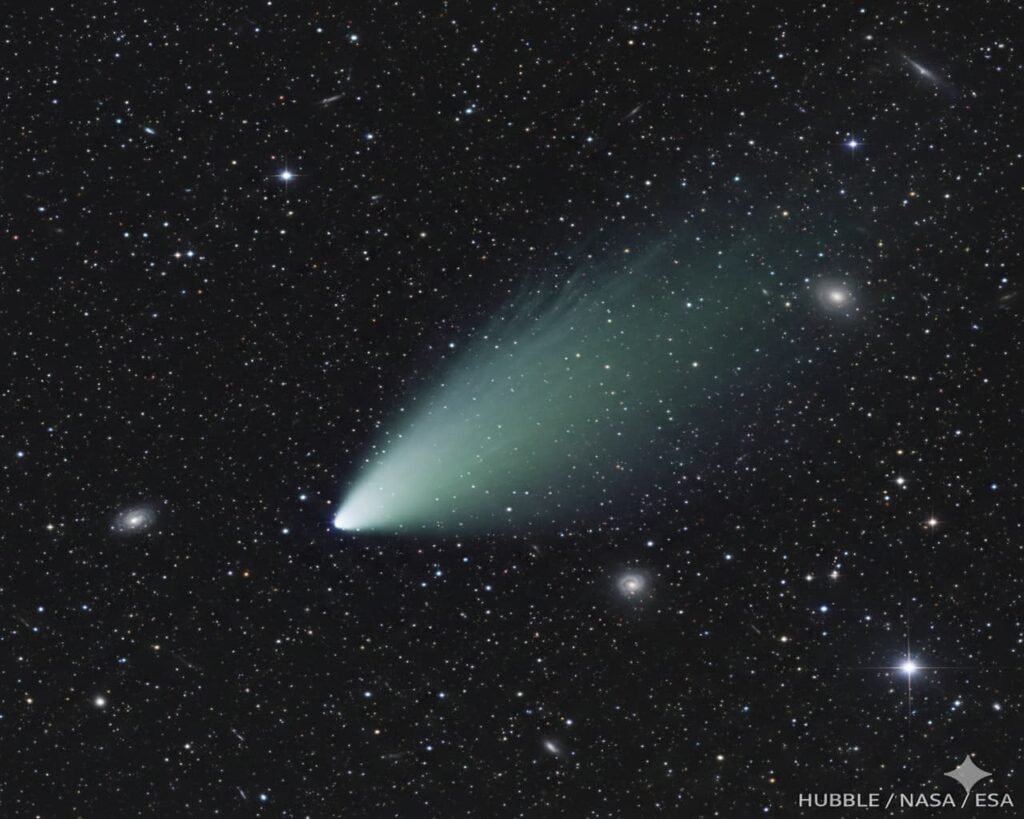
Astronomers have released striking new images of the interstellar comet 3I/ATLAS, offering the clearest look yet at one of the rarest cosmic visitors ever observed passing through the solar system. Observations from NASA’s Hubble Space Telescope and the European Space Agency’s Jupiter Icy Moons Explorer (Juice) mission reveal that the comet has developed two distinct tails as it approaches its closest point to Earth later this month.
The findings provide valuable insight into the structure and behavior of an object that originated beyond our solar system, making 3I/ATLAS only the third confirmed interstellar object ever detected after ‘Oumuamua in 2017 and 2I/Borisov in 2019.
A Rare Visitor From Beyond the Solar System
Comet 3I/ATLAS was first discovered in July 2025, already on a hyperbolic trajectory that confirmed it was not gravitationally bound to the Sun. Its unusually high speed and trajectory indicate it formed around another star before being ejected into interstellar space, eventually passing through Earth’s cosmic neighborhood by chance.
Because of its rarity, astronomers rapidly prioritized the comet for observation across multiple space- and ground-based instruments. Early observations suggested a diffuse, teardrop-shaped coma surrounding a solid icy nucleus, but recent imagery has revealed even more complexity.
Hubble Captures a Sharper View
The Hubble Space Telescope imaged 3I/ATLAS on November 30, when the comet was about 178 million miles (286 million kilometers) from Earth. Using its Wide Field Camera 3, Hubble detected a well-defined coma and a clearer outline of the comet’s dust environment than earlier observations taken in July.
These updated images show how solar heating has intensified activity around the comet since its closest pass by the Sun in October. As sunlight warms the nucleus, frozen gases sublimate directly into vapor, dragging dust away from the surface and forming visible structures.
ESA’s Juice Mission Spots Two Tails
Meanwhile, the European Space Agency’s Jupiter Icy Moons Explorer, currently en route to Jupiter, captured a unique view of the comet on November 2 from a distance of about 41 million miles (66 million kilometers).
Using its onboard Navigation Camera (NavCam) and several scientific instruments, Juice detected two distinct tails streaming from the comet:
- A plasma tail, made of electrically charged gas shaped by the solar wind
- A fainter dust tail, composed of solid particles released from the nucleus
This dual-tail structure is common among comets formed within our solar system, but observing it in an interstellar object helps confirm that similar physical processes operate across planetary systems.
Because Juice is currently using its main antenna as a heat shield while traveling near the Sun, only a portion of the data has been transmitted so far. The remaining high-resolution images and compositional measurements are expected to reach Earth between February 18 and 20, potentially revealing clues about the comet’s birthplace beyond the solar system.
No Threat to Earth
NASA emphasizes that comet 3I/ATLAS poses no danger to Earth. The comet will make its closest approach on December 19, passing within 167 million miles (270 million kilometers)—nearly twice the distance between Earth and the Sun—and will be positioned on the opposite side of the Sun at the time.
After several more months of observation, 3I/ATLAS will exit the solar system permanently, continuing its journey through interstellar space.
Why 3I/ATLAS Matters to Science
Studying interstellar comets offers a rare opportunity to examine material formed around other stars without leaving the solar system. The gases, dust, and isotopic signatures released by 3I/ATLAS can help scientists compare planetary formation processes across the galaxy and refine models of how stellar systems evolve.
As space telescopes grow more sensitive, astronomers expect detections of interstellar visitors to become more frequent. For now, 3I/ATLAS remains a reminder of how dynamic—and connected—the cosmos truly is.