
By Harshit
MOORESVILLE, Ind. — Nov. 23, 2025
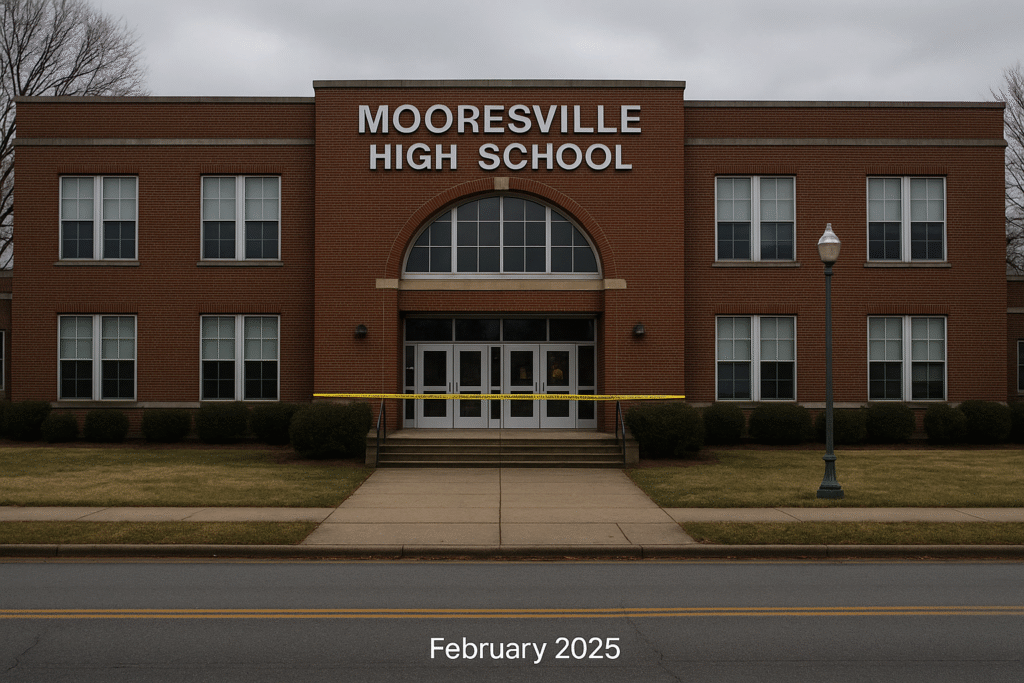
Mooresville High School had protocols, partnerships and mental-health systems in place — the same layers of protection that many American schools rely on to prevent violence. But nothing prepared the community for the shock of learning that an 18-year-old senior was accused of planning what investigators described as “Parkland part two.”
The student, now identified as 19-year-old Trinity “Jamie” Shockley, is expected to plead guilty Monday to conspiracy to commit murder in an Indiana courtroom. The case, unfolding in painful detail for the town of Mooresville, offers a rare look not at the aftermath of a school shooting, but at the aftermath of one that never happened — thanks to anonymous reporting, swift counseling intervention and rapid law-enforcement coordination.
A Community Confronts a Narrow Escape
“Our reaction was one of shock,” said Matt Saner, president of the Mooresville Schools board of trustees. “These aren’t nameless students. These are our neighbors. Our friends. Our family. Our own kids.”
Shockley’s arrest in February 2025 stemmed from two separate warning signs that surfaced within hours: an anonymous tip to the Sandy Hook tip line and a disturbing conversation with a school counselor.
The tipster reported that Shockley had access to an AR-15 rifle, had ordered a bulletproof vest, and had expressed admiration for the Parkland shooter, Nikolas Cruz. In Discord messages later traced by the FBI, Shockley allegedly wrote, “Parkland part two. I’ve been planning this for a YEAR.”
That same day, Shockley requested to speak with a counselor and, according to an affidavit, described an obsession and sexual attraction to Cruz, even wearing a locket with his photo. The counselor immediately notified administrators, triggering a threat-assessment plan.
Arrest at the Student’s Home
The next day, a SWAT team surrounded Shockley’s home and took the student into custody. Police found additional materials in Shockley’s bedroom related to mass shooters, according to the affidavit.
Shockley told investigators the student had suffered a “breakdown” following the recent death of Shockley’s mother and admitted to extensive interest in school shootings. The affidavit also notes that Shockley is transgender and goes by the name Jamie.
A plea agreement now calls for a 20-year sentence, with 12.5 years in custody and the remainder suspended. It also prohibits Shockley from possessing firearms, entering school property, or consuming any material related to school shooters.
School Officials Say Protocols Worked
Mooresville administrators say the system functioned precisely as designed.
“The information the student shared with a counselor, along with the FBI tip, all surfaced within hours,” Saner said. “Our staff responded without hesitation … and our partnership with law enforcement made a tremendous difference.”
Principal Wes Upton credited the school’s standing relationships with local agencies and monthly joint meetings between administrators, police, fire, EMS, and mental-health providers.
“In February, our administrators and law enforcement worked together exactly as our safety protocols are designed to function,” Upton said.
Maintaining communication with anxious parents and students became a second immediate challenge. Officials described transparency as “critical” in sustaining trust.
Missed Opportunities for Mental Health Support
The case also highlighted a deeper issue: early access to mental-health care. School officials told investigators that Shockley had sought help as a freshman and expressed suicidal ideation. But, according to the affidavit, Shockley’s father refused to authorize treatment, saying he “did not believe in mental health treatment.”
“We wish we could have provided the student with the mental health support we recommended long before this incident,” Upton said. “Unfortunately, the school could not get parent permission. We will never know what those services could have changed.”
Shockley eventually enrolled for counseling at age 18, two weeks after becoming legally able to consent without a parent.
Lessons for Other Districts
Superintendent Jake Allen said the district immediately conducted a full debrief with police and other agencies to understand what worked and what didn’t.
“After going through something this serious … my biggest advice to other districts is to learn everything you can from the experience and share those lessons,” Allen said. “Take an honest, comprehensive look at what worked well and what did not.”
Saner said the near-tragedy revealed important insights into how multiple agencies coordinate across jurisdictions and how schools can responsibly share sensitive information with the public.
“Every event teaches you something,” he said. “The board fully supports ongoing efforts to strengthen threat prevention and keep our schools as safe as possible.”
Allen emphasized that the impact goes beyond protocols.
“The aftermath isn’t just about systems and procedures — it’s about people,” he said. “We were extremely fortunate to have avoided what could have been a devastating event.”