
By Harshit
KINGSTON, Jamaica — October 28, 2025
Jamaica is reeling under the devastating impact of Hurricane Melissa, the world’s strongest storm so far this year and possibly the most powerful ever recorded to strike the island. The Category 5 hurricane, packing sustained winds of 175 mph (282 km/h), has already claimed three lives in Jamaica and at least four more in Haiti and the Dominican Republic, as it barrels through the Caribbean with catastrophic force.
A Record-Breaking Monster Storm
According to the U.S. National Hurricane Center (NHC), Melissa is the most intense tropical system of 2025 in terms of wind speed and low central pressure. Experts say that if it maintains its current intensity, it could become the strongest hurricane to ever hit Jamaica since records began in 1851.
At 11:00 p.m. ET Monday (03:00 GMT Tuesday), the NHC placed the hurricane about 140 miles (240 km) southwest of Kingston, moving slowly north-northeast at just 2 mph (4 km/h). This sluggish pace, meteorologists warn, could result in prolonged rainfall, raising the threat of catastrophic flooding and deadly landslides across Jamaica’s mountainous interior and low-lying coastal areas.
The NHC’s advisory described conditions as “catastrophic and life-threatening”, warning that “total structural failure is likely” within the storm’s eyewall — the most intense part of the system surrounding the calm eye.
Jamaica Under Siege
Even before the hurricane’s eyewall reached land, the island was already being battered by torrential rains and violent winds. Jamaica’s Ministry of Health and Wellness confirmed three storm-related deaths late Monday evening.
Prime Minister Andrew Holness ordered immediate evacuations in several flood-prone communities, especially in and around Kingston. “Every Jamaican must prepare and comply with evacuation orders,” Holness urged in a national address. “We will weather this storm and rebuild stronger.”
The government activated all 881 emergency shelters, and school buses were deployed to assist in transporting residents to safety. However, local reports indicate that many people in coastal and low-lying areas are reluctant to leave their homes out of fear of looting.
Citizens Brace for Impact
Residents across Jamaica shared harrowing experiences as the storm intensified.
Evadney Campbell, a Londoner visiting family on Jamaica’s north coast, told the BBC, “The house I’m in is hurricane-proof — built with steel and concrete — but I’m worried about people in the lowlands. Many refuse to leave because they fear their homes will be robbed.”
In the mountainous Hagley Gap area, teacher Damian Anderson reported that roads were already impassable: “We can’t move. We’re scared,” he told Reuters, describing scenes of chaos as trees and power lines fell.
NHC Director Michael Brennan cautioned residents to remain indoors, saying, “Do not venture outside. Catastrophic flash flooding and numerous landslides are expected through Tuesday.” He also warned against stepping out when the eye passes, reminding that the calm would be brief before destructive winds resumed.
‘A Catastrophic Event in the Making’
Meteorologists predict up to 40 inches (100 cm) of rain could fall in some parts of Jamaica over the next four days. Jamie Rhome, Deputy Director of the NHC, described the storm as a “catastrophic event in the making,” noting that the saturated soil from weeks of rain makes the risk of mudslides and flooding exponentially higher.
Jamaica’s Education Minister Dana Morris Dixon told BBC Newshour, “We’ve been having rain all of October, so the ground is already very saturated. We’re going to see extensive flooding and landslides in the mountainous areas. This is a storm the likes of which we’ve never seen.”
Regional Impact: Haiti, Dominican Republic, and Beyond
The storm’s deadly effects are being felt far beyond Jamaica. In Haiti, torrential rain caused severe flooding, killing at least three people and inundating hundreds of homes. Neighboring Dominican Republic reported one fatality — a 79-year-old man swept away by floodwaters in Santo Domingo — while a 13-year-old boy remains missing after being pulled out to sea by strong currents.
As Melissa churns northward, it is expected to impact Cuba later Tuesday night, followed by The Bahamas and Turks and Caicos on Wednesday. The NHC has issued hurricane warnings for all these regions.
A Failed Flight and a Fearful Night
A NOAA Hurricane Hunter aircraft — used to collect critical data from inside storms — was forced to abort its mission due to extreme turbulence inside Melissa’s outer bands, underlining the storm’s sheer intensity.
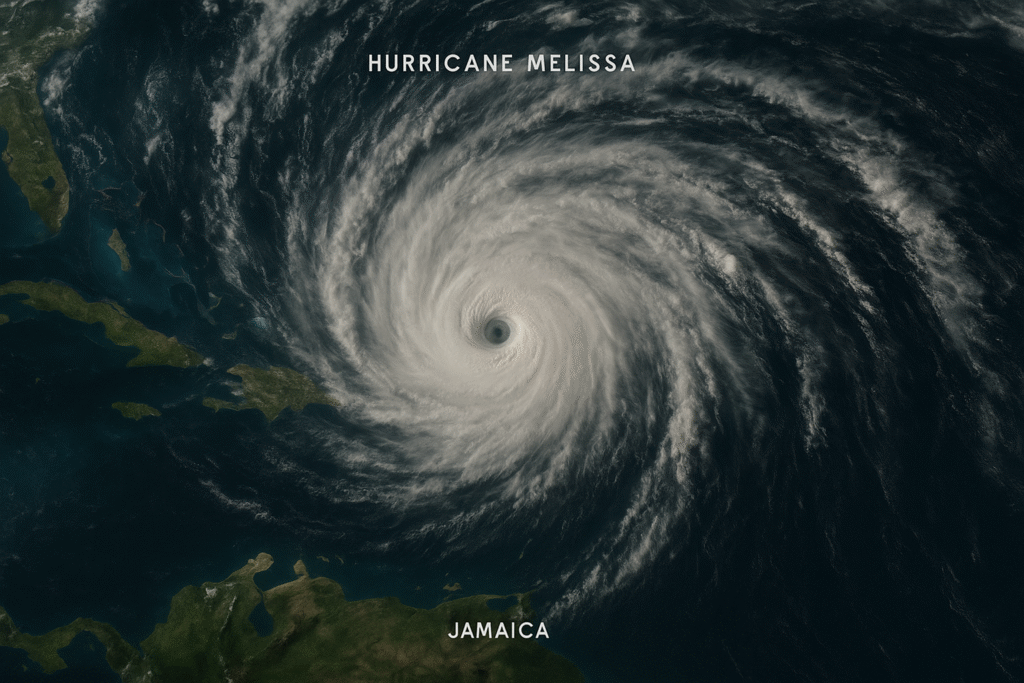
Satellite imagery shows Melissa’s swirling mass covering most of Jamaica, with dense, towering clouds and lightning flashing across its eyewall — a terrifying reminder of nature’s raw power.
‘You Have Been Warned’
Prime Minister Holness’s final words before the storm’s full arrival were direct: “You have been warned. It’s now up to you to make the right decision.”
With winds strong enough to tear roofs off homes, topple trees, and flatten structures, Jamaica braces for what could be its most devastating natural disaster in modern history.