
By Harshit, HAVANA, Oct. 29, 2025 — 1:30 AM EDT
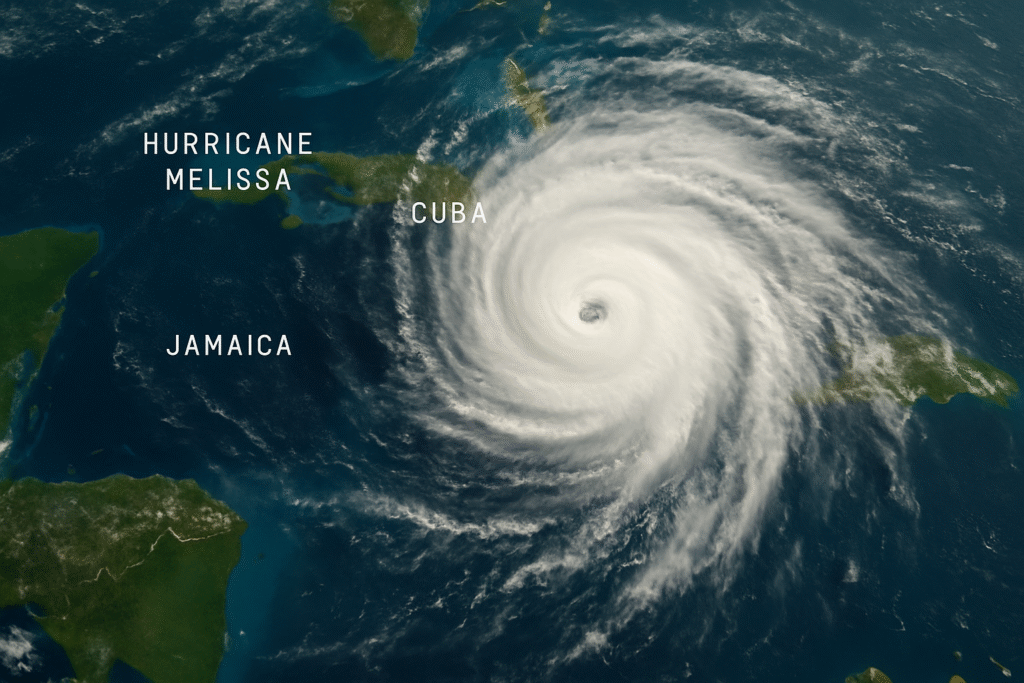
Hurricane Melissa, one of the most powerful storms ever recorded in the Caribbean, has re-strengthened to a Category 4 hurricane as it barrels toward eastern Cuba, bringing life-threatening winds, torrential rainfall, and storm surges expected to reach up to 12 feet (3.6 meters). The U.S. National Hurricane Center (NHC) late Monday night warned residents in Cuba’s eastern provinces to seek shelter immediately, describing the hurricane as an “extremely dangerous major storm” that will make landfall “within hours.”
Melissa’s Path of Destruction
Hurricane Melissa first made landfall in Jamaica on Tuesday as a record-breaking Category 5 storm, packing sustained winds of up to 185 mph (295 km/h) — the strongest ever recorded on the island since the NHC began tracking storms in 1851. The eye of the hurricane struck near Jamaica’s southwestern town of New Hope, leaving a trail of catastrophic damage across St. Elizabeth Parish, which officials said was “underwater.”
More than 500,000 residents were left without electricity, and Jamaica’s Prime Minister Andrew Holness confirmed that hospitals, homes, and public infrastructure had been heavily damaged. “The reports we have include severe damage to hospitals, residential property, and our road network,” Holness said in an interview with CNN, adding that recovery efforts will begin “as soon as it is safe to do so.”
The hurricane weakened briefly over Jamaica’s mountainous terrain but regained strength over the warm waters of the Caribbean Sea late Monday. As of the NHC’s 11 p.m. ET advisory, Melissa’s maximum sustained winds had increased to 145 mph (233 km/h), placing it firmly back in Category 4 status.
Cuba on High Alert
Cuban President Miguel Díaz-Canel issued a televised warning to the nation Monday evening, calling the situation “one of the most severe or possibly the strongest storms ever to hit national territory.” Dressed in an olive-green uniform, Díaz-Canel urged citizens to avoid rivers, remain in shelters, and not to return home until authorities declare it safe. “We are in for a very difficult night,” he said, confirming that 735,000 people had been evacuated from the eastern provinces, including Granma, Santiago de Cuba, Guantánamo, Holguín, and Las Tunas.
The NHC forecasted rainfall totals of up to 20 inches (51 cm) in parts of eastern Cuba, with widespread flooding and numerous landslides expected. “Numerous landslides are likely in those areas,” said Michael Brennan, director of the NHC.
The storm’s arrival comes at a perilous time for Cuba, which is already grappling with a severe economic crisis, power shortages, and fuel and food scarcity. Melissa’s destruction threatens to worsen these conditions and stretch the island’s limited emergency resources even further.
(Credit: FlynonymousWX)
Wider Caribbean Impact
While Cuba braces for impact, other regions across the Caribbean remain under threat. Hurricane warnings have been issued for the southeastern and central Bahamas, while Bermuda is under a hurricane watch. Tropical storm warnings are in effect for Jamaica, Haiti, Camagüey province in Cuba, and the Turks and Caicos Islands, according to the NHC.
The Jamaican government downgraded its hurricane warning to a tropical storm warning late Monday as Melissa moved away, though meteorologists cautioned that dangerous storm surges and flash floods could continue overnight. “As Melissa moves off the coast, its counterclockwise rotation will bring a heavy surge to northern Jamaica through the night,” said Rohan Brown of Jamaica’s Meteorological Service.
U.S. Response and Regional Cooperation
From aboard Air Force One en route from Japan to South Korea, U.S. President Donald Trump told reporters that Washington was prepared to aid Jamaica and other affected nations. “We’re watching it closely, and we’re prepared to move,” Trump said. “I’ve never seen that before — I guess it can get that high, but I’ve never seen it.”
Jamaica’s Prime Minister Holness also confirmed that he received a message from U.S. Secretary of State Marco Rubio, expressing America’s readiness to support relief efforts. “The U.S. and Jamaica have always been strong partners, and we’re confident that whatever assistance we deem necessary will be fulfilled,” Holness said in a televised statement.
Jamaica’s government launched an official relief coordination platform Monday night to mobilize support and manage recovery operations in the wake of Hurricane Melissa. Aid agencies, including the Red Cross and Caribbean Disaster Emergency Management Agency (CDEMA), are on standby to deploy once conditions improve.
Climate Connection and Scientific Concerns
Meteorologists and climate scientists have pointed to Melissa’s rapid intensification — strengthening from a tropical storm to a Category 5 hurricane in less than 36 hours — as another alarming example of how climate change is fueling more powerful and unpredictable storms.
“This extraordinary intensification is linked to record-warm ocean temperatures,” said Dr. Amanda Rinehart, a senior climate scientist at the National Oceanic and Atmospheric Administration (NOAA). “We’re seeing more storms like Melissa forming faster, becoming stronger, and causing greater devastation.”
Melissa marks the fourth Atlantic storm this year to undergo rapid intensification, a phenomenon directly tied to human-induced ocean warming. Experts warn that as global temperatures continue to rise, the Caribbean and Gulf of Mexico will likely face even more frequent and severe hurricanes.