
By Harshit
Washington, D.C. | November 16, 2025 | 1:10 AM EST
Every day, Earth is hit by a constant stream of particles and magnetic energy flowing from the Sun. Most of the time, this interaction is harmless. But when the Sun releases a burst of intense energy known as a solar storm, the effects can ripple across our planet — disrupting power grids, damaging satellites, interrupting GPS signals, and lighting up the sky with spectacular auroras.
Solar storms are becoming more frequent and stronger as the Sun approaches the peak of its current 11-year solar cycle. For millions of Americans who rely on stable electricity, communication systems, and navigation tools for daily life, understanding these storms has never been more important.
This simple guide explains what solar storms are, how they affect technology on Earth, and why scientists watch them closely.
What Is a Solar Storm?
A solar storm occurs when the Sun sends a burst of charged particles and magnetic energy into space. The three main types are:
1. Solar Flares
Explosions on the Sun’s surface that emit radiation and energy.
2. Coronal Mass Ejections (CMEs)
Huge clouds of plasma and magnetic fields released from the Sun’s atmosphere.
CMEs are the most dangerous for Earth.
3. High-Speed Solar Wind Streams
Faster-than-usual flows of solar particles coming from coronal holes.
When any of these events are directed toward Earth, they can trigger a geomagnetic storm — a disturbance in Earth’s magnetic field.
Earth’s Magnetic Shield: Our First Layer of Defense
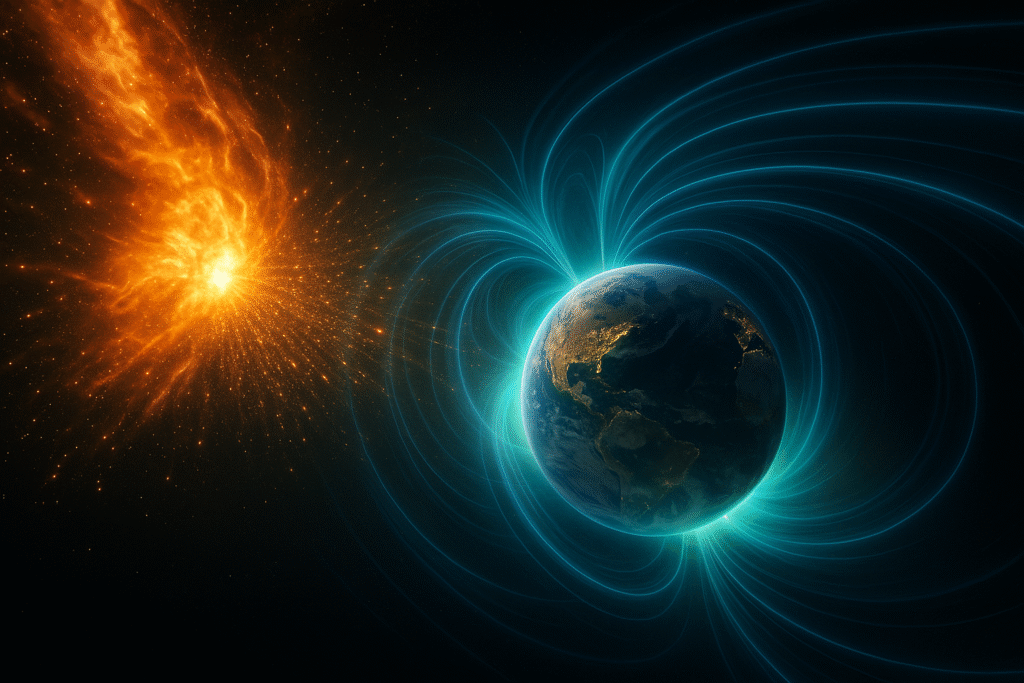
Earth is surrounded by a magnetosphere, a protective magnetic bubble that deflects most solar radiation. But during strong solar storms, the magnetosphere gets compressed and shaken.
This disturbance causes:
- auroras
- fluctuations in magnetic field strength
- electrical currents in the atmosphere
These magnetic shifts are what cause real-world issues — especially for power systems and satellites.
How Solar Storms Affect Power Grids
Power grids are one of the most vulnerable systems during a major solar storm.
1. Induced Electrical Currents
When Earth’s magnetic field fluctuates, it creates geomagnetically induced currents (GICs) that flow through power lines and transformers.
These currents can:
- overload transformers
- trip protection systems
- cause voltage instability
- lead to widespread power outages
The strongest solar storm ever recorded — the 1859 Carrington Event — caused telegraph wires to catch fire. If an event of similar strength happened today, it could cause massive blackouts lasting days to weeks.
2. Risk to High-Voltage Transformers
Large transformers in the U.S. power grid can overheat and become permanently damaged.
These transformers cannot be replaced quickly — some require months or even years to manufacture.
3. Increased Power Demand and Grid Stress
Strong geomagnetic storms can push grid operators to:
- reroute electricity
- temporarily shut down sections
- reduce power flows
The U.S. Federal Energy Regulatory Commission (FERC) and North American Electric Reliability Corporation (NERC) actively monitor space weather forecasts to keep the grid safe.
How Solar Storms Affect Satellites
Satellites orbit above much of Earth’s atmospheric protection, making them highly vulnerable.
1. Loss of GPS Accuracy
Geomagnetic storms can distort:
- GPS signals
- timing signals
- navigation systems
This affects:
- airlines
- shipping routes
- drivers using GPS
- financial networks that depend on precise timing
2. Communication Blackouts
Solar storms can disrupt:
- satellite phones
- internet services
- military communication systems
- high-frequency radio signals
Airplanes flying over the Arctic often reroute during strong storms to avoid radio outages.
3. Satellite Drag
During a storm, Earth’s upper atmosphere heats and expands.
This increases drag on low-Earth orbit satellites, causing them to slow down.
SpaceX famously lost 40 Starlink satellites in 2022 during a geomagnetic storm because they fell too low and burned up in the atmosphere.
4. Damage to Electronics
Charged particles can:
- fry satellite circuits
- damage solar panels
- reduce overall satellite lifespan
Agencies like NASA, NOAA, and the U.S. Space Force monitor solar activity to guide satellite operators during storm events.
How Solar Storms Affect Everyday Life
Solar storms may sound distant, but they influence everyday activities.
1. Airline Flights
Flights over polar regions may lose radio contact.
Pilots reroute through lower latitudes to stay connected.
2. Internet Reliability
While fiber-optic cables are safe, the repeaters that power long-distance internet lines can be affected.
3. Agriculture & GPS Farming
Modern farming uses GPS for:
- tractor navigation
- crop spraying
- soil mapping
Solar storms can disrupt this precision.
4. Emergency Services
Ambulances, firefighters, and police rely on communication systems that can be affected during a large storm.
Why Solar Storms Also Create Auroras
When solar particles collide with gases in Earth’s atmosphere, they create shimmering auroras in shades of green, red, and purple.
During strong storms, these lights can move far south into:
- New York
- Illinois
- Texas
- California
- Georgia
For many Americans, this is the most visible effect of space weather.
Can We Predict Solar Storms?
Partially — but not perfectly.
NASA and NOAA’s Space Weather Prediction Center (SWPC) track solar activity using satellites like:
- SOHO
- DSCOVR
- SDO
They issue:
- Kp index alerts
- geomagnetic storm warnings
- CME tracking updates
However, scientists say space-weather forecasting is still decades behind Earth weather forecasting.
The Bottom Line
Solar storms are a reminder of how closely Earth is connected to the Sun. While most storms are harmless, stronger ones can disrupt power grids, satellites, communication systems, and GPS networks that Americans rely on every day.
As the Sun approaches the peak of its solar cycle, these events may become more frequent — making monitoring and preparedness essential.