
By Harshit
NEW YORK, MARCH 12, 2026 — Every time you catch a cold, survive the flu, or shake off an infection in a few days, your immune system has just won a war you never even noticed was being fought. Here is exactly how it happens — and why, sometimes, it doesn’t.
Your Body’s First Line of Defense
Before a virus ever reaches your bloodstream, your body throws up a series of physical barriers. Skin acts as a waterproof shield. The mucous lining of your nose and throat traps invading particles. Tiny hair-like structures called cilia sweep those trapped particles upward, away from your lungs, to be coughed or blown out.
Most viruses never make it past this stage. The ones that do, however, face something far more sophisticated waiting on the other side.
The Innate Immune System — Your Rapid Response Force
The moment a virus breaches your body’s outer defenses, the innate immune system springs into action. This is the defense system you were born with — a fast, non-specific first responder that doesn’t need to identify a pathogen before attacking it.
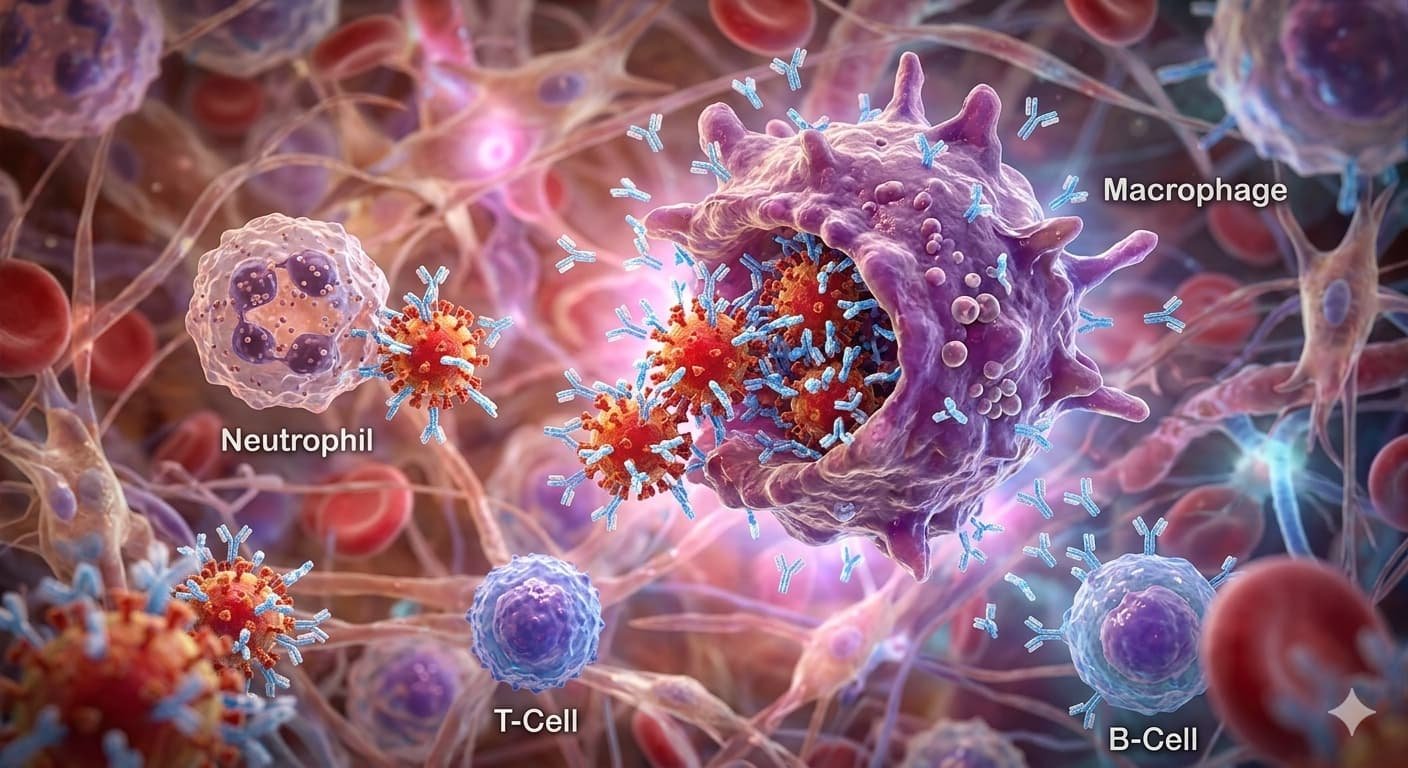
Natural killer cells and phagocytes — literally “eating cells” — rush to the site of infection. Phagocytes engulf and destroy invading virus particles. Natural killer cells hunt down and eliminate cells that have already been infected, cutting off the virus’s ability to replicate and spread.
At the same time, infected cells send out an emergency chemical signal in the form of proteins called interferons. Interferons don’t just fight the virus directly — they warn neighboring cells, triggering them to raise their defenses and become harder to infect. Think of it as a neighborhood alert system that goes off the moment a threat is detected.
The Adaptive Immune System — Precision Warfare
If the innate immune system is a rapid response force, the adaptive immune system is a precision military unit. It takes longer to mobilize — typically three to four days after infection — but when it arrives, it’s devastating to the virus.
The adaptive immune system has two key weapons: B cells and T cells. B cells produce antibodies — proteins engineered to recognize the specific shape of a virus and lock onto it. Once an antibody attaches to a virus particle, it neutralizes it, preventing it from infecting new cells. Antibodies can also trigger other immune cells to destroy the bound virus through a process called phagocytosis.
T cells operate differently. Cytotoxic T cells — sometimes called killer T cells — hunt down cells that are already infected. Every cell in your body constantly displays small fragments of its internal proteins on its surface, like a flag showing what’s happening inside. When a cell is infected by a virus, those fragments include viral proteins. Cytotoxic T cells recognize these flags and destroy the infected cell before the virus inside can replicate further.
The Memory That Protects You for Life
Here is where the immune system does something remarkable. After an infection is cleared, most of the B cells and T cells that fought it die off — but a small number survive as memory cells. These memory cells circulate in your blood, lymph nodes, and spleen indefinitely, on permanent patrol for the same threat.
The next time your body encounters that same virus, the memory response is dramatically faster. Instead of taking days to build up enough antibodies to fight back, your immune system recognizes the threat within hours. The virus is often eliminated before you develop any symptoms at all.
This is exactly how vaccines work. A vaccine introduces a harmless version or fragment of a virus — enough to trigger the adaptive immune response and create memory cells, without ever causing actual illness. Your body builds its defenses without having to fight the real disease first.
Why the Immune System Sometimes Loses
For all its sophistication, the immune system isn’t infallible. Viruses are among the most adaptable organisms on Earth, and many have evolved specifically to evade detection.
Some viruses block the surface proteins that T cells use to identify infected cells, effectively making those cells invisible to the immune system. Others mutate so rapidly — like the influenza virus — that last year’s antibodies no longer recognize this year’s strain, which is why a new flu vaccine is needed every single year.
Stress, poor sleep, and malnutrition all measurably weaken immune function, giving viruses a window of opportunity they wouldn’t otherwise have. Age is another factor — the immune system grows less efficient over time, which is why the elderly are consistently more vulnerable to severe infections.
The Bottom Line
Every time you recover from a virus, your immune system has run a flawlessly coordinated, multi-front campaign involving billions of cells communicating in real time. It is, by any measure, one of the most complex and elegant systems in the natural world.
Understanding how it works doesn’t just satisfy curiosity. It explains why sleep matters, why vaccines work, why stress makes you sick, and why the same virus can be a minor inconvenience for one person and a life-threatening emergency for another. Your immune system is fighting for you every single day — knowing how it fights makes it easier to help it win.
