
By Harshit
NEW YORK, DECEMBER 31, 2025
As American businesses close the books on 2025, the prevailing mood across boardrooms is no longer optimism or fear—but discipline. The post-pandemic surge has faded, inflation has cooled but not vanished, and the Federal Reserve’s battle with price stability has delivered a new, less forgiving economic baseline.
If 2024 was defined by artificial intelligence hype and 2025 by strategic hesitation amid political and rate uncertainty, 2026 is shaping up as the year of the Great Recalibration. Growth is slower, capital is more expensive, labor dynamics have shifted decisively, and efficiency—not expansion—is once again the primary determinant of success.
This is not a recessionary environment. But it is also no longer a growth-at-any-cost economy. For U.S. companies, the mandate entering 2026 is clear: protect margins, automate intelligently, and operate as if volatility is permanent rather than temporary.
The Macro Reality: Stability Without Comfort
The long-anticipated “soft landing” has technically been achieved, but it does not resemble the benign recoveries of past cycles. Economic growth remains resilient but unspectacular, while inflation has settled above levels that businesses and consumers were accustomed to during the 2010s.
Growth and Inflation: The Sticky Middle Ground
Most private-sector forecasts project U.S. GDP growth between 1.8% and 2.2% in 2026, roughly in line with long-term potential. That level of growth reduces the likelihood of a sharp downturn, but it offers little margin for operational mistakes.
Inflation, particularly in services and housing, remains stubborn. Core price measures are expected to hover between 2.7% and 3.0% for much of the year, keeping pressure on wages, rents, and insurance costs. This persistent inflationary floor has reshaped corporate planning assumptions.
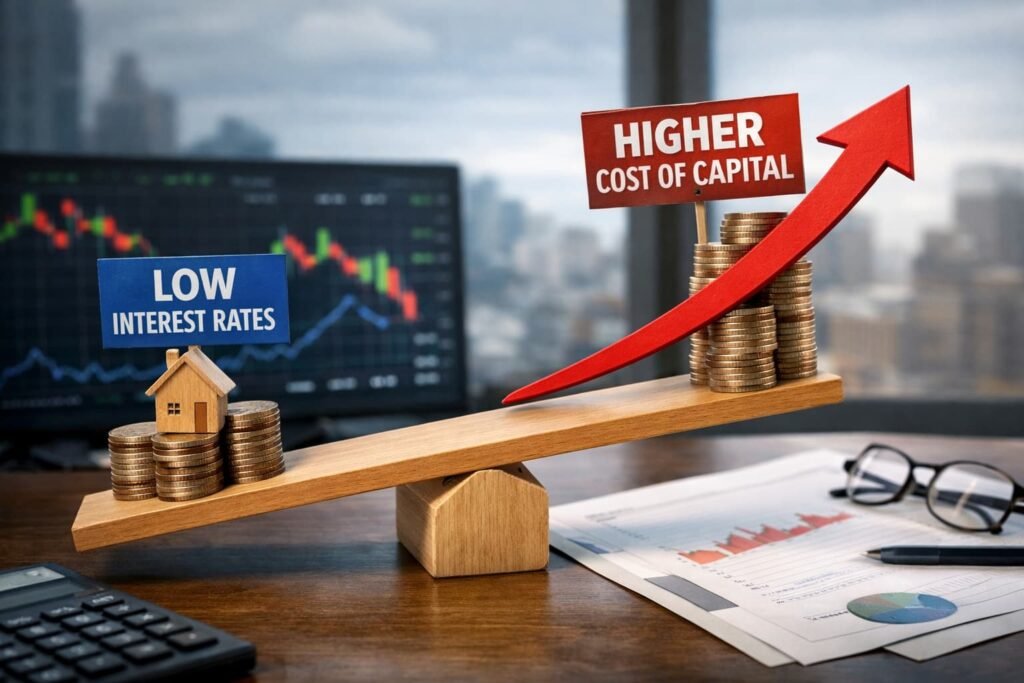
Interest Rates: A Permanently Higher Cost of Capital
The era of near-zero rates is firmly over. Even if the Federal Reserve delivers gradual cuts during 2026, borrowing costs are unlikely to return to pre-2022 norms. The 10-year Treasury yield is widely expected to trade in a 4.0%–4.5% range, setting a new benchmark for financing decisions.
For U.S. businesses, this means capital allocation discipline is back. Projects must clear higher return thresholds, debt-funded acquisitions face tighter scrutiny, and balance-sheet strength has reemerged as a competitive advantage.
Trade, Tariffs, and the Permanent Friction Economy
Trade policy uncertainty has shifted from episodic risk to structural reality. Tariffs, reshoring incentives, and geopolitical fragmentation have permanently altered cost structures for U.S. companies.
Import costs remain elevated, and logistics expenses are increasingly volatile. Supply-chain managers are no longer chasing efficiency alone; they are prioritizing redundancy, geographic diversification, and resilience, even at the expense of higher unit costs.
For many companies, 2026 will be the year when “China-plus-one” strategies move from PowerPoint to full operational execution.
Labor Markets: From the Great Resignation to the Big Stay
The U.S. labor market has entered a new phase. Voluntary job switching has fallen sharply, layoffs remain contained, and hiring has slowed across most sectors. Economists increasingly describe this environment as “low hire, low fire.”
What This Means for Employers
Employee retention costs have stabilized, but the labor market has not become easier. The skills gap is wider than ever, especially in data analytics, AI integration, cybersecurity, and advanced manufacturing.
While unemployment is expected to drift modestly higher—toward 4.4%–4.5% by mid-2026—the availability of highly specialized talent remains constrained. Companies can find general managers, but they struggle to hire AI-literate operators who can translate technology into productivity gains.
With fewer promotion opportunities available, employee engagement has become a strategic risk. Forward-looking firms are focusing on internal mobility, targeted upskilling, and retention of their most productive employees rather than expanding headcount.
Technology in 2026: From Experiments to Infrastructure
Artificial intelligence has entered its most consequential phase. In 2026, AI is no longer a novelty or a pilot project—it is becoming operational infrastructure.
The Rise of Agentic AI
The defining technology shift of the year is the move from generative tools to agent-based systems—software that can autonomously execute workflows rather than simply produce content.
U.S. enterprises are deploying AI agents that can:
- Reconcile financial transactions
- Handle Tier-1 customer service via voice
- Optimize logistics in real time
- Monitor compliance and flag anomalies
The objective is no longer innovation theater. It is process elimination—decoupling revenue growth from headcount growth.
Physical AI and Capital Spending
AI adoption is also driving physical investment. Autonomous mobile robots are becoming economically viable for mid-sized warehouses. Data-center demand continues to surge, fueling secondary booms in construction, power infrastructure, cooling systems, and utilities.
For many manufacturers and logistics firms, AI-enabled automation is now the most reliable hedge against labor shortages and cost volatility.
Regulation and Tax Policy: Planning for Uncertainty
The regulatory environment entering 2026 remains fluid. Tax incentives for capital spending and R&D have provided near-term relief, encouraging companies to front-load investment. At the same time, data-localization and cybersecurity rules are tightening, particularly for firms serving government and critical-infrastructure clients.
“Sovereign cloud” requirements are reshaping enterprise IT decisions, pushing sensitive data back onto U.S. soil and accelerating investment in domestic cloud and on-premise infrastructure.
The broader lesson for executives is flexibility. Businesses are no longer planning around a single regulatory outcome; they are designing strategies that can adapt to multiple scenarios.
Sector Spotlights: Where Pressure and Opportunity Collide
Commercial Real Estate: A Market Divides
Commercial real estate faces a moment of reckoning in 2026 as low-rate loans from the early 2020s mature. Class B and C office assets in major cities remain under severe pressure, while industrial logistics facilities and high-end office space continue to command premium rents.
Conversions, restructurings, and selective defaults are expected to accelerate as lenders and owners confront valuation gaps.
Healthcare: Cost Pressures Ripple Outward
Healthcare remains one of the most complex sectors for U.S. businesses. The rise of advanced metabolic drugs is reshaping demand across food, wellness, and medical-device markets, while employer-sponsored health insurance costs continue to rise.
For corporate America, healthcare inflation has become a board-level issue, driving renewed interest in wellness programs, benefit redesign, and cost containment strategies.
Energy: Reliability Takes Center Stage
Electricity demand is rising faster than at any point in decades, driven by EV adoption and AI-driven data-center expansion. Renewable energy continues to grow, but grid reliability has emerged as the central challenge.
Battery storage and natural-gas peaker plants are attracting renewed investment as businesses seek predictable, uninterrupted power supply in an increasingly energy-intensive economy.
The C-Suite Playbook for 2026
The recalibration underway demands a new operating mindset. The most successful U.S. businesses in 2026 will focus on four core imperatives:
- Automate with Intent
Identify rule-based workflows that can be eliminated or fully automated. AI is no longer optional for operational efficiency. - Protect Margins First
Pricing discipline, cost control, and capital efficiency matter more than expanding market share. - Secure Energy and Supply Chains
Power volatility and trade friction are permanent risks. Resilience must be built into operations. - Retain and Reskill Talent
Hiring may be frozen, but productivity depends on keeping and upgrading top performers.
Conclusion: A Professional Era for U.S. Business
2026 is not a year of collapse, nor is it a year of exuberance. It is a year that rewards competence. The easy money is gone. Viral growth narratives have faded. What remains is a business environment that favors disciplined balance sheets, AI-native operations, and leaders who understand that resilience is now a core competitive advantage.
The Great Recalibration is not temporary. It is the new baseline.