
By Harshit | Santa Barbara, CA | October 23, 2025 | 1:15 AM EDT
A Milestone in Quantum Computing Verification
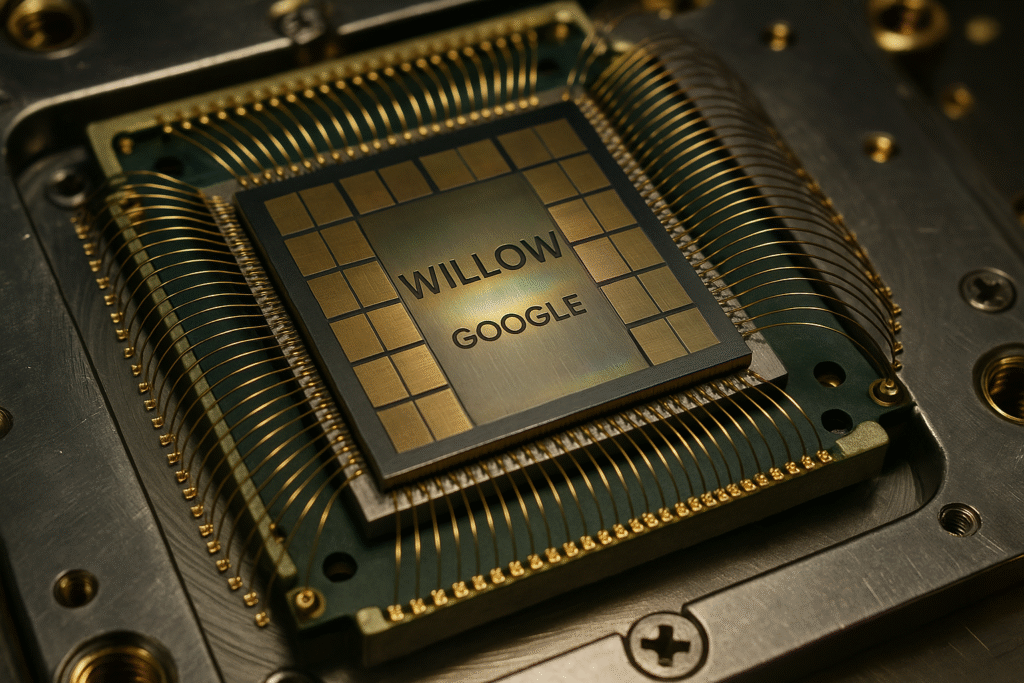
Quantum computing just got a little closer to practical applications. Scientists at Google have announced that their Willow quantum chip has achieved verifiable quantum advantage — a computation that outpaces classical computers but can still be confirmed as correct. The findings were reported October 22 in Nature and mark a critical step in proving that quantum machines can deliver reliable, real-world results.
Unlike previous claims of quantum advantage, this computation can potentially be efficiently verified by another quantum computer of similar capability, addressing a long-standing challenge in the field: proving that quantum results are accurate without relying on infeasible classical computations.
“If I can’t prove to you that the data is correct, how can I do anything with it?” said Tom O’Brien, a physicist with Google Quantum AI in Santa Barbara, California, during an October 17 news conference.
Quantum Echoes: A Butterfly Effect in Qubits
The calculation measured a phenomenon nicknamed “quantum echoes,” scientifically known as out-of-time-order correlators. These signals capture the chaotic behavior of quantum systems, a kind of butterfly effect, where a small change in one qubit can propagate across the system in complex ways.
To achieve the result, the researchers used 65 of Willow’s 105 qubits. They applied a series of random operations, then slightly perturbed a few “butterfly” qubits before reversing the operations. This time-reversal procedure allows the quantum system to reveal subtle correlations that would normally disappear in chaotic evolution. The process produces a complex quantum interference effect that is extraordinarily difficult to replicate using classical supercomputers.
The result was remarkable: the calculation ran 13,000 times faster on Willow than it would on the Frontier supercomputer, one of the world’s most powerful classical machines. A classical computation of the same task would take roughly 150 years, whereas Willow completed it in days.
Verification Is Key
Past claims of quantum advantage have sometimes been overturned when classical computing methods improved. Aram Harrow, a quantum physicist at MIT not involved in the research, commented that while the result is convincing, “it’s not crazy to imagine” that future classical algorithms could partially replicate it.
Scott Aaronson, a computer scientist at the University of Texas at Austin, highlighted the significance of verifiable quantum advantage: previous calculations could be verified, but only inefficiently. “This is a decent candidate,” he said, emphasizing the importance of being able to confirm results without extreme computational effort.
An ideal quantum algorithm, Harrow notes, would be verifiable by a classical computer, like Shor’s algorithm, which factors large integers. While Shor’s algorithm has practical encryption applications, quantum echoes are more complex, offering insights into quantum chaos and molecular simulations rather than encryption.
Toward Practical Applications
In a preprint posted to arXiv.org on October 22, Google researchers demonstrated that the technique could model the 3-D arrangement of portions of molecules, producing results that agreed with nuclear magnetic resonance experiments. While these calculations do not yet outperform classical methods, they show promise for future applications in chemistry, materials science, and physics.
Harrow praised the work for connecting quantum calculations to real-world experiments: “It’s very nice to see their quantum computer linked to a physical experiment,” he said.
What This Means for Quantum Computing
Achieving verifiable quantum advantage is a milestone because it confirms that quantum computers can solve problems beyond the reach of classical computers, while still producing results that can be checked.
Google’s Willow chip, with its 105 qubits, is part of the company’s broader goal of scaling quantum processors for practical scientific and industrial problems. As researchers continue refining both hardware and algorithms, the ability to efficiently verify quantum results will be crucial for wider adoption in research, drug discovery, and complex simulations.
While still in early stages, these findings represent a tangible step toward trusted, practical quantum computation — a future where quantum machines can solve problems classical computers cannot, with confidence in their correctness.