
By Harshit
TEL AVIV, Dec. 7, 2025 —8 AM EDT
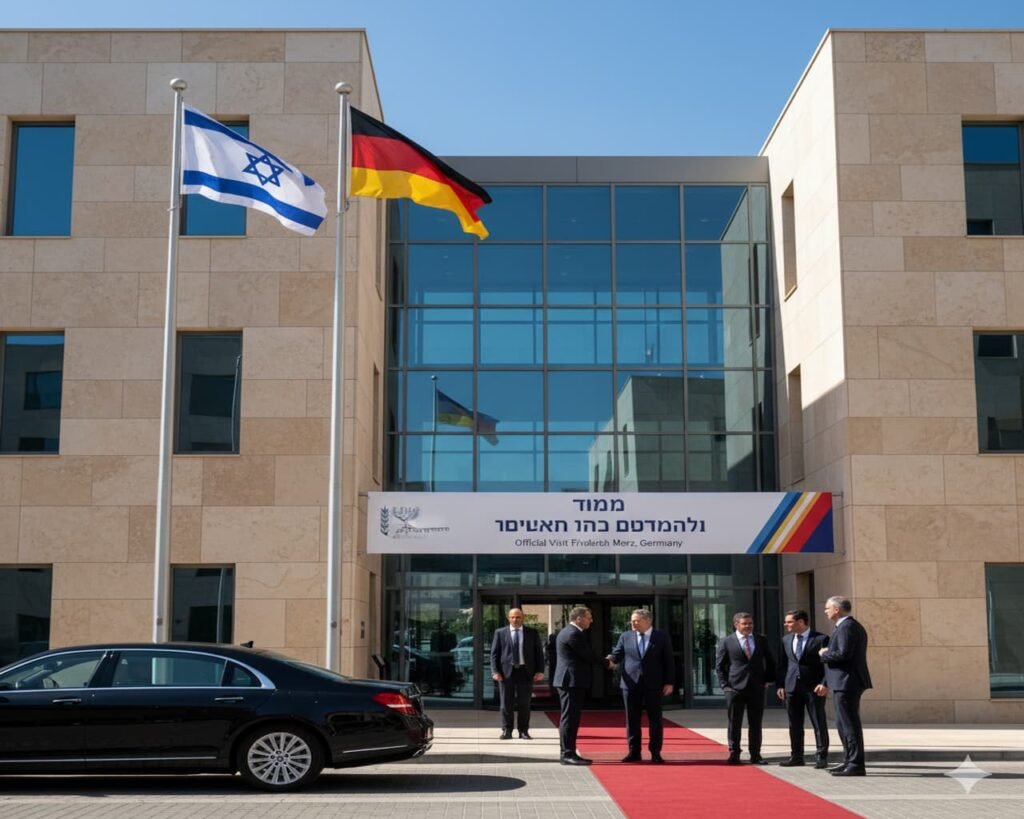
German Chancellor Friedrich Merz publicly reaffirmed his support for the eventual creation of a Palestinian state during a high-profile visit to Israel on Sunday, sharply contrasting with Israeli Prime Minister Benjamin Netanyahu’s renewed rejection of a two-state solution and underscoring widening diplomatic rifts over Gaza’s future.
Speaking alongside Netanyahu in Tel Aviv, Merz said negotiations toward Palestinian statehood must begin now, even as he acknowledged Israel’s security concerns and reiterated Germany’s long-standing opposition to Hamas playing any role in governing Gaza.
“We want a new Middle East that recognizes a Palestinian state alongside the State of Israel,” Merz said following talks with Netanyahu. “Negotiations on this are necessary now, and a Palestinian state must come at the end of this process.”
Merz’s comments came as Israel continues military operations in Gaza and the occupied West Bank, and as international pressure mounts for a political roadmap to end the war that began after Hamas’s October 2023 attacks. While Germany remains one of Israel’s strongest diplomatic and military supporters, Merz’s remarks reflected a growing European push to revive the two-state framework.
Netanyahu, however, was unequivocal in his opposition.
“The purpose of a Palestinian state is to destroy the Jewish state,” Netanyahu said, claiming that 99 out of 120 members of Israel’s parliament oppose Palestinian statehood. He added that the status quo in the occupied West Bank would remain unchanged “for the foreseeable future.”
The stark exchange illustrated the deep divide between Israel’s current government and key European allies, even as Germany signed a $4.5 billion weapons procurement deal with Israel during the visit — reinforcing Berlin’s continued military backing despite mounting humanitarian concerns.
Germany’s Balancing Act
Germany has walked a careful line throughout the Gaza war, combining steadfast support for Israel’s right to self-defense with increasingly vocal calls for humanitarian access and political solutions. Merz said Israel must sometimes be placed “under surveillance,” a remark interpreted by analysts as a reference to international monitoring mechanisms to ensure compliance with ceasefire and humanitarian agreements.
“We are helping the Palestinian Authority,” Merz added, “but we also criticize it for its various activities.” He stressed that Hamas must be excluded entirely from any future governance arrangement in Gaza.
German officials also reiterated their opposition to the annexation of occupied West Bank territory, though developments on the ground continue to contradict those assurances. Israeli settlement expansion and settler violence have intensified in recent months, according to Palestinian officials and international rights groups.
Regional and International Reactions
Merz’s visit coincided with a flurry of diplomatic activity across the region. Saudi Arabia, Norway, Qatar, and Egypt have all reiterated in recent days that a two-state solution remains the only viable path to ending the conflict. Egypt’s foreign minister called for the deployment of an international peacekeeping force in Gaza to ensure adherence to ceasefire terms, while Qatar warned against any forced displacement of Palestinians.
At the same time, Israeli actions in both Gaza and the West Bank have drawn sharp criticism. In Gaza, health officials report hundreds of deaths since a fragile ceasefire took effect in October, while UN agencies warn of worsening malnutrition and restricted humanitarian access. In the West Bank, Israeli forces and settlers have killed more than 1,000 Palestinians since the war began, according to Palestinian authorities.
Netanyahu dismissed much of the criticism, insisting Israel is close to completing the first phase of US President Donald Trump’s Gaza plan and preparing to move into a second phase focused on security and reconstruction.
Aid, Arms, and Accountability
Merz’s visit also reignited debate in Germany over arms exports to Israel. Berlin is Israel’s second-largest arms supplier after the United States and recently lifted a temporary suspension on weapons exports that could be used in Gaza. Critics argue that continued arms sales undermine Germany’s calls for restraint and accountability, especially as Netanyahu faces an ongoing corruption trial at home and an arrest warrant request at the International Criminal Court over alleged war crimes.
German officials maintain that supporting Israel’s security does not contradict backing Palestinian statehood. “There is no contradiction,” Merz said, framing Germany’s position as one rooted in long-term regional stability rather than short-term political alignment.
A Fractured Path Forward
Despite growing international consensus around a two-state solution, prospects for near-term progress appear bleak. Netanyahu’s governing coalition includes hard-line parties openly advocating annexation of Palestinian territory, while Gaza remains devastated and politically fractured.
For European leaders like Merz, the challenge lies in translating diplomatic pressure into tangible change without fracturing alliances or emboldening extremists on either side.
As Merz concluded his visit, the message from Berlin was clear: Germany will continue to stand by Israel — but the era of unconditional political support appears to be narrowing, replaced by renewed calls for a negotiated Palestinian state as the only sustainable end to the conflict.