
WASHINGTON, MARCH 18, 2026 — The Federal Reserve did exactly what everyone expected on Wednesday. It held interest rates steady, kept borrowing costs unchanged, and sent a clear message to millions of Americans hoping for relief on mortgages, car loans, and credit card debt: not yet.
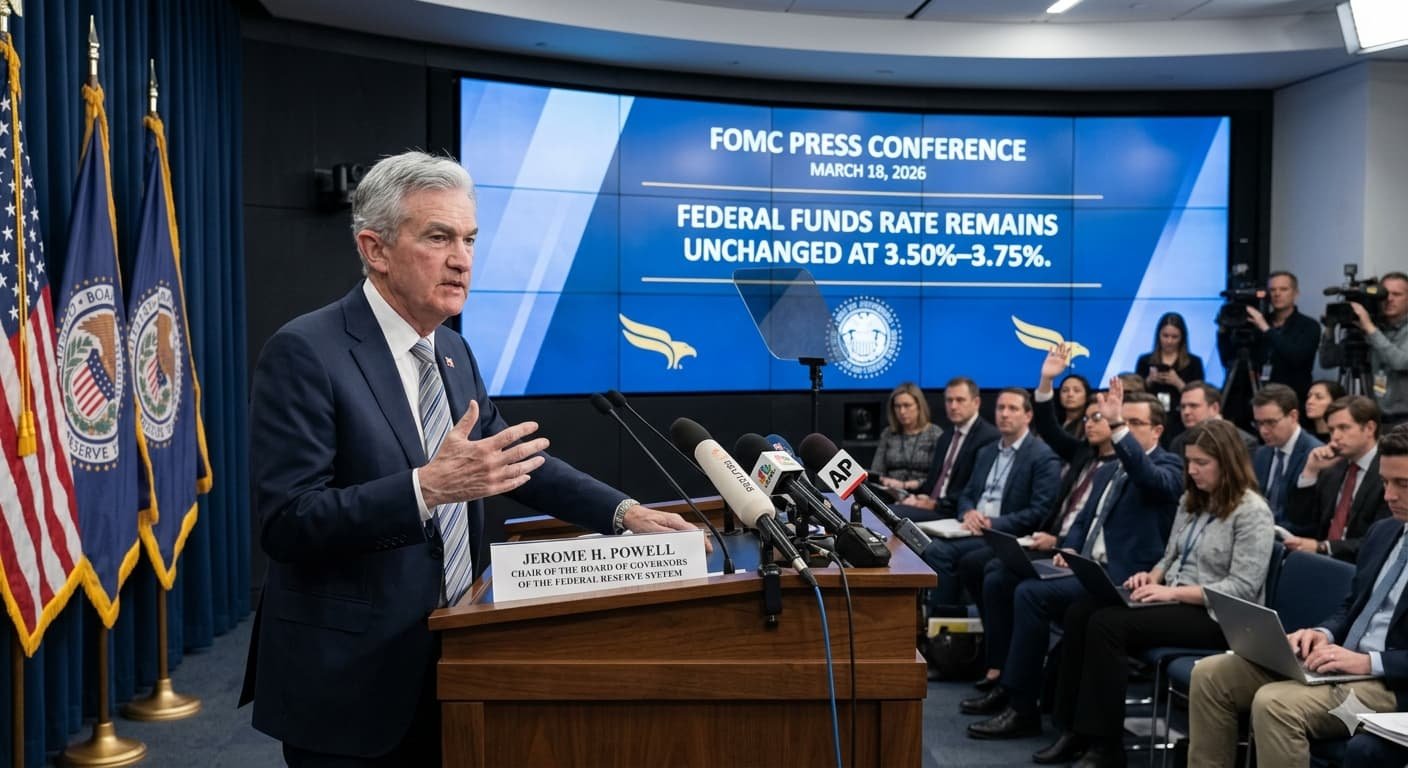
The Federal Open Market Committee voted to maintain the federal funds rate at its current target range of 3.5% to 3.75% — the second consecutive hold of 2026 and the latest signal that the central bank is in no hurry to ease policy while the Iran war continues driving oil prices toward levels not seen in years.
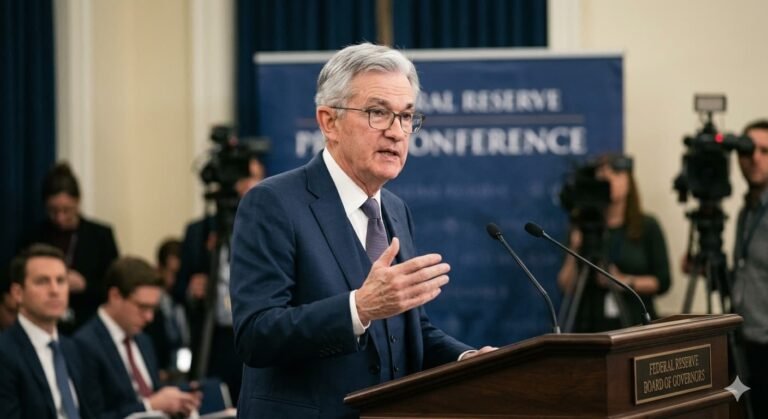
The decision was announced at 2:00 PM ET, with Fed Chair Jerome Powell scheduled to face reporters at 2:30 PM ET in what is expected to be one of the most closely watched press conferences of his tenure — and likely one of his last, with his term expiring on May 15, 2026.
A Decision Made Easy by a War Nobody Planned For
Three months ago, Wall Street had mapped out a clean path for 2026. The Iran conflict changed everything. Oil crossed $100 a barrel in mid-March, pushing up gas prices, transportation costs, and the price of virtually everything that moves through a supply chain. Inflation, which had been cooling steadily through late 2025, is back in dangerous territory.
The Fed’s preferred inflation gauge — the Personal Consumption Expenditures index — showed consumer prices rising at an annual rate of 2.9% heading into March, well above the central bank’s 2% target. Core PCE, which strips out food and energy, held at 3.0%. Neither number gives Powell room to cut.
“The Federal Reserve has little choice but to stay on the sidelines” — a view shared widely across Wall Street heading into Wednesday’s decision. Markets had priced in a near-zero probability of a rate cut at this meeting — a verdict that proved correct.
The Dot Plot: When Will Cuts Actually Come?
Wednesday’s meeting is more than just a rate decision. The Fed also released its quarterly Summary of Economic Projections — the so-called dot plot — which maps out where officials expect interest rates, inflation, and economic growth to be through the end of 2026 and beyond.
Heading into the meeting, economists had dramatically revised their forecasts over the past three weeks. What began as a clear path to two or three rate cuts in 2026 has been rewritten by the Iran war’s economic shock.
According to CME FedWatch, there is now a 95% probability the Fed maintains its current rate range at the April 30 meeting and a 77% likelihood it holds again in June. Futures markets now point to the first realistic cut arriving no earlier than October or December 2026 — a dramatic shift from January, when a June cut was widely anticipated.
EY-Parthenon chief economist Gregory Daco revised his baseline to show only one quarter-point cut in 2026, likely in December, adding that it was entirely plausible the Fed would deliver no cuts at all this year.
Trump Wants Cuts. Powell Is Not Listening.
The political pressure on the Fed has been relentless. President Trump has repeatedly demanded aggressive rate reductions, posting on Truth Social that Powell should be cutting rates “IMMEDIATELY.” The president’s frustration has been a running theme of his second term, though it has done little to move the needle inside the Eccles Building.
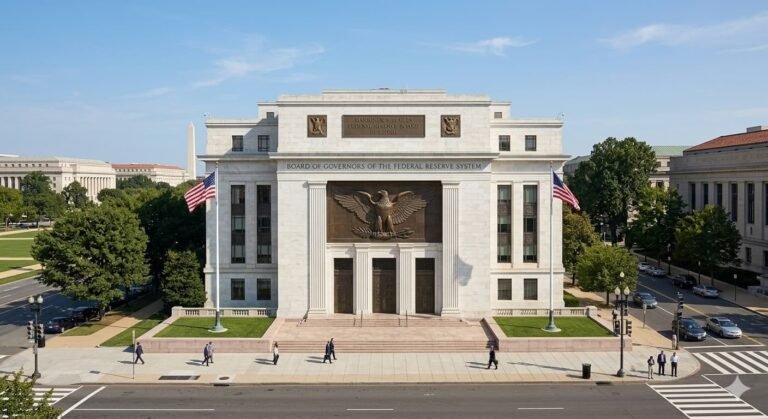
Powell’s departure in May adds another layer of complexity. Trump has nominated Kevin Warsh — a former Fed governor and Wall Street veteran — to replace him. Warsh is seen by markets as a stabilizing force, though his path to confirmation is not certain. Republican Senator Thom Tillis has publicly vowed to block any Fed nomination until a DOJ investigation into Powell concludes.
The FOMC is expected to see two dissents in favor of a quarter-point cut — with Governor Stephen Miran signaling willingness to dissent for a fifth consecutive meeting, and either Governor Chris Waller or Governor Miki Bowman likely joining him.
What This Means for Your Wallet Right Now
The hold matters to ordinary Americans in direct, immediate ways. Mortgage rates, which had briefly dipped below 6% in late February, climbed back to 6.26% as of March 16. Every rate hold makes the timeline for relief on home buying longer.
Credit card rates, which are directly tied to the federal funds rate, remain at historically high levels. Auto loan rates have shown no sign of meaningful decline. And with futures markets now pushing the first likely cut to the fall at the earliest, borrowers face months more of elevated costs.
The Fed’s challenge is not lost on anyone watching. Oil above $100, inflation above target, a slowing labor market, and a war with no clear end date — it is an equation with no easy solution, and Wednesday’s decision reflects a central bank that has chosen to wait rather than risk making things worse.
Powell will speak at 2:30 PM ET. His words on the Iran war’s inflation impact — and any signals about the dot plot’s rate path — will move markets. Every American with a mortgage, a car payment, or a credit card balance will be listening.