
By HarshitWashington, D.C., October 28, 2025 – 9:10 AM EDT
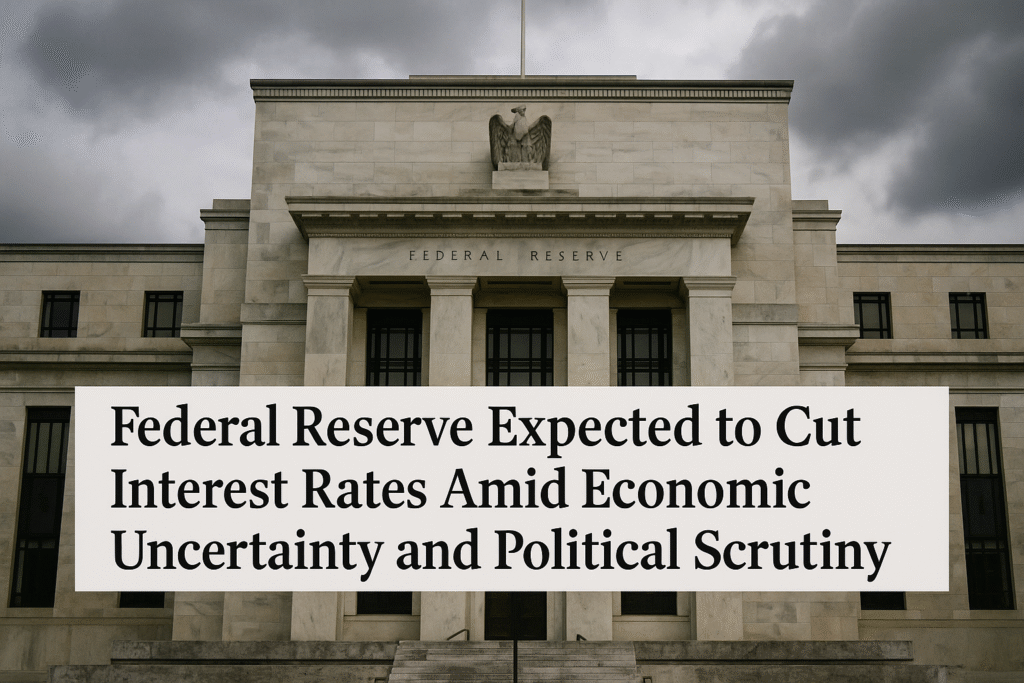
The Federal Reserve is widely expected to lower interest rates by a quarter point at its upcoming policy meeting this week, with additional cuts likely at the December and January meetings, according to the latest October CNBC Fed Survey. Yet behind the consensus prediction lies deep division among economists, strategists, and fund managers over whether the move is justified — and whether political influence may be clouding the central bank’s judgment.
A Divided Economic Outlook
Of the 38 experts surveyed, 92% expect a rate cut, but only 66% believe it should happen, while a notable 38% oppose any reduction at this stage. Many cited concerns about high inflation, a resilient GDP growth rate of 3.5–4%, and financial conditions that remain historically loose.
“Politics rather than financial conditions are clearly influencing the Fed’s rate decisions,” warned Richard Bernstein, CEO of Richard Bernstein Advisors. “In more normal times, there is no way the Fed would be cutting rates.”
Others see deeper issues at play — including the ongoing government shutdown, a potential artificial intelligence (AI) market bubble, and the risk of data blind spots created by incomplete economic reporting.
“Flying in a blizzard with a blindfold on and no backup instrumentation isn’t a great place for monetary policy,” said Guy Lebas, chief fixed income strategist at Janney Montgomery Scott. “It’s even worse when there are mountains in the area.”
More Cuts Likely — But Opinions Split
Following the expected quarter-point cut this week, 84% of respondents anticipate another reduction in December, while 54% expect a third in January. Collectively, the survey forecasts a total of 100 basis points in rate cuts over the next year, bringing the federal funds rate down to roughly 3.2% by the end of 2026.
Still, not everyone agrees on the magnitude. Some economists believe larger, preemptive cuts are necessary to prevent a potential recession.
“Labor market weakness and the government shutdown are increasing recession risk and suggesting preemptive bigger rate cuts are necessary,” said Allen Sinai, chief economist at Decision Economics. “The productivity boom is the main reason for the economy’s resiliency and the stunning equity market boom that is not a bubble.”
The AI Boom — and Fears of a Bubble
Nearly 80% of respondents said AI-related stocks are extremely or somewhat overvalued, estimating prices are inflated by at least 20% on average.
“The single most important short- and long-run dynamic in the U.S. macro landscape is artificial intelligence — and whether it is over-, under-, or appropriately hyped,” noted Troy Ludtka, senior U.S. economist at SMBC Nikko Securities Americas.
John Lonski, president of The Lonski Group, was more blunt: “Once the AI bubble bursts, only the financially strong participants in the AI space will survive.”
Despite those warnings, many expect equity markets to remain relatively stable through year-end, with only modest gains in 2026. The S&P 500 is projected to top 7,200 next year and potentially reach 7,700 by 2027.
Shutdown and Data Blind Spots
The ongoing government shutdown has complicated the Fed’s decision-making, leaving policymakers without key economic data. About 71% of respondents said they are only “somewhat confident” they’re getting an accurate read on the economy, while just 5% said they are “extremely confident.”
“Fed officials are unable to draw much of a conclusion about anything and should arguably remain on hold,” said Lindsey Piegza, chief economist at Stifel. “Acting without data risks compounding a policy error with another if the cut is unwarranted.”
The shutdown, however, is not seen as a major market disruptor. 82% of survey participants believe it will have no lasting impact on stocks, and most expect it to end by November.
Growth and Inflation Outlook
Economic forecasts from the survey show moderate but steady growth in the coming years:
- GDP: 1.9% in 2025, 2.2% in 2026, and 2.3% in 2027
- Unemployment: Peaking near 4.5% next year
- Inflation: Ending 2025 at 3%, easing to 2.8% in 2026, and 2.6% in 2027
While inflation has cooled from its 2022 highs, it remains above the Fed’s 2% target, fueling debate about whether easing policy could reignite price pressures.
Tariffs, Trade, and Future Risks
The survey identified tariffs as the No. 1 risk to the ongoing expansion. Yet nearly two-thirds of respondents said the impact of tariffs on inflation has been less severe than expected — though many warn the effects may not yet be fully felt.
Some analysts believe that companies absorbing costs to remain competitive has temporarily muted inflationary pressures, but that strategy may be unsustainable if tariffs persist into 2026.
The Bottom Line
As the Federal Reserve prepares to announce its latest policy decision, the institution faces an increasingly complex and politically charged economic landscape. Whether the anticipated rate cuts help stabilize growth or add new fuel to inflation and asset bubbles remains to be seen.
For now, both Wall Street and Main Street are bracing for what could be a pivotal moment in the U.S. economic cycle — one where data scarcity, political pressure, and market optimism collide in the Fed’s most scrutinized decision of the year.