
WASHINGTON, MARCH 20, 2026 —
Key Takeaways
- The Federal Reserve held rates at 3.50–3.75% on Wednesday — but slashed its growth outlook and raised its inflation forecast simultaneously
- Powell directly warned that the Iran war’s oil shock is already pushing near-term inflation expectations higher — and the Fed has no clean tool to fight it
- Mortgage rates climbed to 6.11% — erasing hopes of a housing market recovery that briefly appeared when rates dipped below 6% for the first time in three years
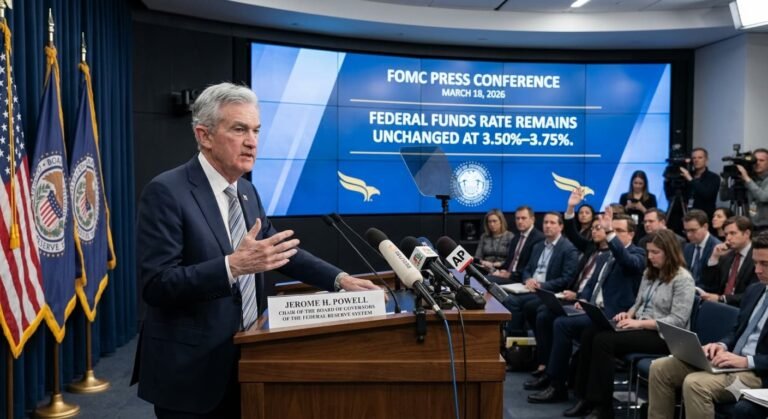
Jerome Powell stood at the Federal Reserve podium on Wednesday afternoon and delivered the kind of press conference that central bankers dread. Not because anything went dramatically wrong. But because everything is going wrong at once — and there is no good answer for any of it.
The Fed held interest rates steady at 3.50–3.75%, as every economist on Wall Street expected. What nobody fully anticipated was the candor with which Powell described the position the American economy now occupies. Rising oil prices. Weakening jobs. Stubborn inflation. A war with no end date. And a central bank that can only move one lever — in one direction — at a time.
What the Fed Actually Decided
The Federal Open Market Committee voted 11-1 to hold the benchmark federal funds rate in its current range. The lone dissenter was Governor Stephen Miran, who voted for a quarter-point cut — citing rising concerns about the deteriorating jobs climate. Governor Christopher Waller, who joined Miran in voting for a cut at the January meeting, switched his vote this time to hold.
The Fed’s updated Summary of Economic Projections — the dot plot — told the real story:
| Indicator | December 2025 Projection | March 2026 Projection | Change |
|---|---|---|---|
| Rate cuts expected in 2026 | 2 cuts | 1 cut | ⬇️ Fewer cuts |
| Inflation projection 2026 | ~2.4% | Higher | ⬆️ Rising |
| GDP growth 2026 | ~2.1% | Slightly faster | ➡️ Marginal |
| Officials expecting zero cuts | 6 of 19 | 7 of 19 | ⬆️ More hawkish |
| Mortgage rate 30-year fixed | — | 6.11% | ⬆️ Rising |
Of the 19 FOMC participants, seven now expect rates to remain unchanged for all of 2026 — one more than in December. The median outlook still projects one cut this year and another in 2027, with the funds rate eventually settling around 3.1% for the long term. But that median is doing a lot of work to paper over a committee that is genuinely divided about which direction the economy is heading.
The Oil Shock Is Already Changing Everything
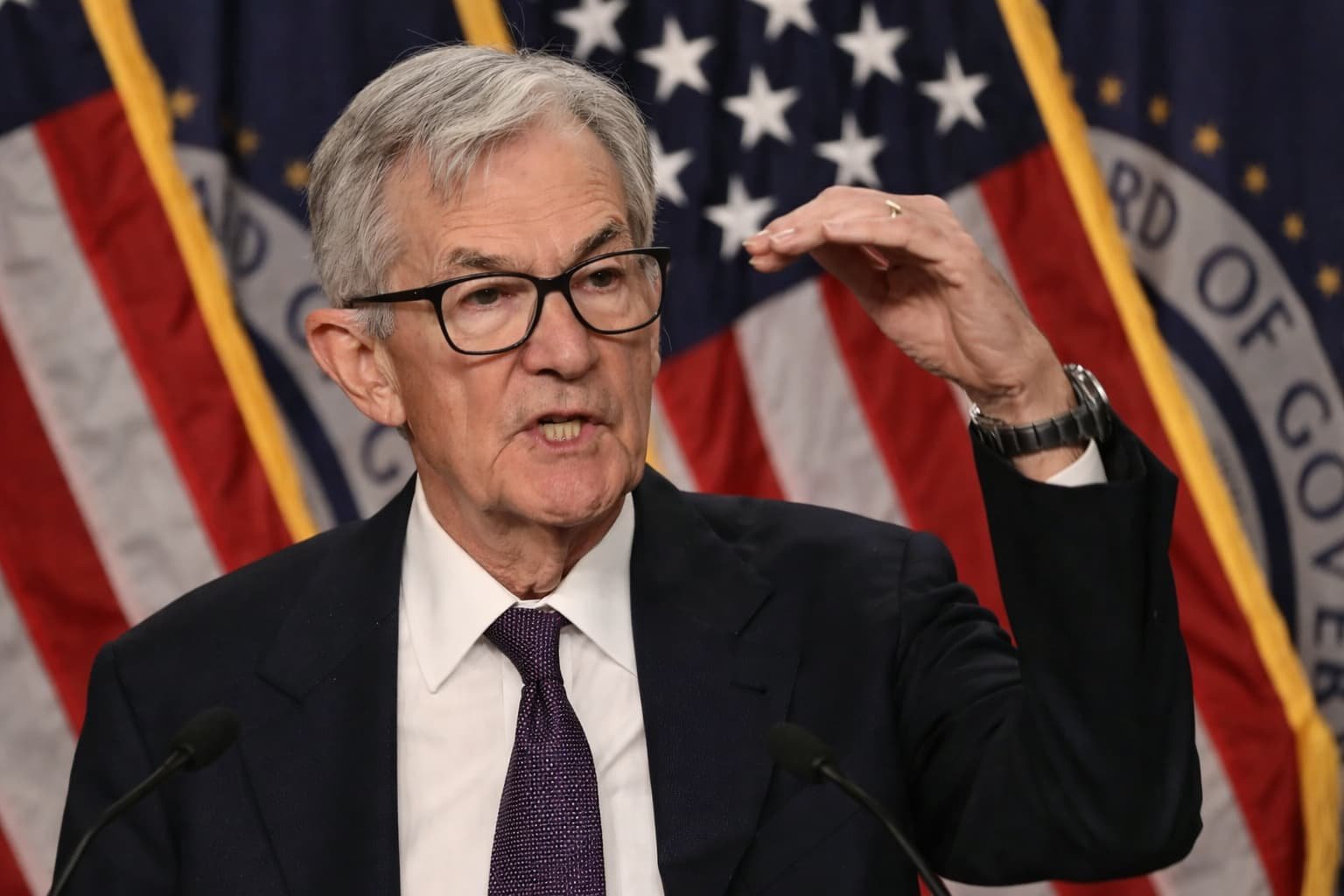
Powell was unusually direct about the Iran war’s impact on the Fed’s calculations. “The implications of developments in the Middle East for the U.S. economy are uncertain,” he told reporters. He acknowledged that near-term inflation expectations have risen recently — and attributed that rise directly to the substantial increase in oil prices caused by supply disruptions in the Middle East.
The math behind that statement is brutal for ordinary Americans. Oil has risen from roughly $72 a barrel when the war began on February 28 to $118 as of Thursday morning — a $46 per barrel surge in 20 days. Every $10 rise in oil adds approximately 25 cents per gallon at the pump over several weeks. The full pass-through of this oil shock into gasoline, groceries, and goods has barely begun to show up in official inflation data. March’s CPI report — due next month — will be the first real look at what the war has done to American prices.
The Housing Market’s Window Just Closed
For millions of Americans waiting on the sidelines of the housing market, Wednesday’s Fed meeting delivered particularly unwelcome news. The average rate on a standard 30-year fixed mortgage climbed to 6.11% for the week ending March 12 — just two weeks after briefly falling below 6% for the first time in more than three years.
That dip below 6% had represented the first genuine opening for potential homebuyers since the Fed’s aggressive 2022-2023 tightening cycle. Housing economists had hoped it would unlock a wave of listings from homeowners who had locked in ultra-low pandemic-era rates and been reluctant to sell. The oil shock and the resulting rate reversal has almost certainly shut that window — at least until the war ends and oil retreats.
Powell Refuses to Leave
Wednesday’s press conference carried one subplot that has nothing to do with monetary policy — and everything to do with the political pressure now surrounding the institution Powell leads. U.S. Attorney Jeanine Pirro subpoenaed Powell for evidence relating to the Fed’s multibillion-dollar headquarters renovation — a move Powell publicly called a pretext to pressure the Fed into cutting rates. A federal judge agreed, tossing the subpoenas. Pirro has vowed to appeal.
Powell’s response on Wednesday was unambiguous: “I have no intention of leaving the board until the investigation is well and truly over, with transparency and finality.” His term as Fed chair expires May 15. Kevin Warsh — Trump’s preferred successor — faces a Senate confirmation process that Senator Thom Tillis has vowed to block until the Powell subpoena matter is resolved. The standoff means Powell may remain in his seat well past his nominal term end date.
What This Means For You
| If You Have… | Impact of Wednesday’s Decision |
|---|---|
| 30-year fixed mortgage | Rate now 6.11% — no relief coming soon |
| Adjustable rate mortgage | Rates stay elevated — refinancing unlikely to help |
| Credit card debt | No APR reduction — carrying balances gets costlier |
| High-yield savings account | Rates stay high — savers benefit |
| Home purchase plans | Housing affordability worsens as mortgage rates rise |
| 401(k) / stock portfolio | Stocks fell to session lows after Powell’s comments |
| Car loan | Borrowing costs remain elevated through 2026 |
The Federal Reserve did not make any dramatic moves on Wednesday. It held steady, updated its projections, and told America what its economy looks like right now — slowing growth, rising inflation, and a war that has made both problems significantly harder to solve. For the millions of Americans on the other side of those numbers, steady is cold comfort.