
By Harshit, LONDON, Nov. 4, 2025
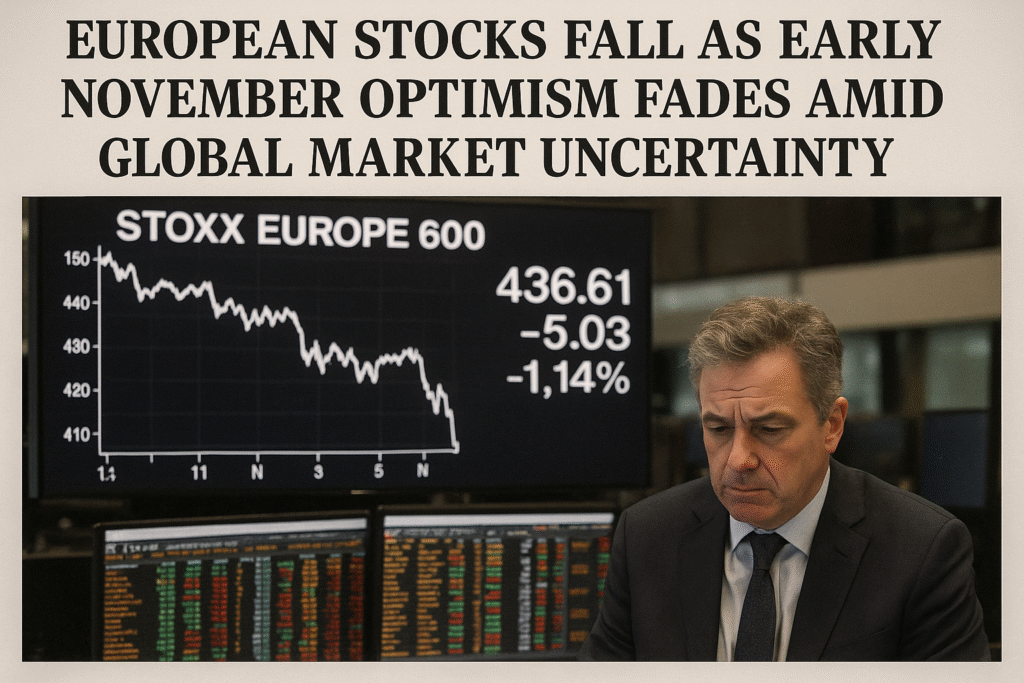
European equities slipped on Tuesday, reversing early-week optimism as investors digested weak sentiment, mixed corporate earnings, and global market volatility ahead of key central bank decisions later this week.
Broad Market Decline Across Europe
The pan-European Stoxx 600 index was down nearly 0.8% by 2 p.m. (9 a.m. ET), with almost every sector trading in the red. The U.K.’s FTSE 100 dipped 0.5%, while Germany’s DAX fell 1.1%, France’s CAC 40 slid 1%, and Italy’s FTSE MIB dropped 0.6%.
Investors are bracing for monetary policy announcements from the Bank of England and European Central Bank, both expected to offer clues on whether rate cuts could arrive before year-end. Despite the broader declines, analysts say markets are still holding steady within a narrow range after strong U.S. earnings in late October boosted global sentiment.
U.K. Bond Yields Ease as Finance Minister Signals Fiscal Discipline
In the U.K., the yield on 10-year government bonds, or gilts, fell more than 2 basis points to 4.413% following a speech by Finance Minister Rachel Reeves, who emphasized that the government would make “hard choices” ahead of the upcoming Nov. 26 national budget.
The remarks were interpreted as a signal of fiscal prudence, aimed at stabilizing investor confidence after months of concern over public spending and sluggish growth. The British pound fell 0.6% against the U.S. dollar, trading around $1.31 in afternoon sessions.
Corporate Movers: Orsted, BP, and Philips in Focus
Orsted (ORSTED.CO) shares edged 0.1% lower after the Danish renewable energy firm agreed to sell a 50% stake in its Hornsea 3 offshore windfarm project in the U.K. to Apollo Global Management in a $6 billion deal. The sale is part of Orsted’s plan to strengthen its balance sheet following a challenging year for renewable developers facing rising costs and financing hurdles.
Meanwhile, BP (BP.L) shares moved 0.1% higher after reporting an underlying replacement cost profit of $2.21 billion for the third quarter — exceeding analyst expectations. The figure, BP’s preferred measure of net income, reflected stronger-than-expected refining margins and disciplined cost management despite ongoing oil price volatility.
In contrast, Philips (PHIA.AS) gained 2.5% after reporting €4.3 billion ($5 billion) in third-quarter revenues, slightly below last year’s €4.34 billion but supported by stable demand for medical imaging and personal health products. Net income rose to €187 million, as cost efficiencies and steady healthcare demand helped offset a softening European consumer market.
Upcoming Earnings and Sector Outlook
Investors are awaiting earnings reports from Geberit, Associated British Foods, and Ferrari, all due later Tuesday. Analysts expect these reports to provide more clarity on the strength of Europe’s industrial and consumer sectors heading into the final quarter of 2025.
Earlier, Saudi Aramco reported a 0.9% rise in third-quarter profit, driven by higher production volumes even as global oil prices remained subdued. The modest gain underscores the delicate balance facing energy exporters between maintaining output and responding to weaker demand from China and Europe.
Global Market Picture: Asia Mixed, U.S. Futures Edge Lower
Across Asia-Pacific, markets traded mixed overnight, while U.S. stock futures were slightly lower after Wall Street’s Monday rally. The S&P 500 and Nasdaq Composite both ended the previous session higher, buoyed by continued enthusiasm for artificial intelligence-related stocks.
Tech-driven optimism remained strong as Amazon (AMZN) soared 4% to a record high, following reports of a $38 billion partnership with OpenAI — a move that further cements the e-commerce giant’s commitment to AI-driven infrastructure.
However, analysts warn that Europe’s equity rebound seen earlier this week could fade quickly if global rate cut expectations or corporate earnings disappoint. “We’re in a tug of war between improving inflation trends and weaker industrial data,” said Sophie Lund-Yates, lead equity analyst at Hargreaves Lansdown. “That tension is keeping investors cautious.”
Outlook: Inflation Data and Policy Decisions Ahead
Market attention now shifts to inflation prints and central bank decisions later this week. Traders will watch for any signals from policymakers on how quickly rate cuts might follow the recent cooldown in consumer prices across the eurozone and the U.K.
While risk appetite remains fragile, analysts expect defensive sectors such as healthcare, utilities, and consumer staples to outperform in the short term. “Volatility is likely to remain elevated until the policy outlook becomes clearer,” said Frederic Leroux, a strategist at Carmignac.
As Europe digests mixed earnings and economic data, investors appear to be recalibrating expectations — moving cautiously from October’s optimism to November’s uncertainty.