
By Harshit, NEW YORK, Oct. 28, 2025
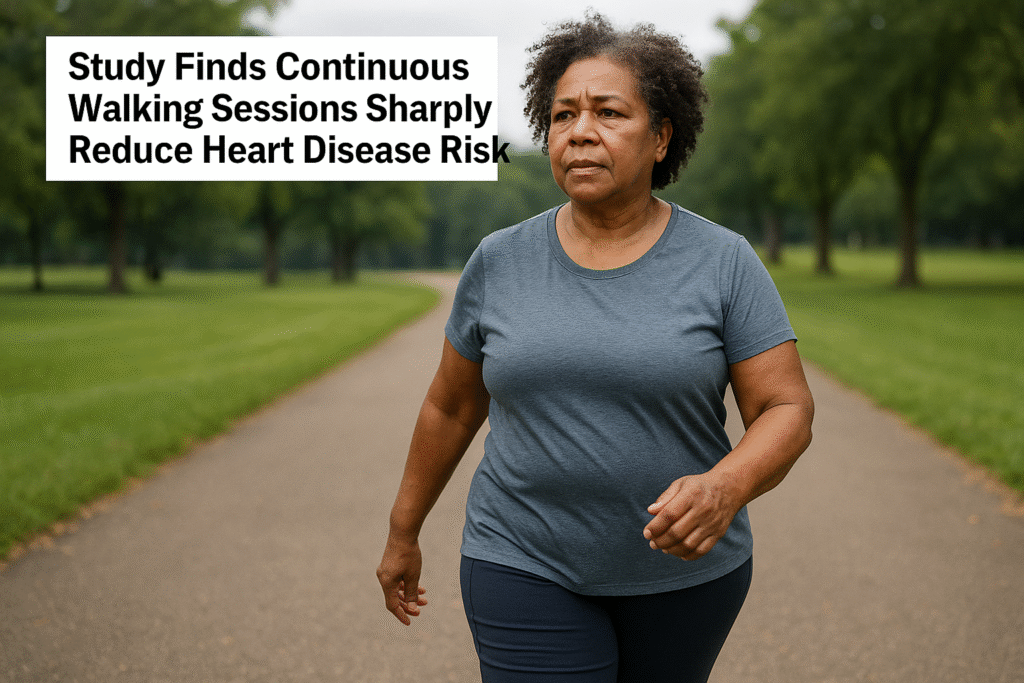
A new international study has revealed that walking continuously for 10 to 15 minutes at a time can dramatically lower the risk of cardiovascular disease — even more effectively than short, scattered walks spread throughout the day.
Researchers from the University of Sydney and the Universidad Europea in Spain found that people who walked in one or two steady sessions daily saw up to a two-thirds reduction in heart disease risk compared to those who only took brief, fragmented walks lasting less than five minutes. The study’s findings, published in the Annals of Internal Medicine, highlight how walking patterns — not just total step counts — play a crucial role in cardiovascular health.
Longer, Uninterrupted Walks Offer Greater Heart Benefits
The researchers discovered that even among people who took the same total number of steps, continuous walking sessions were far more beneficial than steps accumulated in short bursts. Participants who walked for 10–15 minutes without interruption had significantly lower rates of heart attack, stroke, and death than those who walked in brief intervals.
“For the most inactive individuals, switching from brief walks here and there to longer continuous walks may come with substantial health benefits,” said Dr. Matthew Ahmadi, co-lead author and Deputy Director of the Mackenzie Wearables Research Hub at the University of Sydney’s Charles Perkins Centre.
Dr. Ahmadi added that while the popular “10,000 steps per day” benchmark has long been considered a gold standard for fitness, it’s not a strict requirement. “Simply adding one or two longer walks per day, each lasting at least 10 to 15 minutes at a comfortable but steady pace, may bring major improvements — especially for people who don’t walk much,” he explained.
Tracking How People Walk, Not Just How Much
The study analyzed 33,560 adults aged between 40 and 79 years who averaged fewer than 8,000 steps per day and had no history of heart disease or cancer. Each participant wore a research-grade wristband for one week to track both their total step counts and how those steps were distributed throughout the day.
Over an average follow-up period of eight years, the researchers compared cardiovascular outcomes across different walking patterns. The results were clear: those who engaged in sustained walking sessions had dramatically lower risks of cardiovascular events and premature death.
The Numbers Behind the Findings
The data revealed striking contrasts in heart health outcomes:
- Individuals who walked continuously for 10–15 minutes a day had just a 4% chance of suffering a cardiovascular event such as a heart attack or stroke, compared to a 13% chance among those whose longest walks lasted only five minutes.
- For people walking fewer than 5,000 steps daily, the risk of developing heart disease dropped from 15% to 7% when switching from shorter walks to longer continuous ones.
- Among the most sedentary group, the risk of death fell from 5% to under 1% when participants walked for at least 10–15 minutes without breaks.
These results underscore that consistency and duration matter more than the number of steps alone. Longer, uninterrupted movement helps the body maintain optimal blood flow, improve heart function, and reduce inflammation — all key factors in cardiovascular protection.
Why Duration Matters More Than Step Count
Experts believe that longer walking bouts enhance the body’s ability to regulate blood pressure, glucose, and cholesterol more effectively than shorter, intermittent activity. When walks last 10 minutes or more, the cardiovascular system reaches a steady state that boosts oxygen delivery and improves vascular elasticity.
Dr. Ahmadi and his colleagues noted that continuous walking can be easier to fit into daily routines than many realize. “Even if you don’t have time for a gym workout, one or two brisk 15-minute walks — during lunch or after dinner — can meaningfully reduce your long-term cardiovascular risk,” he said.
Public Health Implications
The study adds to growing evidence supporting moderate-intensity physical activity as one of the simplest and most cost-effective ways to prevent heart disease. Given that cardiovascular conditions remain the leading cause of death worldwide, these findings could inform new public health guidelines encouraging structured walking sessions rather than fragmented movement.
Health experts say even small changes — like taking a longer route during a commute, walking with a friend, or using a timer to ensure 10–15 uninterrupted minutes of movement — can have lasting effects on heart health.