
By Harshit, WASHINGTON, D.C., November 2, 2025 — 3:00 AM EDT
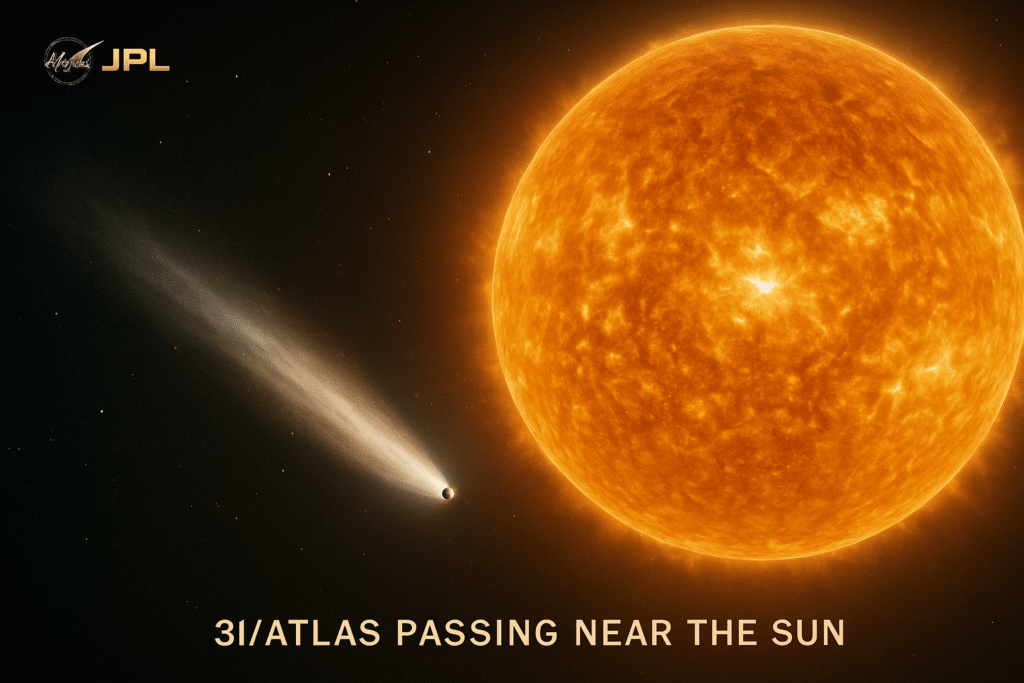
For only the third time in recorded history, astronomers are witnessing an object from beyond our solar system — Comet 3I/ATLAS. First detected in July 2025, this mysterious interstellar visitor has captivated the world’s leading observatories and reignited discussions about the origins of our galaxy. Scientists are now tracking the comet’s path, composition, and extraordinary behavior as it makes its closest approach to the Sun.
A Visitor from Beyond the Solar System
Comet 3I/ATLAS — officially named after the Asteroid Terrestrial-impact Last Alert System (ATLAS) telescope that discovered it — was first identified on July 1, 2025, by astronomers using the ATLAS survey telescope in Río Hurtado, Chile. What set it apart from ordinary comets was the unmistakably hyperbolic shape of its orbit, confirming that it is not gravitationally bound to the Sun.
When astronomers traced its trajectory backward, they found that it originated outside the solar system, likely from a distant region of the Milky Way. This discovery made it the third known interstellar object after ʻOumuamua (1I/ʻOumuamua), discovered in 2017, and 2I/Borisov, identified in 2019.
In naming conventions, the “3I” indicates it is the third interstellar object detected, while “ATLAS” refers to the telescope network responsible for the find.
Discovery and Early Observations
Following the initial detection, researchers quickly scoured archived data from other telescopes, including Caltech’s Zwicky Transient Facility at Palomar Observatory in California and other ATLAS stations in Hawaii and South Africa. These pre-discovery images showed that 3I/ATLAS had been visible since June 14, 2025, but its interstellar nature had not yet been recognized.
NASA’s Jet Propulsion Laboratory (JPL) confirmed that the comet was traveling at an extraordinary 130,000 miles per hour (209,000 km/h) — the highest velocity ever recorded for any known object entering our solar system. Such speed indicated that the comet was merely passing through and would eventually exit the solar system permanently.
What Makes 3I/ATLAS Interstellar
The defining evidence of 3I/ATLAS’s interstellar origin lies in its orbital path. Unlike planets, asteroids, or most comets, which follow elliptical orbits around the Sun, 3I/ATLAS moves along a hyperbolic trajectory. This means it entered the solar system from interstellar space and will eventually leave, never to return.
According to NASA, its perihelion — the point at which it comes closest to the Sun — occurs around October 30, 2025, at a distance of approximately 1.36 astronomical units (about 200 million kilometers). For comparison, Earth is 1 AU from the Sun. The comet poses no threat to Earth, staying roughly 1.8 AU (270 million kilometers) away at its nearest approach to our planet.
NASA and ESA’s Ongoing Observation Campaign
A wide range of space-based observatories and planetary missions are currently tracking Comet 3I/ATLAS. These include NASA’s Hubble Space Telescope, James Webb Space Telescope (JWST), TESS, Swift, SPHEREx, Perseverance rover, Mars Reconnaissance Orbiter, and even ESA/NASA collaborations such as SOHO and JUICE.
Hubble captured its first detailed image of the comet on July 21, 2025, when it was about 277 million miles (445 million kilometers) from Earth. The image revealed a teardrop-shaped dust coma — a glowing cocoon surrounding its icy nucleus. The background stars appeared streaked in Hubble’s exposure as it tracked the comet’s rapid movement through space.
Early estimates from Hubble suggest the nucleus of 3I/ATLAS measures between 440 meters and 5.6 kilometers (1,444 feet to 3.5 miles) across — roughly the size of Manhattan.
A 3-Billion-Year-Old Relic
Recent findings from researchers at the University of Oxford and the European Space Agency (ESA) suggest that 3I/ATLAS could be among the oldest comets ever observed. The object may predate our solar system by nearly three billion years, forming in an ancient region of the Milky Way known as the thick disk, which contains some of the galaxy’s oldest stars.
This makes the comet a cosmic time capsule, potentially containing unaltered material from the early universe. Studying its composition could reveal critical insights into how stars and planets formed billions of years ago.
The Comet’s Curious Behavior
In recent weeks, astronomers have reported that Comet 3I/ATLAS has brightened unexpectedly as it approached the Sun — far faster than predicted. Normally, a comet’s glow intensifies as sunlight vaporizes surface ice, releasing gas and dust. But in 3I/ATLAS’s case, the rate of increase has puzzled researchers.
Even more intriguing are the signs of non-gravitational acceleration. Data from NASA’s JPL indicate that the comet briefly shifted direction — first moving slightly away from the Sun and then sideways — behavior not fully explained by solar gravity alone.
Such anomalies have led to speculation that evaporating gases or internal pressure variations might be propelling it. Some scientists, including Harvard astrophysicist Avi Loeb, have even suggested that the object’s color changes and acceleration patterns could indicate artificial properties — though NASA and ESA emphasize that no evidence currently supports such claims.
Alien Theories and Scientific Skepticism
The idea that 3I/ATLAS could be an alien probe has attracted public curiosity, especially following Loeb’s earlier speculation about ʻOumuamua. Loeb noted that the comet’s shift in color — becoming bluer instead of redder near the Sun — might indicate ionized gases or heat-driven mechanisms. However, mainstream scientists argue that these phenomena can be explained by chemical reactions involving carbon monoxide and organic compounds on the comet’s surface.
According to NASA, such activity does not imply anything artificial but rather reflects complex natural processes occurring in volatile-rich interstellar objects exposed to intense solar radiation for the first time.
Where Is It Now and What Comes Next
As of early November 2025, 3I/ATLAS is completing its closest pass to the Sun and will soon begin its outward journey. It is expected to reappear in the eastern predawn sky around November 11, though it will only be visible through large telescopes. By early December, it will become accessible again to professional observatories for renewed imaging and spectral analysis.
The European Space Agency confirmed that the comet will next make a close approach to Jupiter in March 2026, providing a second and final chance for detailed study before it leaves the solar system forever.
Scientists plan to use data from Webb and Hubble to analyze the comet’s chemical composition, focusing on traces of metals like nickel and gases like carbon monoxide. Such studies will help determine how materials from interstellar space differ from those in our own solar system.
A Milestone for Astronomy
For the global astronomy community, Comet 3I/ATLAS represents a historic opportunity — not only to study a pristine interstellar object but to better understand the cosmic processes that shaped the Milky Way.
Each interstellar visitor provides clues about distant planetary systems, star formation, and the movement of matter across galactic space. 3I/ATLAS, with its unusual brightness, speed, and age, may hold some of the most compelling answers yet.
As NASA’s Dr. Le Bin Ho summarized, “Objects like 3I/ATLAS remind us that our solar system is not isolated — it’s part of a vast, dynamic galaxy, constantly exchanging material with the stars beyond.”