
By Harshit
NEW DELHI, DECEMBER 15, 2025
For decades, historians and archaeologists have debated why one of the world’s earliest and most sophisticated urban civilizations gradually disappeared. Now, new climate modeling research suggests the answer lies not in sudden catastrophe, invasion, or disease, but in a long series of persistent environmental stresses that quietly reshaped how Indus Valley communities lived, moved, and survived.
A study published in Communications Earth & Environment presents evidence that repeated, century-scale droughts severely strained water availability across the Indus Valley region, contributing to the slow unraveling of its urban systems. Rather than collapsing abruptly, the civilization appears to have adapted, reorganized, and eventually dispersed as climate conditions steadily worsened.
A Civilization Built on Water Management
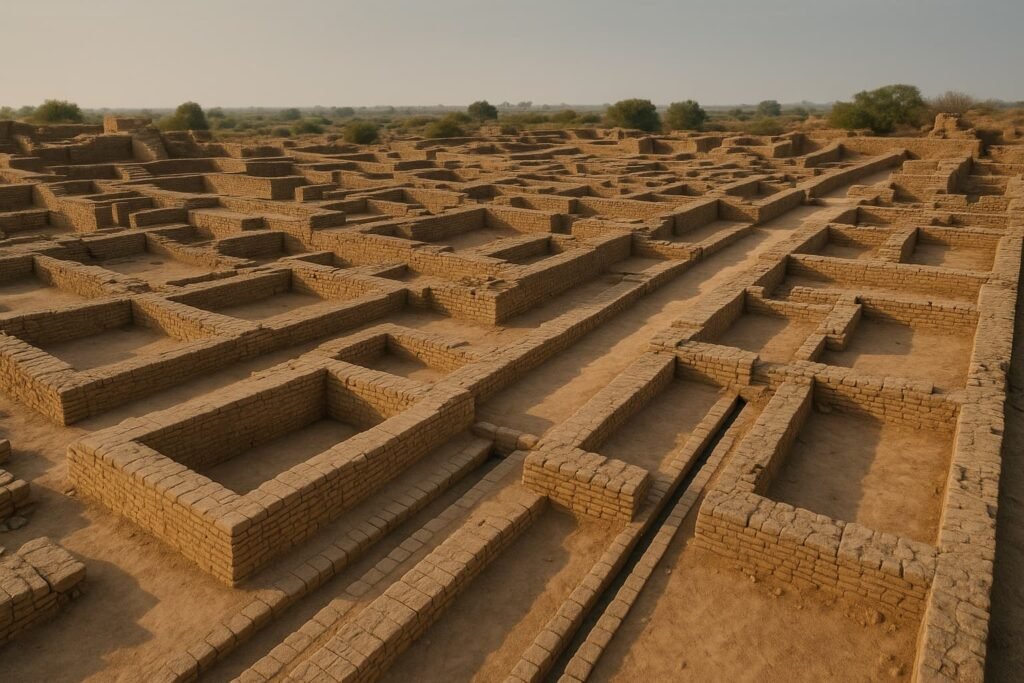
The Indus Valley Civilization (IVC), also known as the Harappan Civilization, flourished between roughly 5,000 and 3,500 years ago in what is now Pakistan and northwest India. At its height, between 4,500 and 3,900 years ago, it supported large, carefully planned cities such as Harappa and Mohenjo-daro.
Unlike many contemporaries, the IVC showed no clear evidence of centralized kingship or monumental palaces. Instead, it invested heavily in water systems: wells, drainage channels, reservoirs, and flood-resilient urban layouts. This dependence on stable water supply made the civilization highly efficient—but also vulnerable to long-term climatic shifts.
Reconstructing Ancient Climate Conditions
To understand environmental pressures on the Indus region, researchers led by Vimal Mishra reconstructed climate patterns spanning 5,000 to 3,000 years ago. The team combined advanced climate simulations with physical records of past environmental change.
These records included chemical signatures preserved in stalactites and stalagmites from caves in India, which reflect past rainfall patterns, and sediment data from five lakes across northwest India, which track long-term changes in water levels. Together, these sources allowed scientists to estimate both temperature and precipitation trends with increasing precision.
The results indicate a gradual regional warming of approximately 0.5 degrees Celsius, alongside a 10 to 20 percent decline in average annual rainfall.
Century-Long Droughts and Regional Stress
More striking than the overall trends was the identification of four prolonged drought periods between roughly 4,450 and 3,400 years ago. Each drought persisted for more than 85 years, with some lasting well over a century.
During these dry intervals, between 65 percent and 91 percent of the broader Indus Valley region experienced significant reductions in water availability. Such extended droughts would have disrupted agriculture, strained reservoirs and wells, and increased competition for reliable river access.
One particularly severe drought, lasting approximately 113 years between 3,531 and 3,418 years ago, coincides closely with archaeological evidence of widespread deurbanization—when large cities were abandoned or significantly reduced in size.
Shifting Settlements, Not Sudden Abandonment
Archaeological data suggest that Indus communities did not disappear overnight. Instead, settlement patterns gradually shifted in response to increasing climate stress.
Earlier populations, between 5,000 and 4,500 years ago, tended to settle in regions with higher rainfall. As drought conditions intensified, communities increasingly clustered closer to the Indus River and its major tributaries, relying on more predictable water sources.
Over time, maintaining large, densely populated urban centers likely became unsustainable. Smaller, more dispersed settlements offered greater flexibility in adapting to fluctuating rainfall and declining agricultural productivity.
Climate Stress as a Long-Term Driver
The study’s authors emphasize that climate alone did not “destroy” the Indus Valley Civilization. Instead, repeated environmental stress acted as a persistent pressure that gradually reshaped social organization, trade networks, and settlement choices.
Urban infrastructure designed for stable monsoon patterns may have become increasingly difficult to maintain under prolonged drought conditions. Agricultural surpluses would have declined, weakening the economic foundations that supported large cities.
This interpretation challenges earlier theories that focused on single catastrophic events and instead frames the Indus decline as a long, uneven process driven by environmental limits.
Lessons for Modern Societies
Beyond its historical implications, the research carries a modern warning. The Indus Valley Civilization was technologically advanced for its time, with robust water engineering and urban planning. Yet even such systems proved vulnerable to sustained climate shifts.
The study highlights how gradual environmental change—rather than sudden disaster—can undermine complex societies by eroding the resources they depend on most. As modern populations face increasing climate variability, the Indus experience offers a cautionary example of how resilience has limits when stress persists for generations.
Conclusion
The fading of the Indus Valley cities was not the result of a single collapse, but of long-term climate stress that slowly altered where and how people could live. By combining climate modeling with geological and archaeological evidence, scientists are now closing a key gap in understanding how environmental forces shape human history over centuries.
The story of the Indus Valley is not one of sudden failure—but of adaptation stretched too far.