Economic News

Image of shipping containers at an Indian port representing global trade flows.

India Says U.S. Trade Deal Near Completion as New Delhi Seals Landmark Pact With EU

By HarshitNEW DELHI, JANUARY 28, 2026 — A long-anticipated trade agreement between India and the United States is at a “very advanced stage,” according to India’s petroleum and natural gas minister, signaling potential momentum in negotiations that have been slowed by tariff disputes and geopolitical tensions. Speaking to CNBC on Tuesday, Hardeep Singh Puri said […]

India Says U.S. Trade Deal Near Completion as New Delhi Seals Landmark Pact With EU Read More »

U.S. Consumers Spent More in November.

U.S. Consumers Spent More in November, but Inflation and Falling Savings Signal Strain

By HarshitWASHINGTON, JANUARY 24, 2026 — U.S. consumer spending accelerated in November as the holiday shopping season began, but new government data suggests the momentum is increasingly fragile, supported by shrinking savings and pressured by stubborn inflation. A shutdown-delayed report released Thursday by the U.S. Department of Commerce showed that consumer spending rose 0.5% in

U.S. Consumers Spent More in November, but Inflation and Falling Savings Signal Strain Read More »

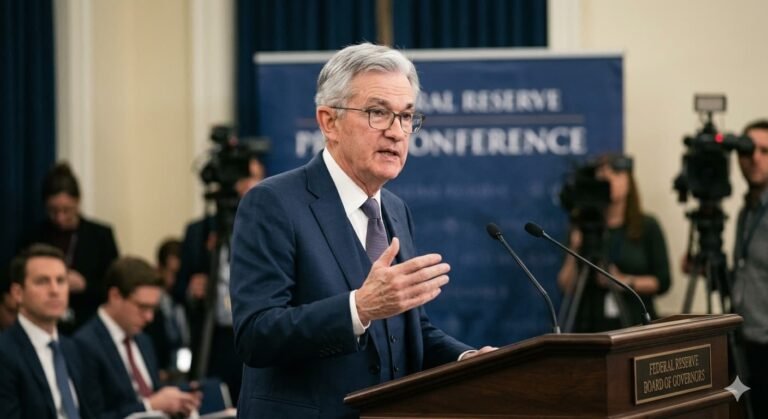
Federal Reserve officials monitoring economic conditions

The U.S. Economy Adjusts to a Slower, More Uneven Growth Cycle

By Harshit WASHINGTON, JANUARY 23 — As 2026 takes shape, the U.S. economy is settling into a growth pattern that feels unfamiliar to many Americans. The era of rapid rebounds and stimulus-driven momentum has faded, replaced by a slower, more uneven expansion that is challenging long-held assumptions about what a “healthy” economy looks like. Growth

The U.S. Economy Adjusts to a Slower, More Uneven Growth Cycle Read More »

American businesses using technology to increase worker efficiency

Why U.S. Productivity Growth Is Quietly Becoming the Economy’s Biggest Advantage

By Harshit WASHINGTON, JANUARY 22 — While public attention in recent years has focused on inflation, interest rates, and labor shortages, a less visible shift is gaining importance inside the U.S. economy: productivity growth. In 2026, improvements in how efficiently Americans work—rather than how many people are employed—are increasingly driving economic stability. This trend is

Why U.S. Productivity Growth Is Quietly Becoming the Economy’s Biggest Advantage Read More »

Employees discussing compensation in modern U.S. workplaces

Why U.S. Wage Growth Is Slowing in 2026 Even as Jobs Remain Plentiful

By Harshit WASHINGTON, JANUARY 21 — The U.S. labor market in 2026 continues to defy traditional recession signals. Jobs remain available, unemployment is relatively low, and layoffs—outside of a few sectors—are not widespread. Yet one key engine of household financial momentum is losing speed: wage growth. For millions of American workers, paychecks are still rising,

Why U.S. Wage Growth Is Slowing in 2026 Even as Jobs Remain Plentiful Read More »

American families managing credit card and loan payments

Why U.S. Household Debt Is Becoming the Biggest Economic Risk of 2026

By Harshit WASHINGTON, JANUARY 20 — The U.S. economy has defied repeated recession forecasts, supported by steady employment and resilient consumer activity. Yet beneath this surface stability lies a growing vulnerability that economists, lenders, and policymakers are watching closely in 2026: rising household debt. Unlike previous cycles driven primarily by corporate leverage or government borrowing,

Why U.S. Household Debt Is Becoming the Biggest Economic Risk of 2026 Read More »

American consumers navigating higher living costs

Why the U.S. Economy in 2026 Feels Stable on Paper but Uneven in Real Life

By Harshit WASHINGTON, JANUARY 18 — By most traditional indicators, the U.S. economy has avoided the worst-case scenarios once feared during the inflation surge of the early 2020s. Growth has not collapsed, unemployment remains historically low, and inflation—while still above the Federal Reserve’s long-term target—has cooled significantly from its peak. Yet for millions of Americans,

Why the U.S. Economy in 2026 Feels Stable on Paper but Uneven in Real Life Read More »

Individual planning finances amid economic uncertainty

Why Economic Uncertainty in the U.S. Now Comes More From Costs Than From Jobs

By Harshit WASHINGTON, JANUARY 17, 2026 —For much of the past century, economic uncertainty in the United States has been closely tied to employment. Job losses, layoffs, and recessions were the primary sources of financial anxiety for households. In early 2026, that relationship has shifted. While concerns about employment still matter, uncertainty for many Americans

Why Economic Uncertainty in the U.S. Now Comes More From Costs Than From Jobs Read More »

American worker reviewing household budget and expenses

Why Wage Growth Alone Is No Longer Enough to Improve Financial Security for Americans

By Harshit WASHINGTON, JANUARY 14, 2026 —For much of modern economic history, wage growth has been treated as the primary measure of improving household well-being. Higher pay was assumed to translate directly into better living standards, stronger consumer confidence, and greater financial security. As the United States moves through early 2026, that assumption is increasingly

Why Wage Growth Alone Is No Longer Enough to Improve Financial Security for Americans Read More »

Shoppers comparing prices in a U.S. store

Why the U.S. Economy Is Growing While Many Americans Still Feel Financially Stretched

By Harshit WASHINGTON, JANUARY 13, 2026 —As the United States moves through the early weeks of 2026, the national economy continues to show signs of stability. Employment remains steady, businesses are operating without major disruption, and key economic indicators suggest ongoing growth rather than contraction. Yet for many Americans, this macroeconomic picture does not align

Why the U.S. Economy Is Growing While Many Americans Still Feel Financially Stretched Read More »