
By Harshit
SAN JUAN, PUERTO RICO, JANUARY 6 —
The US military operation that led to the capture of Nicolás Maduro and his wife, Cilia Flores, triggered widespread travel disruption across the Caribbean, leaving thousands of passengers stranded after US aviation authorities temporarily shut down large swathes of regional airspace.
The Federal Aviation Administration (FAA) imposed the closure on Saturday amid security concerns following the Venezuela operation, prompting airlines to cancel more than 425 flights in and out of the Caribbean at the height of the holiday travel season, according to aviation analytics firm Cirium.
More than half of the cancellations involved routes to and from Puerto Rico, turning popular island gateways into bottlenecks of uncertainty and frustration.
Passengers Left in the Dark
Julie Hurwitz, returning from a family vacation in St. John in the US Virgin Islands, learned of her fate via a 3 a.m. notification from Delta Air Lines.
“There was no information, really,” Hurwitz said, describing the sudden cancellation of her flight to Atlanta. “I found out about the whole situation from other people.”
Hurwitz and her extended family of 12 scrambled to find accommodation as adults called out of work and contingency plans — including camping — were discussed. Their rebooked flight is now scheduled for Tuesday, narrowly avoiding the risk of missing a family birthday celebration.
Island Hopping Comes to a Halt
For Kelly and John Maher of Michigan, the disruption struck just as they were about to board a ferry from Anguilla to Saint Maarten. Their flight, and all other American commercial departures, were abruptly canceled.
“Everything’s shut down,” John Maher said, adding that passengers relied on rumours among ferry queues to understand what was happening. “We heard whispers that it was something to do with US military action.”
Celebrities Also Grounded
Even high-profile travellers were not spared. Oscar-winning actor Leonardo DiCaprio was reportedly unable to return from St Barts in time to attend the Palm Springs International Film Festival. His flight was grounded by the airspace closure, according to Variety.
Airlines Scramble to Recover
Although the FAA has since lifted the restrictions, airlines are now racing to clear backlogs created by the sudden shutdown.
Delta, which recorded the highest number of cancellations among US carriers on Sunday according to FlightAware, urged passengers without same-day tickets to stay away from airports due to space constraints. The airline said it had added more than 2,600 seats through extra flights and expects to re-accommodate all affected customers by Tuesday.
At Luis Muñoz Marín International Airport, conditions improved markedly. While 57% of departures were canceled on Saturday, that figure dropped to just 4% by Sunday.
American, United and JetBlue Add Capacity
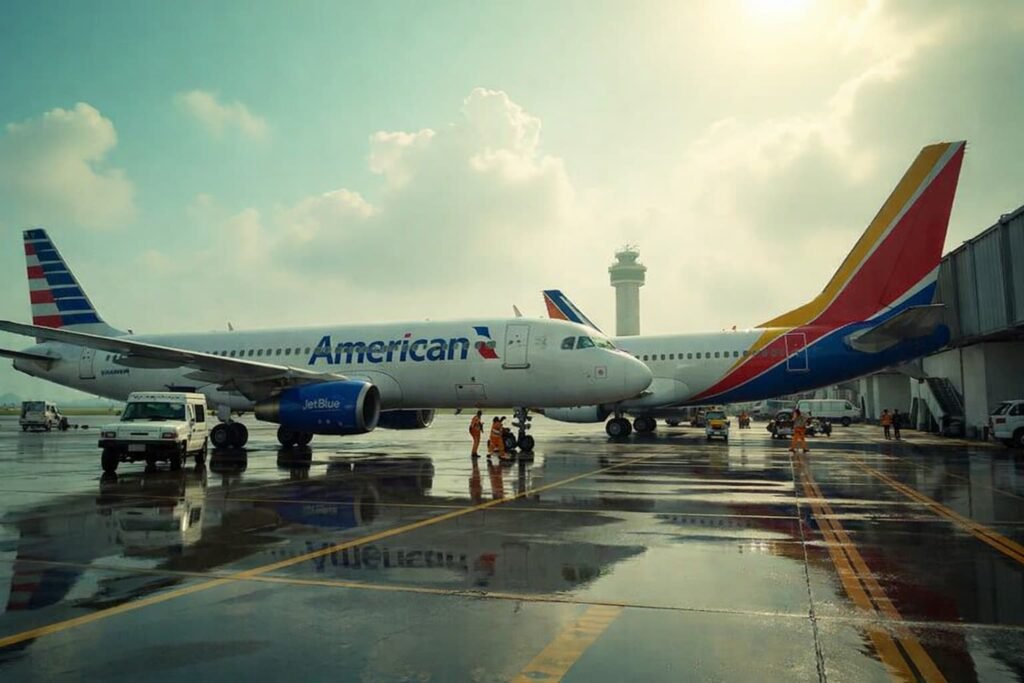
American Airlines described the response as “all hands on deck,” announcing nearly 7,000 additional seats across 43 extra flights. The carrier deployed its largest aircraft, the Boeing 777-300, on key routes and added inter-island services from Anguilla and the British Virgin Islands to San Juan.
United Airlines added 14 extra flights on Sunday and expanded services again on Monday, while JetBlue worked to rebook customers after canceling the most flights on Saturday and delaying more than 600 on Sunday.
Southwest Airlines said it has added additional roundtrip flights to Puerto Rico and Aruba this week to ease congestion.
A Holiday Weekend to Remember — for the Wrong Reasons
The temporary Caribbean airspace shutdown, though brief, underscored how geopolitical events can ripple instantly into civilian life. For thousands of travelers, what began as a winter escape ended in long airport lines, cancelled celebrations, and days of uncertainty.
While airlines say schedules are stabilising, many passengers say the experience exposed just how vulnerable global travel remains to sudden political and military shocks.